Awake, for morning in the bowl of night has flung the stone that puts the stars to flight.
And, lo, the hunter of the east has caught the sultan’s turret in a noose of light!
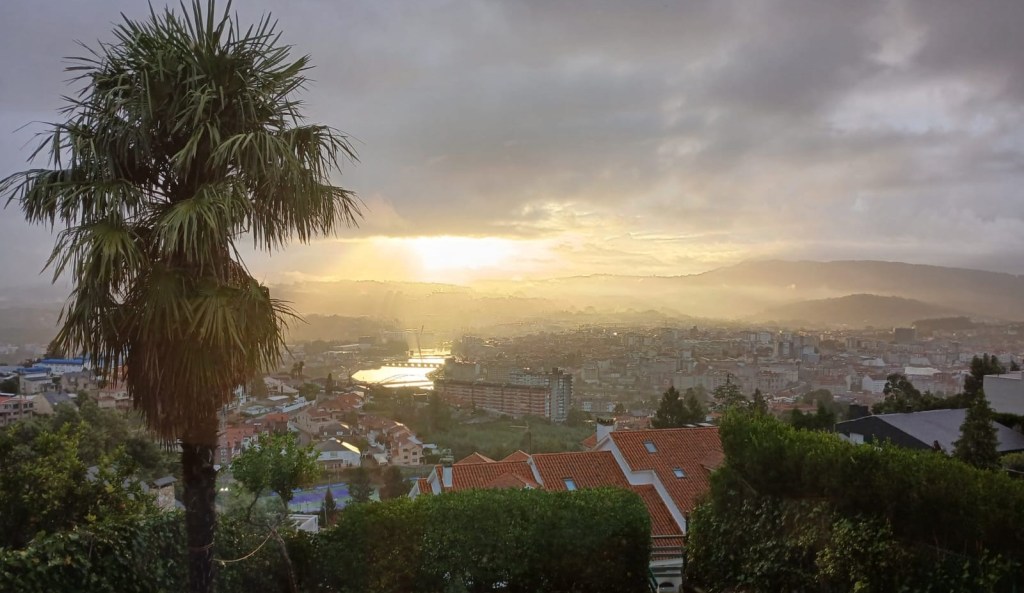
Spanish life is not always likeable but it is compellingly loveable – Christopher Howse: ‘A Pilgrim in Spain’
NB: If there’s a RV in brackets after a (paywalled) link, you might be able to read it via a Reader View extension to your browser, avoiding the paywall. If there is no RV, it will mean that the article is free to view or listen to. If there’s RV2, it means a second click on RV might let you see the article though the first RV click didn’t work.
Cosas de España/Galiza
Politics: I’m sure to no one’s great surprise, the small parties to the left of the PSOE have failed to come together under one coalition banner. I think because Podemos has proved averse to this. I’ll have to wait for the next edition of Lenox Napier’s Business Over Tapas to find out what this means in practice.
The Economy: Trump initiates punitive/vindictive measures against Spanish exports to the USA.
Local News:
- With Samhain coming up, here’s an article on Celtic legends on the Camino de Santiago. It’s in Spanish but there’s a machine translation at the end of this post.
- Having been thwarted by the Xunta from offering a narcotráfico trip by sea, one of our ex-narcos is now offering a round trip by coach from his bodega to the sea, at a cost of €185 each, on October 31st and November 1st. He’s organising this in in partnership with the travel agency Galitravel. Which doesn’t seem to mention this on its webpage. I expect it will be oversubscribed.
The UK and The EU
There is much rejoicing in many quarters that the new British PM has said he’ll take the UK back into the EU, one way or another. Lots of turbulent water will flow under this bridge in the years to come. Even some anti-Brexit commentators wonder whether this endeavour wouldn’t come at a large opportunity cost, even if eventually successful. Which it might not be, of course. Possibly depends on the French, who could soon have a Eurosceptic government.
France
Marine Le Pen is strongly Eurosceptic, though her position has shifted from openly advocating France’s exit from the EU to seeking a radically reduced, more nation-state-led EU. She describes herself as “deeply Eurosceptic,” arguing that the EU’s current structure undermines national sovereignty and democracy.
The Middle East War
Now apparently called The West Asian War . . . The latest update from Naked Capitalism.
The United States of Trump America
Trump
- We don’t have inflation. [Even a Fox poll says 85% of (US)Americans are concerned about inflation.]
- Tariffs don’t cause inflation.[He might actually believe that. Who will ever know?]
- Ukraine’s resumption of strikes on Russian oil refineries is a disgrace.
Zelensky is more difficult to deal with than Putin. [We know that he finds it easy to please Putin, so this ranks as one of his rare truthful statements.]
Others
The idea that Kimberley Guilfoyle crossed some sort of previously unseen corruption red line is laughable. Guilfoyle was pushed out because she became [Like Cristi Noem] an embarrass– ment. She overstepped her bounds, tried to trade on the president’s name, and then made the administration look bad when she got caught. Also, she is a woman, and in this administration, self-dealing is mostly a man’s game.
Trump’s sinister plot against Susie Wiles
The Democratic(!) candidate in Alaska owns 176 rifles and shotguns. I mean, why? Is this obligatory there?
In case you wondered . . . Perplexity advises: US 30-year mortgage rates are above 7% mainly because the 10-year Treasury yield—the benchmark lenders use to price long-term mortgages—has surged. Investors are demanding higher returns to hold US government debt amid persistent inflation, higher oil prices, and expectations that the Federal Reserve will keep policy rates elevated.
Relevant Books
- Betrayal: Trump, Putin and the New Age of Conquest
- To be published in October. Can be pre-ordered now: Wtf America?!: The Way Out of This Hell and Back to Democracy. On Amazon or here. This is not simply a book about Trump. He is the vessel, not the disease – the product of a system decades in the making, fueled by powerful interests, weakened democratic institutions, and a media ecosystem that too often chose access and complicity over accountability. The book confronts the defining questions of our time: How did we get here? Why did so many institutions fail when they were needed most? And what must we do now to defend democracy before it is too late?
- Fantasyland: How America went haywire. A 500 year history.
- Profiles in Cowardice, by Jacob Weisberg. Cited in this podcast.
- The final pages of Kurt Andersen’s fascinating run through the USA’s history
Russia
The Kremlin has accused Ukraine of derailing US peace efforts by resuming its strikes on oil refineries. As you’d expect, Trump has endorsed this claim.
Spanish
- Patear: To walk. To kick, boot.
- Extrañar a alguien: To miss someone
- No es de extrañar: It’s no wonder/a surprise. Small surprise.
English
Reader Colin advises: While researching the Freemasons, I came across the word ‘bumper’. It is a glass used in toasts by them, they thump the table with the glass that has a stronger base than usual.
Did you know?
The strangest US Supreme Court decisions.
You Have to Laugh
Six product names that prove common sense isn’t always part of the job description..
Finally . . .
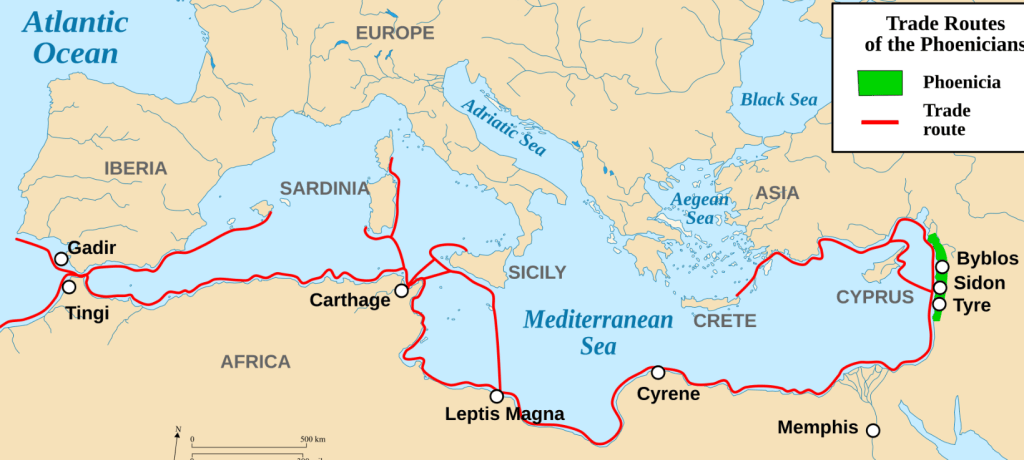
Here’s a map of the maritime achievements of the Phoenicians. I forgot to add it to recent comments. It should show that they left the Med and reached the SW of England, where they obtained tin.
My thanks to those readers who take the trouble to Like my posts.
Celtic legends on the Camino-, The pre-Roman heritage you’ll meet
The Camino de Santiago is world-renowned as one of the most significant Christian pilgrimage routes on the planet. Yet, long before the [fancifully alleged] discovery of the Apostle’s tomb in the 9th century transformed the European landscape, these very paths were already being traversed. Pre-Roman peoples—most notably the Celts—journeyed toward the edge of the known world, following the path of the Milky Way.
Today, the Celtic heritage in Galicia and along the various Camino routes remains very much alive. It manifests in traditional architecture, place names, folk rituals, and a rich oral tradition steeped in myth.
The Journey to Finisterre: The Celtic Cult of the Setting Sun
For the Celtic tribes that inhabited the Iberian Peninsula, the Atlantic Ocean was not merely a geographical boundary, but the frontier between the world of the living and the realm of the dead. The modern-day Camino de Santiago route to Finisterre and Muxía largely follows the ancient pagan path once taken to witness the daily “death” of the Sun (Arao).
At Cape Fisterra (Finis Terrae, or “the end of the earth”), the Celts established the Arao Solis—a stone altar dedicated to the worship of the sun. The tradition of burning one’s clothes or boots upon reaching the sea—a practice still observed by many contemporary pilgrims—is a direct echo of the purification and rebirth ritual performed by the ancient inhabitants after completing their westward journey.
Myths and Magical Places Along the Camino de Santiago
As the route unfolds, pilgrims traverse landscapes where Celtic sacred geography merges with medieval miracles:
- The Milky Way and the Path of the Stars: Long before the term “Compostela” became associated with Campus Stellae (Field of Stars)[Or ‘cemetery`], the Druids interpreted the galaxy as a cosmic guide. They believed the Milky Way reflected, in the heavens, the earthly path leading to the westernmost point of Europe—a sacred journey that spirits were said to follow to reach their final resting place.
- Pedrafita do Cebreiro and the Gateway to Galicia: At the point where the Camino Francés (French Way) enters Galicia lies O Cebreiro. This site is notable for its pallozas—circular or elliptical stone dwellings with thatched roofs—whose origins can be traced directly back to the pre-Roman castro (hillfort) culture. Beyond the famous “Miracle of the Holy Grail,” the surrounding mountains of O Courel and Os Ancares are steeped in tales of mythological beings that once inhabited the ancient sacred groves (lucus).
- Magical Stones: Os Santos Mártires and Muxía: The veneration of megaliths and uniquely shaped rock formations—such as petroglyphs and pedras de abalar (rocking stones)—was absorbed by the Church during the Middle Ages. A clear example can be found in Muxía, where the Pedra de Abalar and the Pedra dos Cadrados are woven into the legend of the Virgin Mary’s arrival in a stone boat[a new one for me]; however, the healing rituals associated with these stones stem directly from pan-Celtic traditions.
Beings from Galician mythology that “inhabit” the Camino
As you walk through the woodlands and along the winding paths of the Northern Way (Camino del Norte) or the Primitive Way (Camino Primitivo), local folklore speaks of the presence of fantastical beings:-
As Mouras: Mythological female entities of extraordinary beauty that dwell in ancient hillforts (castros), springs, and dolmens. They guard ancestral treasures and embody the power of the subterranean world and nature itself.
A Santa Compaña: One of the most deeply rooted legends in the magical realm of Galicia. It consists of a procession of lost souls that roam the paths by night. Although it has been Christianized through the inclusion of a crucifix, its origins are linked to Celtic myths concerning the passage of the dead and the connection between worlds.
O Trasno: A mischievous, imp-like creature—often associated with the home—that, according to folklore, tends to scatter the belongings of travellers or lead those who fail to respect the nature of the forest astray.
Pre-Roman Rites That Still Endure in the Pilgrim’s Experience
If you decide to undertake the pilgrimage, you will notice that certain contemporary customs bear a direct connection to the Celtic past:
- Leaving a stone at the Cruz de Ferro (Iron Cross): Located on Mount Irago, the act of placing a stone—while facing away from the monument—to unburden oneself symbolises an ancient tradition practised by travellers and shepherds in pre-Roman times to appease the gods of the roads and mark territorial boundaries.
- The Queimada and the conxuro (incantation): Although the drink as we know it today is of more recent origin, the ritual of igniting aguardiente (a strong spirit) to ward off meigas and demons (evil spirits) is directly rooted in the Celtic reverence for fire as a purifying element.
- Milladoiros: Piles of stones found at crossroads, which ancient peasants and travellers used as altars to seek protection during their journeys.
Experience Ancient Magic on Your Journey
Understanding the Celtic heritage along the Camino de Santiago completely transforms the pilgrim’s experience. Every oak forest, every stone cross (cruceiro) erected atop an ancient pagan site, and every morning mist in the Galician valleys serve as a reminder that this route has, for millennia, connected humanity with nature and the mysteries of the universe.
If you would like to plan your route and discover these places steeped in history and mysticism, consult our guides for Stage 1 of the Camino Francés (French Way), or explore the best options for walking the
starting from Sarria—the ideal departure point for venturing into the heart of magical Galicia.
The Usual Links
This – from veteran blogger Lenox Napier – is an excellent weekly newsletter (Business Over Tapas) on all matters Spanish. Indispensable for those who needs insights on how and why things happen here.
You can get my posts by email as soon as they’re published. With the added bonus that they’ll contain the typos I’ll discover later. I believe there’s a box for this at the bottom of each post. If you do this but don’t read the posts, I will delete your subscription. So perhaps don’t bother if you have other reasons for subscribing . . .
I can also be read on X at Thoughts from Galicia. And on Substack here. I no longer post on Facebook.
For new readers: If you’ve landed here looking for info on Galicia or Pontevedra, try here. If you’re passing through Pontevedra on the Camino, you’ll find a guide to the city there.
If you´re thinking of moving to Spain, this link should be useful to you. And this, on the annual costs of owning property here.

