Awake, for morning in the bowl of night has flung the stone that puts the stars to flight.
And, lo, the hunter of the east has caught the sultan’s turret in a noose of light!
Spanish life is not always likeable but it is compellingly loveable – Christopher Howse: ‘A Pilgrim in Spain’
NB: If there’s a RV in brackets after a (paywalled) link, you might be able to read it via a Reader View extension to your browser, avoiding the paywall. If there is no RV, it will mean that the article is free to view or listen to. If there’s RV2, it means a second click on RV might let you see the article though the first RV click didn’t work.
Cosas de España/Galiza
Politics;
Lenox Napier has a few thoughts here on the upcoming general election.
The Property Crisis
- Spain’s long-term rental home listings have plunged 44% since 2018. losing nearly 400,000 advertised homes in just 7 years, with Barcelona suffering an astonishing 83% drop. (RV/RV2)
- Owners of tourist accommodation in parts of Spain could see their annual property tax bills more than double under a new housing decree. The legislation allows town halls in officially designated ‘housing-pressure’ areas to impose surcharges on residential properties used as tourist accommodation. The standard surcharge can reach 50% of the annual property tax (IBI) bill. This rises to a maximum of 100% for owners with 2 or more tourist properties, and 150% for those with 4 or more. The Bank of Spain estimates that this type of accommodation represents 10% of the rental market across Spain.
- I asked Perplexity about the factors behind Spain’s huge construction deficit. The response is at the end of this post. Clearly, things are going to continue to worsen for a while yet.
Local news
- Pv city now has a camp-in protest against the housing situation, sited strategically opposite the town hall. An encampment(‘acampada’) for decent housing has put down indefinite roots in Pontevedra. Around 50 young people have launched a peaceful protest with no set end date, pending the coordination of their demands. Which might be the 12th of Never.
- As it does every year, my old friend the tyre-shredding pot-hole has re-appeared on my route down to my parking place across the river from Pv city. And is getting worse by the day. I expect it’ll be repaired in 6 months or so, when the cycle will begin again.
But some good news . . . .
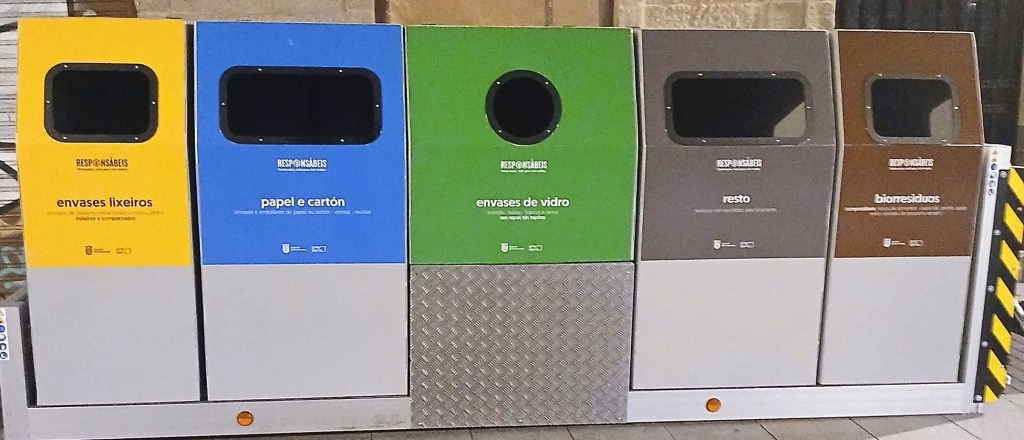
- Pv city has some snazzy-looking bins (contenadores), which now come in 5 colours.
- The new commercial centre(mall) near my house is beginning to look like it might well be open for Xmas, just a year later than planned.
Talking of delays . . . It’s actually 2 years since work on new access and exit roads to the AP9 were suspended, not just one year, as I wrote yesterday. Time flies. (BTW, the mayors of Pv city and Poio characterise the news of a re-start as a pre-election ploy by the central government. Which they weren’t told about).
There’s still no sign of the move of the driving test centre from my daily route to and from the edge of Pv city. I suspect no one expected this to happen as planned/forecasted. Least of all me.
Which reminds me . . . The plan for the commercial centre was first announced 25 years ago. And the land for it was partially cleared at least twice n the interim before this was finally done ahead of the current works.
The Middle East War
The latest update from Naked Capitalism. Trump seems to have TACO’d again, delaying any renewed attacks on Iran until after the US midterm elections.
The United States of Trump America
Trump. Madder and madder
- The White House considers anyone that uses the term, ‘Artificial Intelligence,’ as opposed to … ‘Super Intelligence,’ THE ENEMY!
Others
- Trump is deeply upset that Fox News is trying [by not showing his speeches] to save him from himself and to save the Republican party from this grossly unpopular president.
- I didn’t think we’d get to the “public executions” stage of Trump’s project to roll back the last 100 years of societal development.[In case you’ve missed it, Trump has approved the live streaming of an execution by firing squad].
- Trump speaks in mangled, incoherent half-sentences that no one can understand.
- Trump claims that the upper rows of his rally venues are empty because people have ‘migrated’ down to a lower floor, failing to realise that this could only happen if there were empty seat there for them,
The Republicans are said to be trying to shore up their base by keeping the increasingly unpopular Trump away from both red states and, especially, purple and blue states. One wonders how they’re explaining their priorities to him. Or perhaps they avoid this and simply rely on him being too stupid to realise what’s going on. Proving yet again that he’s the least self-aware person in the history of mankind.
When you think about it, the great majority of (US) Americans are pincered between 2 small but powerful groups who don’t share their interests – MAGA fanatics, on the one hand, and rapacious oligarchs, on the other. I fancy that – in a society which worships Mammon even more than God and where the political system is so corrupt – it’ll prove easier to reduce the power of the former than that of the latter.
Relevant Books
- Betrayal: Trump, Putin and the New Age of Conquest
- To be published in October. Can be pre-ordered now: Wtf America?!: The Way Out of This Hell and Back to Democracy. On Amazon or here. This is not simply a book about Trump. He is the vessel, not the disease – the product of a system decades in the making, fueled by powerful interests, weakened democratic institutions, and a media ecosystem that too often chose access and complicity over accountability. The book confronts the defining questions of our time: How did we get here? Why did so many institutions fail when they were needed most? And what must we do now to defend democracy before it is too late?
- The final pages of Kurt Andersen’s fascinating run through the USA’s history – Fantasyland: How America went haywire. A 500 year history.
- Profiles in Cowardice, by Jacob Weisberg. Cited in this podcast.
The Way of the World/Social Media/AI
Spanish
- Pelirrojo: Redhead. Ginger
- Petirrojo: Robin
- Gafado: Junxed. Hexed
English
- Modernising scheme: Job cuts

Did you know?
China has been the longest-lived empire in world history—as well as one of the largest. In the 1820s the Manchu dynasty directly ruled a vast territory, roughly coterminous with today’s People’s Republic; in addition, Korea, Indochina, Siam, Burma and Nepal all were Chinese vassals. For most of modern history, China has been home to between a quarter and a third of the world’s population—perhaps as many as 37% in 1820. Prior to the Industrial Revolution, China was also the titan of the world economy. Between 1500 and 1820 its share of world output was never less than a fifth, and it may have risen as high as a third in 1820. Yet the 19th and 20th centuries saw a disastrous collapse of living standards. Between 1820 and 1950, GDP per capita fell by roughly a quarter. By 1973 income per head was around a fifth of the world average, worse than in many parts of Africa. China’s share of world output, which had been close to 33% in 1820, fell below 5%. Why this happened remains a hotly debated question.
Finally . . . You Have to Laugh
Finally . . .
Spain’s huge residential construction deficit
This is widely attributed to a combination of strong demand-side pressures and deep, structural constraints on the supply side that have prevented new building from keeping pace with household formation since around 2021.
Demand-side drivers
- Rapid household formation: Net creation of new households has averaged well over 200,000 per year since 2021, while annual completions have hovered around 100–120,000, creating a cumulative gap now estimated at roughly 730,000–740,000 homes
- Population growth and immigration: Spain’s population has risen towards 50 million, largely via immigration, boosting the labour force and the number of people needing homes, especially in dynamic urban and coastal areas.
- Improved purchasing power and cheap credit (until recently): Lower interest rates and stronger incomes supported high transaction volumes, intensifying competition for available
- Foreign buyers and alternative uses: Non-resident purchases and the expansion of tourist/short-term rentals have removed some units from the long-term residential pool, particularly in cities and tourist zones.
Supply-side bottlenecks
Analysts (BBVA, CaixaBank Research, OBS Business School, Bank of Spain) consistently highlight these factors as the main brakes on new construction:
- Shortage of “ready-to-build” land: In the areas with the strongest demand (Madrid, Barcelona, Valencia, Alicante, Murcia), there is simply too little zoned, serviced land available for immediate development.
- Lengthy, complex planning processes: Urban planning involves many actors, reports, and approvals; procedures can stretch to a decade or more, and recent changes in housing legislation have added legal uncertainty for developers.
- Higher costs and tighter margins: Since the pandemic, construction materials, energy, and regulatory compliance costs have risen sharply, squeezing project profitability in a sector already seen as offering historically low returns.
- Labour shortages and skills gaps: The sector struggles to find enough skilled workers; a large share of employees lack formal vocational training, limiting capacity to ramp up activity.
- Infrastructure bottlenecks (especially electricity): Grid saturation in some areas now delays or blocks new developments, as grid access is a prerequisite for permits.
- Reduced bank financing since 2008. After the property crash, bank lending to developers fell by ar0und 80% from its 2008 peak and has not fully recovered, constraining the pipeline even as institutional investors partly filled the gap.
Why the deficit is “huge” now
The deficit is not just cyclical; it reflects a structural mismatch: demand has surged in precisely the regions where land, planning capacity, labour, and grid infrastructure are most constrained, so supply cannot respond elastically. Estimates suggest that, at record-breaking recent construction rates, it would still take around 8 years to close the gap—implying Spain would need to sustainably deliver well over 200,000 new homes per year, far above current levels.
My thanks to those readers who take the trouble to Like my posts.
The Usual Links
This – from veteran blogger Lenox Napier – is an excellent weekly newsletter (Business Over Tapas) on all matters Spanish. Indispensable for those who needs insights on how and why things happen here.
You can get my posts by email as soon as they’re published. With the added bonus that they’ll contain the typos I’ll discover later. I believe there’s a box for this at the bottom of each post. If you do this but don’t read the posts, I will delete your subscription. So perhaps don’t bother if you have other reasons for subscribing . . .
I can also be read on X at Thoughts from Galicia. And on Substack here. I no longer post on Facebook.
For new readers: If you’ve landed here looking for info on Galicia or Pontevedra, try here. If you’re passing through Pontevedra on the Camino, you’ll find a guide to the city there.
If you´re thinking of moving to Spain, this link should be useful to you. And this, on the annual costs of owning property here.

