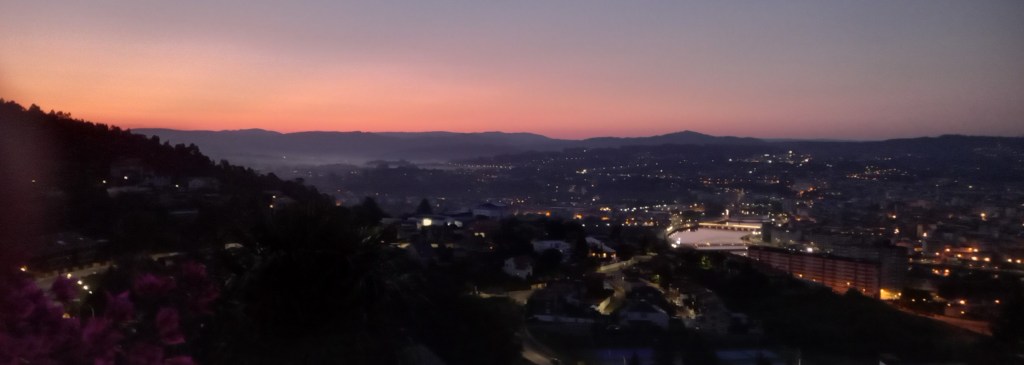
Awake, for morning in the bowl of night has flung the stone that puts the stars to flight.
And, lo, the hunter of the east has caught the sultan’s turret in a noose of light!
Spanish life is not always likeable but it is compellingly loveable – Christopher Howse: ‘A Pilgrim in Spain’
NB: The archive.ph way to get behind a paywall in Spain is now closed off. A VPN doesn’t help in these circumstances but a Reader View in you browser might well do so. For the moment, when I post a link, if there’s a RV in brackets after the link, you might well be able to read it that way, If there is no RV in brackets, it will mean that the article is free to view. Or that I’ve forgotten to type it . . .
Cosas de España/Galiza
Ceuta: Madrid says that most of the 2-5,000 minors who got across the border from Morocco into Ceuta won’t be returned. The relevant Minister has defended an approach based on the rule of law and empathy, while criticising what she called the “trivialisation of evil” in the political debate.
I believe that Galicia has taken 7 of these minors and has said No more.
The Corner here describes what it alleges is the collapse of the basics of defence, education, healthcare and housing in Spain. And all this despite one of the best micro economic growth rates in Europe.
From Opus Dei alumni to McKinsey consultants(RV): The clans that run Spain’s biggest companies. Many executives and board members at the largest listed firms in Spain share ties through the same consulting firms, business schools or senior public-sector posts. Experts warn of the risks posed by these tightly knit networks of power.
The United States of Trump America
So, will Trump be mad enough to try to bomb Iran to perdition? And are we en route to World War 3?
News Snippets/Commentaries
- Natalie Harp played a critical role in the shock meltdown that saw him dramatically ban media outlets from the White House. Harp had specifically played Trump clips of anchors on MS NOW “criticizing his administration” before his social media tantrum . . A Politico report claimed that even senior White House staffers were blindsided by Trump’s media ban and suggested the shock move happened while his influential chief of staff, Susie Wiles, was out of town.
- Trump’s latest attack on the media doesn’t look like the work of a one-time master of media manipulation. It looks like the petulant outburst of a man who has lost all impulse control and is lashing out as his presidency tanks. This action runs up against the Constitution and in ways even his all-too-friendly Supreme Court will find difficult to ignore. In his desperate search for a fight he can win, Trump has almost guaranteed that he’ll strike out again. The flailing President has picked a fight with the media he’s almost certainly going to lose.
Republican candidates in tight races are publicly distancing themselves from Trump, seeing hm as ‘kryptonite’.
By the way . . . In the Senate, the seats breakdown is: Republicans, 53; Democrats 45 and Independents 2. Of the 53 Republicans, 37 are millionaires, possibly precluding empathy with the challenges faced by their constituents.
Relevant Books
- To be published in October. Can be pre-ordered now: Wtf America?!: The Way Out of This Hell and Back to Democracy. On Amazon or here.
- The final pages of Kurt Andersen’s fascinating run through the USA’s history – Fantasyland: How America went haywire. A 500 year history.
- Profiles in Cowardice, by Jacob Weisberg. Cited in this podcast.
The Way of the World
Are you up-to-date on the impending El Niño shock? This refers to the economic and inflationary impact expected from the 2026–27 El Niño, which could be the strongest on record and is already rippling through food, energy, shipping and commodity markets. More details below this post under Expansions.
Spanish
- Losa: Slab, heavy stone (flag/pave/mill/paving)
- Desganado: Apathetic, listless, half-hearted
- Moralla: Trash fish. Whitebait. Junk, rubbish, garbage.
English
I listen to several US podcasts and, as a result, have begun to wonder if (US)Americans suffer from what one might call ‘positive-adjective overload’. So, I asked Perplexity and got this answer: Yes, but “positive-adjective overload” is more a perceptive description than a standard linguistic term. American English does seem particularly fond of using strongly positive words—awesome, amazing, incredible, fantastic, great, wonderful, brilliant—for things that are merely good, satisfactory, or mildly pleasing. . . . So your observation is sound, with one qualification: Americans do not necessarily experience more positive emotion; American conversational English often has a larger and more habitual vocabulary of enthusiastic approval. Awesome is the clearest example because it has travelled so far from “inspiring awe” to “fine, thanks.” Perplexity said quite a bit more and this can be found at the end of this post under Expansion.
Did you know?
Against his wife’s wishes, Lenin’s brain was cut into hundreds of very thin slices, so that scientists could investigate the source of his genius. Which they gave up looking for after 10 years or so.
Finally . . .
The temperature for yesterday’s Camino walk of 23km was 36, not 33. In my car at midday today, it was 40. But this plummeted to 35 by the time I got home. I don’t envy triathlon runners in the world championships being held this week in Pv city. Presumably arranged in the expectation the temperatures would be normal. Say 25 max. But at least the water of the river Lérez will be a quite warm for the swimming leg of races. The first event of this kind was held several years ago, in April, when several contestants suffered from hypothermia. This year, the danger will be heatstroke.
My thanks to those readers who take the trouble to Like my posts.
EXPANSIONS
1. The El Niño shock
- Ocean temperatures in the eastern Pacific are warming fast, and NOAA assigns:
- >90% probability of a “very strong” El Niño between October–December 2026
- ~75% probability it reaches a “historic/super” level (≥+2.5°C on the RONI index), potentially the strongest since 1950.
- The event is expected to peak in late 2026 and persist into early 2027, with elevated risks of floods, droughts and extreme heat lasting until around February 2027.
In macroeconomics, a “shock” is a sudden, large supply-side disturbance. El Niño acts as a climate-driven supply shock by disrupting production and transport, then feeding into prices and inflation with a lag.
Channels already cited in 2026 reporting include:
- Agriculture and food prices: Droughts and abnormal rains threaten crops in Asia, Latin America, Africa and Australia, with particular concern for sugar, corn, rice and some wheat regions.
- Energy and hydropower: Reduced rainfall in some regions constrains hydro generation, tightening power markets and raising electricity costs.
- Shipping and logistics: Lower water levels and operational restrictions (e.g., at the Panama Canal) raise transit costs and delay goods.
- Commodities beyond food: Impacts on mining output (e.g., Chilean copper) and other raw materials are already being noted.
Because many economies are still dealing with elevated energy and input costs, even a moderate food-price spike can translate into stickier inflation.
Analysts’ estimates vary by model and horizon, but recent 2026 assessments include:
- Global GDP:
- Near-term (2026–27) losses around 0.6% of global GDP
- Europe:
- Combined weather shocks (heat, drought, El Niño) could reduce euro-area GDP by ~0.4% after 12 months, with food inflation pressured upwards by up to ~0.7 percentage points.
- Emerging markets:
- Strongest inflation risks in parts of Latin America (Brazil, Colombia, Peru) and Asia (Indonesia, Philippines, Thailand), via food and energy prices.
- Food inflation:
- Some banks project global food inflation rising from ~2.8% in H1 2026 to ~5% in H1 2027 if El Niño compounds with other geopolitical/fertiliser shocks.
Importantly, the peak inflationary impact is expected in 2027, even if the meteorological peak is late 2026, because agricultural and price effects lag ocean warming by many months.
For households and policymakers, the “El Niño shock” narrative is less about dramatic weather headlines and more about:
- Higher and more volatile food and energy bills in exposed regions
- Central banks facing a tougher trade‑off between inflation and growth in 2027
- Greater risk of export restrictions and supply-chain bottlenecks in key commodities (rice, sugar, some grains, copper)
2. AWESOME ET AL
Originally, awesome meant something that inspired awe, reverence, fear, or wonder. Its everyday American meaning gradually weakened from “awe-inspiring” to “very impressive,” and then to the general conversational exclamation meaning “excellent” or simply “okay, great.” The OED dates the enthusiastic slang use to the late twentieth century.
So an American might say: “Your dentist can see you at 3 p.m.? Awesome!”. That does not mean the appointment is sublime or spiritually overwhelming. It may merely mean: “That’s convenient—thanks.” The word has become partly an interactional response, signalling enthusiasm, approval, or friendliness rather than making a carefully measured judgement.
There is some evidence that North American varieties use certain high-positive adjectives more heavily than British varieties. A comparison of Toronto and York English, for example, found awesome and amazing much more prominent in the Toronto data, whereas British speakers showed greater reliance on combinations such as really good.
But the tendency is not uniquely American. British English has its own versions:
- brilliant
- lovely
- fantastic
- terrific
- marvellous
- super
- increasingly, amazing
A British person may say “Brilliant!” about a minor administrative success, just as an American says “Awesome!” The difference is partly one of preferred vocabulary and conversational style, not simply a difference in emotional exaggeration.
Several forces are involved:
- Semantic weakening: words lose some of their original force through frequent use. Terrific, for instance, once suggested something terrifying; now it usually means excellent.
- Politeness and enthusiasm: saying “Awesome!” is a quick way to show cooperation and positive engagement.
- Advertising and consumer language: products, meals, holidays, experiences, and services are routinely described as amazing or incredible.
- Conversational economy: one versatile word can replace more precise judgements such as convenient, satisfactory, enjoyable, or surprisingly good.
- Social signalling: enthusiastic language can make the speaker sound warm, upbeat, and supportive.
There is also a general tendency for positive adjectives to attract intensification. Research on English varieties finds that words such as really, so, very, and pretty occur particularly often with positive adjectives.
Sometimes. If everything is awesome, the word loses its ability to distinguish between:
- a spectacular concert,
- a good cup of coffee,
- a mildly useful piece of information.
That is the phenomenon you are noticing: ‘lexical inflation’. The emotional currency is devalued because the same high-value adjectives are used for low-value events.
Still, context and intonation often restore the distinction. Compare:
- “Awesome.” — possibly sincere, possibly routine.
- “That was awesome.” — perhaps genuinely exceptional.
- “Oh, awesome…” — possibly sarcastic or disappointed.
The Usual Links .
You can get my posts by email as soon as they’re published. With the added bonus that they’ll contain the typos I’ll discover later. I believe there’s a box for this at the bottom of each post. If you do this but don’t read the posts, I will delete your subscription. So perhaps don’t bother if you have other reasons for subscribing . . .
I can also be read on X at Thoughts from Galicia. And on Substack here. I no longer post on Facebook.
For new readers: If you’ve landed here looking for info on Galicia or Pontevedra, try here. If you’re passing through Pontevedra on the Camino, you’ll find a guide to the city there.
This – from veteran blogger Lenox Napier – is an excellent weekly newsletter (Business Over Tapas) on all matters Spanish. Indispensable for those who needs insights on how and why things happen here.
If you´re thinking of moving to Spain, this link should be useful to you. And this, on the annual costs of owning property here.


Es difícil la devolución de menores, si sufren una situación de violencia en sus familias otros, no tienen familia, pobreza extrema, etc…y esos menores no quieren regresar porque están muy asustados. Por lo que hay que hacer una valoración profunda. Según la ley en España y los derechos humanos, La UE y diversos Tratados Internacionales, es un asunto complejo.
De Trump ya nos extraña casi nada. No entiendo al Partido Republicano que mantiene a un sociópata, ahí. Dudo mucho que ganen las elecciones de medio mandato. Con la prensa mantiene una guerra, menos mal que Los Tribunales, le paran los pies en diferentes decisiones.
Por supuesto que la temperatura de los Océanos ha subido, los cambios bruscos son cada vez más frecuentes. Por consiguiente, entre el calor y las fuertes lluvias, habrá pérdidas muy grandes, en las cosechas. Pero algunos siguen negando la evidencia científica. Algo que antes se producía lentamente ahora se produce deprisa.
Tenemos grandes problemas en el planeta entre ellos, problemas políticos que tendrán consecuencias poco deseables.
Gracias por la información sobre la gramática, léxico en inglés en los diferentes países anglosajones. Se nota bastante.
La palabra genial se está utilizando de forma rutinaria como bien explicas, también en español.
LikeLike
Trump the idiot told Zelensky to stop attacking Russian oil refineries. Does he realize that because he stopped weapon supplies to the Ukranians he has probably lost all leverage the US had with them?
LikeLike
Apparently not
LikeLike