Awake, for morning in the bowl of night has flung the stone that puts the stars to flight
And, lo, the hunter of the east has caught the sultan’s turret in a noose of light.
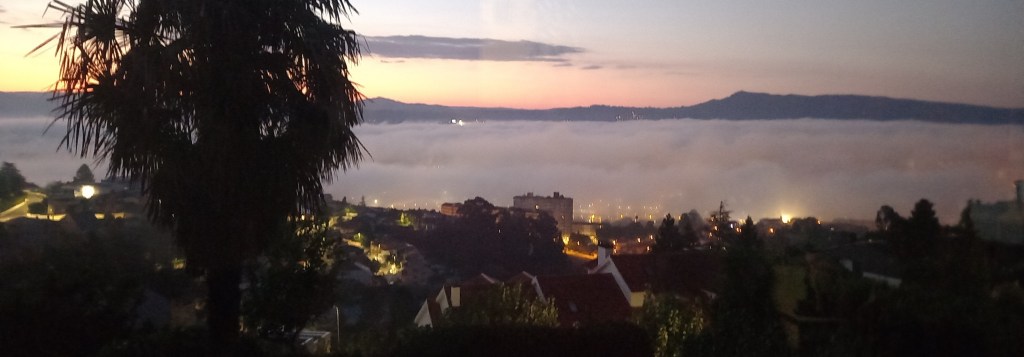
Spanish life is not always likeable but it is compellingly loveable – Christopher Howse: ‘A Pilgrim in Spain’.
Cosas de España/Galiza
Spain’s plan to grant legal status to c.500,000 migrants has attracted a record-breaking 900,000 applications in just 2 months – nearly double the government’s estimate. And there are still 15 days to go before the deadline.
Spain is planning to block public benefit payments to anyone who owes money to the state, under a sweeping new system being built by the country’s tax agency. Possibly even pensions.
Aer Lingus has introduced a flight from Cork to Santiago de Compostela. With sinking heart, I read that: Irish visitor-to-Galicia numbers are rising and this flight allows more visits to Pontevedra,, Costa da Morte, and Cape Finisterre. Not to mention giving Caminoers from southern Ireland a better return option than Dublin. BTW: They are welcome to the Costa da Morte and Cape Finisterre, which are oversold in my view. And to La/A Coruña and Vigo, of course.
In contrast, Ryanair has recently cut flights to Santiago de Compostela, citing excessive airport fees from Spain’s state airport operator Aena. It hasn’t flown to a major NW English city since the early 2000s and neither Perplexity nor ChatGPT can offer a Ryan rationale for this. Not enough Scouse or Manc Caminoers, perhaps.
Talking of Caminos . . . El Mundo has featured one that is far superior than the Portuguese or the French and which I”m planning to do in September. It’s the Camino de los Faros here in Galicia and translation of the article is below.
As I suspected, Pv city now has more pets than young kids – 21.533 in fact. 3% up on last year. Dogs predominate but cat ownership is growing faster.
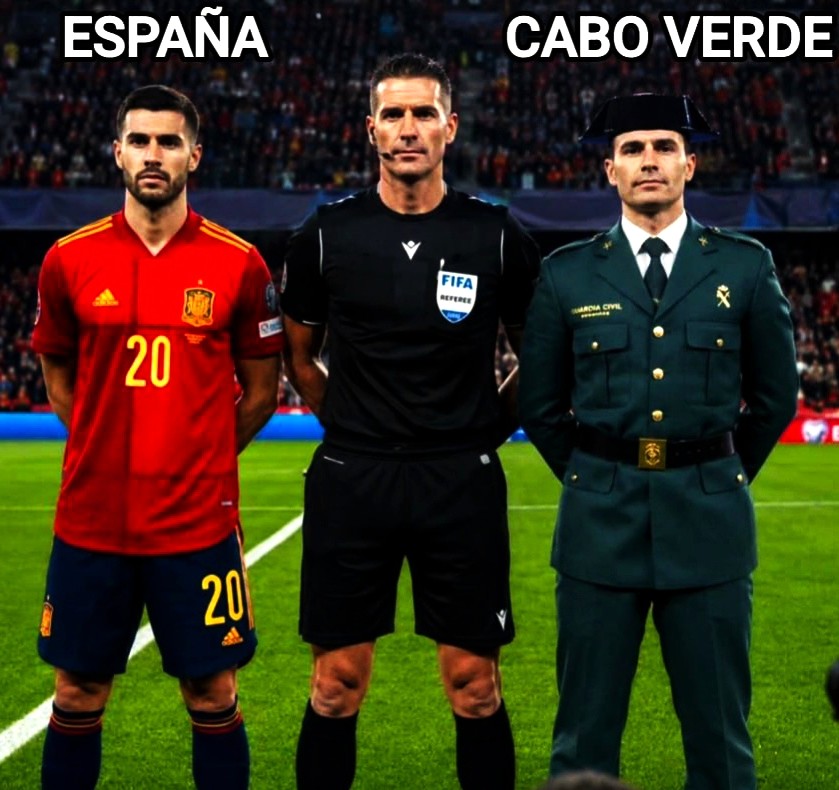
Need I say that Spain’s draw(tie) with Cabo Verde hasn’t gone down well here. Spanish sports columnists can be vicious. One paper this this morning gave the players marks between 2 and 5, with most of them being at the lowest end and only a few at 4 or 5. Some of them might be divorced by now.
One wag’s view of the game . . .
I guess most, if not all, readers will have realised we don’t actually have wild boards rampaging through Galicia, as opposed to carnivorous wild boars. And probably several bores. And some boors.
The UK
The World Cup
The Dutch team has no one who plays in the Nederland domestic league.
Which is also true of the defiant minnows of the Cape Verde team, whose players are spread: Portugal 7; Türkiye 3; Russia, the USA, Bulgaria, Cyprus 2 each; and Spain, Israel, Hungary, UAE, Netherlands, Romania, Finland, and Ireland 1 each.
I was confused for a second or two to hear Cape Verde referred to as an American team, until I recalled that to the Spanish and the Portuguese. ‘America’ doesn’t mean the USA, or even the whole of North America. It’s shorthand for South America. Logically enough.
The Middle East War
The latest update from Naked Capitalism
Quotes
- There is no bigger Trump lie right now than saying the Iran War is good for you – or the world.
- The Iran “deal” is a tacit admission of strategic defeat by the Trump administration .
- After a war costing an estimated $30bn, killing thousands and destroying hundreds of millions of dollars worth of US military hardware, none of Trump’s declared objectives have been fulfilled.
- The US and Iran have agreed to stop fighting and to open the Strait of Hormuz. Everything else is being kicked down the road over 60 days of ceasefire and beyond. [Well beyond, in my view]
- As things stand, the deal achieves none of what Obama’s 2015 nuclear deal did.
The United States of Trump America
Quotes
The odious Trump suffers from ODS – Obama Derangement Syndrome . . .
That ‘deal’ . . .
The Way of the World
The 1939 film, The Wizard of Oz, was – and is – a wonderful film. Judy Garland was just 16 when she starred in it. But the truly astonishing fact is that MGM Studios had, by then, had her on a daily mixture of uppers and downers so as to enable her to withstand a punishing work schedule. As with all child stars of that era. Things have moved on a but there are still rapacious parents, of course.
Only Fans – This is a depressing article about a possibly even-more-depressing BBC documentary, which you’ll need a VPN to watch if you’re outside the UK.
BTW: More and more websites are blocking VPN users, with banks, streaming services, email providers, and other sites increasingly refusing access to traffic from shared VPN IP addresses.
Spanish
- Mascota: Pet
- Logopeda: Speech therapist
- Acechar: To lurk, lie in wait, etc.
English
Pablum: Trite, insipid, or simplistic writing, speech, or conceptualisation
Did you know?
How Benedict Arnold built a navy on Lake Champain and saved the revolution by losing.
You Have to Laugh
Finally . . .
You can see how inflation works to reduce disposable income bit by bit . . . Some of the recent increases in my life:- Bird seed: from 2.0 to 2.25; a bottle of beer from 2.80 to 3.00 or more; Coffee from 1.40 to 1.60. octopus from 15.00 to well above 20.00. Inflation might well be below 5% but no one does 5% increases these days. Are they all still in the mindset of compensating for Covid losses?
Actually, I don’t eat octopus. Or bird seeds.
My thanks to those readers who take the trouble to Like my posts. .
Finally . . . Finally
The Lighthouse Trail of the Costa da Morte: The Atlantic Route to Finisterre, but Without Pilgrims
The fascination with the Camino de Santiago is overflowing onto the paths leading to Compostela. Pilgrims number in the thousands, or tens of thousands, on all its routes: the French Way, the Portuguese Way, the Primitive Way, the Northern Way, the Portuguese Way… Faith. The need for forgiveness. To alleviate stress. To wash away fears. To make a wish, a promise, or to find friends—these are the secrets of its success. This report isn’t about that formula; it’s about discovering another path that leads to Finisterre, but which is practically empty and, surprisingly, without pilgrims. A wild route that traverses the Costa da Morte in A Coruña province, from Malpica to the Finisterre Lighthouse. Two hundred kilometers of stark greenery, intense sea, rivers, waves, reefs, and churning foam. An irregular line through cliffs and heroic agriculture. A unique opportunity to discover the world almost entirely alone: the Lighthouse Trail.
Before setting off, the Lighthouse Trail requires a little planning. 99% of hikers walk from north to south, starting in Malpica and ending in Finisterre. While writing this report, I only saw one couple from the Basque Country hiking in the opposite direction. The rule is simple: follow the green dots or the green footprints. The signage is adequate, but it could use repainting and adding signs in some areas overgrown with weeds after a particularly rainy winter.
Regarding planning, you should consider whether you’re planning to carry your backpack in a snail’s pace and sleep in a different town each night. The downside: carrying more weight, changing cots daily, and making reservations in advance because there are no mountain huts or hostels like on the Camino de Santiago. The option we chose was to stay in just two hotels: five nights in Laxe (Vida Mar), four in Camariñas (Devalar do Mar). This allowed us to pack more clothes, be more comfortable, and carry a minimal backpack with water, nuts, and a raincoat. The downside: the logistics. Each day we took one or two taxis or used our own cars combined with another taxi. Prices ranged from 20 to 30 euros for seven people. We did get ripped off, though: we’re still smarting from the 35 euros Josito charged us!
The starting point is in the port of Malpica. There, the Instagrammable sign of a green Smurf with a blue cap, Traski, the mascot of the Route, welcomes us. The first stage connects Malpica with the secluded beach of Niñóns. The official website states 21 km, but my GPS rounded it up to 22.5 km, 6 hours and 40 minutes of walking, and 832 m of elevation gain. of elevation gain. Although it may not seem like it. The first day puts us in our place. The trail is more demanding than it looks, and we won’t be in shape until the fourth day. So, patience and steady progress.
Looking back at photos, notes, and emotions from that first day, I see the solitary beaches of Seaia and Beo, and the signs warning swimmers of the “presence of Portuguese man-of-war,” those giant and dangerous jellyfish. Dry stone walls, narrow paths, lots of grass. The sun will be constant for all eight days. Galicia isn’t what it used to be.
RIVER FOOTBATH
We take off our shoes and cross rivers that carve enormous furrows in the beach sand before emptying into the sea—what a great experience! In Barizo, we pass by A Ostreira, a leading Galician company in aquaculture and oysters that produces 150 million seed clams of the grooved carpet shell, grooved carpet shell, and Japanese clam annually. At its base, the sea ripples gently, playfully crashing against the rocks that cluster along the shore. The first wind turbines appear on the crests. The rolling hills lead to the charming Punta Nariga lighthouse, an ideal spot to rest, eat, and nap, lulled by the gentle lapping of the tide.
Day two stretches from Niñóns to Ponteceso: 28 km, 9 hours, and 1,054 meters of elevation gain. New, secluded beaches and a narrow path through overgrown vegetation await. Ferns, nettles, and brambles scratch your legs relentlessly. Long trousers are recommended to avoid this. A Barda beach boasts crystal-clear waters, followed by challenging switchbacks along the Tremosa Coast until reaching the village of Roncudo and its modern lighthouse, surrounded by scaffolding.
We passed through fishermen’s huts, stopped at the Antón viewpoint, admired its shell dreamcatcher, and photographed the sheltered rocks covered in shimmering green algae, as well as the granite crosses that stand facing the sea, underscoring that we were on the Costa da Morte (Coast of Death).
The
third day takes us from Ponteceso to Laxe, our first base camp. It’s
a 25-kilometer, seven-hour hike with 735 meters of elevation gain.
There, we venture into the shadows of the Mills Route, harnessing the
river’s power. We explore the remains of the water channels, admire
the lichens, pick the red berries from the bracken, and continue
through immense birch trees. We keep going until we reach the
Borneiro hill fort.
We’re in the municipality of Cabana de
Bergantiños, standing before the archaeological remains and the
round walls of a fortified village that housed 400 people during the
Iron Age. We also stop briefly to admire the Dombate dolmen and climb
to a geodetic marker to see the mouth of the Anllóns River where it
flows into the Corme Estuary.
The path remains solitary; we only
encounter four or five other people each day. Until we spotted three
women who accelerated, who flew, every time they sensed us. They were
three incredibly friendly young nurses from the Nephrology Department
in Ourense. Three angels for the dialysis patients who were
completing the first four stages of the Lighthouse Way.
Fatigue
and Magnesium
The fourth day (Laxe-Arou) was a turning point for
me and my companions. Cristina, Marta, Roberto, Picus, and I
accumulated fatigue and muscle soreness in equal measure. In addition
to stretching, we took magnesium and a muscle recovery supplement
with turmeric and collagen. It was a flat day: only 18 km, but I
won’t lie to you, it wasn’t exactly a walk in the park. In Laxe, we
discovered the cemetery next to the Beach of Crystals, its floor
littered with broken bottles rounded by the tide. Nearby is the
Lovers’ Stone, the place where the young people of Laxe flirt,
watched over by the sea and their ancestors.
In Laxe, we
enjoyed its dunes, its seafront promenade, and its barnacles. There
was even time for a touch of spirituality: by taking advantage of the
sacristan, we managed to get him to open the Church of Santa María
de la Atalaya so we could light candles for our university daughters
who were taking exams. Outside the parish church, following the
Barnacle Route, we came across the Laxe Lighthouse, another recent
and automated structure. A few meters away, a circular marker marks
the Memorial of Waiting, where the figure of a woman and her baby
gaze at the horizon, waiting for her fisherman husband lost in the
vastness of the sea. The descent to Soesto beach is spectacular. In
the distance, camper vans wait for the tide to bring them some
surfable waves. The place, a little slice of paradise, is deserted.
Our big question is: what will it be like in summer?
The fifth
day, Arou-Camariñas, covered 25 km and took 7 hours and 47 minutes.
The pleasant stroll along dunes, wooden walkways, and wide beaches
leads to Camelle. There, we pay tribute to the memory of Manfred, the
German artist who became a symbol of resistance against the Prestige
oil spill in 2002, the year he died. We also had a disappointing meal
at the Rotterdam bar, a stark reminder that the old adage “you
can eat well anywhere in Galicia” no longer holds true.
The
English Cemetery, a humble site facing the wild Atlantic where the
memory of all those shipwrecked off the Costa da Morte (Coast of
Death) is honored, gives one pause for thought. So does the imposing
Cabo Villán lighthouse, the oldest electric lighthouse in Spain. A
25-meter behemoth erected on the site of the former lighthouse
keepers’ quarters—at one point, six families lived there
simultaneously—on a peninsula surrounded by a sea whose ferocity is
frightening. An ingenious device that has saved countless
lives.
With Luz Casal
At the entrance to Camariñas,
I set an epic tone, much to my team’s surprise. I take out my phone,
open Amazon Music, and tune in to Luz Casal singing “Camariñas”
with the Royal Philharmonic Orchestra of Galicia. The neighbors
leaning out from their balconies give me strange looks, but I don’t
care: “Camariñas, Camariñas/you’re already making me feel like
Camariñas/for one of Camariñas/I live in the world
suffering…”.
Stage 6, Camariñas-Muxía, is huge, 32.6
km, but at this point in the hike, other walkers have advised us to
skip the first ten kilometers of road and asphalt. Wise decision!
Along the way, a quick pee and coffee in the lovely chill-out area
overlooking the Lago Mar campsite. We continue along the Río Negro
Trail, enjoying some cleverly disguised mills. In Muxía, we
encountered pilgrims and followed them into the Sanctuary of Our Lady
of the Boat, where we lit two more candles for our daughters to pass
their finals.
Day
7 connects Muxía with the open, surfer beach of Nemiña: 19
kilometers and a six-hour walk after some last-minute adjustments. In
Muxía, we bought delicious empanadas at the Jurés bakery, where we
were captivated listening to the owner as she reminisced about how
her parents started their business from poverty. Just outside the
town, a beach overlooked by the colossal and futuristic Parador
Nacional (a state-run hotel).
Day 8, the grand finale, takes us
to Finisterre after 25 kilometers. Our legs feel fresh because we
walked along the shore and rode the waves crashing on Rostro beach
for two kilometers. At the Finisterre lighthouse, with the sound of
the sea still fresh in our minds and endorphins through the roof, we
hug each other and vow to hike again next year. Not a single problem,
complaint, or reproach. Kilometers that give life.
PRACTICAL
GUIDE
HOW
TO GET THERE
Flights to A Coruña or Santiago. Consider driving.
WHERE
TO EAT
In Laxe, enjoy excellent fish at Mar de Fondo. Near
Finisterre, in Lires, indulge in aged beef at Hotel As Eiras. And for
something different, try a dreamy Italian restaurant in Ponte de
Porto: La Tavernetta.
WHERE
TO STAY
Hotel Vida Mar de Laxe. Three stars, reasonably priced,
and clean rooms.
Hotel Devalar do Mar Camariñas. Modern and fun
architecture with three stars. Friendly staff and reasonable rates.
MORE
INFORMATION
At caminodosfaros.com
 Thoughts from Pontevedra, Galicia, Spain
(Lenox) I had to find Cabo Verde on the map. You need to as well!
LikeLike
No i initially wrote Africa and then got totally confused . . . I knew where ir was in fact but got confused witn Curacao . . The other tiny island team . .
will delete that para
Ta
LikeLike
All transatlantic sailors know the whereabouts of Capo Verde.
Benedict Arnold is buried below.
https://www.google.co.uk/maps/@51.4763655,-0.1756373,3a,75y,38.9h,101.84t/data=!3m7!1e1!3m5!1sUb65qJyXtpsqSOnmDcxCAA!2e0!6shttps:%2F%2Fstreetviewpixels-pa.googleapis.com%2Fv1%2Fthumbnail%3Fcb_client%3Dmaps_sv.tactile%26w%3D900%26h%3D600%26pitch%3D-11.844768390727708%26panoid%3DUb65qJyXtpsqSOnmDcxCAA%26yaw%3D38.903390329084715!7i16384!8i8192?entry=ttu&g_ep=EgoyMDI2MDYxMy4wIKXMDSoASAFQAw%3D%3D
I used to live in sarf Lunnen & drank at The Old Swan in Battersea Church Road, next to St. Mary’s church from 1969/72, afore I scarpered to Chislehurst. Horst, the restaurant manager, was great fun & he would join a group of us on decadent Sunday afternoons at my attic flat, to play “Risk”, drink vodka & pass out on the floor. Those were the days! Horst had lodgings with a Chinese family & my wife Liz & I were invited to a crab supper. Afterwards, we fully understood the Chinese phrase “After crab, nothing!”. 除了螃蟹,其他什麼都別吃。 I have never been able to repeat the sheer deliciousness of that meal. It lingers still in my memory.
https://www.closedpubs.co.uk/london/sw11_battersea_oldswan.html
https://boakandbailey.com/2017/10/changing-scene-watneys-pubs-1964/
Inquisitively,
Perry
LikeLike