Awake, for morning in the bowl of night has flung the stone that puts the stars to flight
And, lo, the hunter of the east has caught the sultan’s turret in a noose of light.

Spanish life is not always likeable but it is compellingly loveable – Christopher Howse: ‘A Pilgrim in Spain’.
Cosas de España/Galiza.
This is a perspicacious comment from an observer of things Spanish: Spaniards are the great space optimisers and social improvisers. In a country where most people live crammed into small apartments and the working day often drags beyond 8pm, they’ve no other choice. Every second of free time counts. A land of social chameleons, they’re masters of moving from fiesta back to business as usual in the time it takes northern Europeans to plan their annual meet-up with friends. But this is no accident. Dense urban living facilitates spontaneous socialising — it feeds the ability to quickly mobilise, instantly transforming unremarkable streets into a wave of noise, colour and joy. One question: Is this true of other countries where there is ‘dense urban living’ and a long working day? Or is Spain unique?
This is the (surprising?) face on one of Spain’s leading drug ‘lords’, Francisca Cortés Picazo (‘La Paca’).

She’s the matriarch of a powerful Romani (gypsy) clan, operating out of Palma, Majorca. Apple TV has a documentary about here called La Paca, matriarca de la droga. She might well be in prison at the moment. Not for the first time, of course.
I’ve mentioned the regular deaths of drivers of un-cabbed tractors here in Galicia, when they turn over. Pv province leads the country in tractor-related accidents, at getting on for half of them this year. One every 2 days, it’s reported. I guess the hilly terrain is a major factor. And maybe wet, soft earth.
I’ve also mentioned that there are several police forces operating in Pv city. A Spanish friend tells me that the local/municipal force deals with ‘administrative’ matters and, not for example, with robberies. Which is why we had to go to the offices of the national police on Sunday.
Today, I was again passed by a car when I was in the middle of a crossing and this time I didn’t get the usual exculpatory wave of the hand – because the driver was looking down on his phone and didn’t even notice me. Hence my advice to always wait to see what’s heading for you when you’re halfway across. And never to run! Especially past a vehicle that’s stopped for you on the near side of the crossing. This is inviting death.
Europe
More on the turning tide . . . A quiet but historic transformation is unfolding across Europe. Yesterday morning, officials in the Parliament opened their computers to discover that Google was no longer the default search engine. In its place is Qwant, a French privacy-focused platform operating entirely under European jurisdiction. But this was not an isolated move. On the same day, the Commission unveiled a sweeping “Tech Sovereignty Package” designed to reduce dependence on American cloud providers, software systems, and digital infrastructure. And, just days from now, a coalition of European tech firms will officially launch Euro Office — a full alternative to Microsoft 365, built specifically for European governments, schools, and enterprises.
The Middle East War
The latest update from Naked Capitalism.
The United States of Trump America
Quotes
- [If you don’t agree with my version of reality], you are either crooked or stupid.
- If Putin sat with his generals to consider how to weaken US intelligence, he could not have been as effective as Trump has been in the last 18 months.
- Trump has no friends, only actual enemies and potential enemies – those who will eventually upset him. [Which reminds me . . . His latest petty, spiteful act is to change US policy towards the Falkland Islands (Las Malvinas) because the UK upset him].
Click here for how Trump aims to void the November elections.
And click here to listen to David Rothkof and Diana Coles as they dive into a week of extraordinary political turmoil, from alarming warnings about Trump’s reshaping of America’s national security apparatus to growing fears over the future of democratic institutions, the intelligence community, and a rapidly escalating Middle East crisis. Along the way, they unpack protests erupting overseas over Trump-linked business ventures, the fallout from Trump’s explosive confrontation with NBC, and the stunning upheaval at 60 Minutes that has veteran journalists questioning the future of independent media. Rothkopf and Coles connect the dots between power, corruption, media intimidation, and a changing political landscape—culminating in a provocative discussion about why so many Americans seem unwilling to confront what they see as the defining crisis of the era.
Says Rothkopf: Trump is exactly the type of person the founding fathers didn’t want as president and, therefore, designed the Constitution the way they finally did. Insufficiently watertightly, it would seem. Presumably because they never envisaged a subservient, spineless Congress and a corrupt judiciary. One wonders how they would have changed their master plan if they had.
Ticket prices for NBA series-final matches this week are astronomically high, though they must represent an even smaller percentage of the income of the US uber-rich than a ticket to a normal basketball match does for the average Joe. Thus do the greatest public pleasures of the US become the exclusive preserve of the extremely wealthy. Which might well have been the case for some of them – say, opera – for quite some time now.
On a lighter note. . . . A fascinating podcast on the history of the US anthem, The Star-Spangled Banner, featuring one or two major surprises. Listen to Anacreon in Heaven on YouTube here.
Latin America
An El País editorial: Latin America Doesn’t Need Tutors or Guardians. In democracies like Mexico, Brazil, and Colombia, the US practices a kind of interference reminiscent of another era. See the full text below.
The Way of the World
Uber was famously unprofitable for 14 years, despite keeping costs down by treating its drivers badly and ‘trashing many cities taxi systems’. But it is profitable now is. Because it’s started to monetise all the customer data it had amassed. So, now earns its revenue from advertising and this year will make 2bn dollars in profit just from this. So . . . ‘It’s become an allegory for all tech companies. Whatever one of these says it’s selling, it almost always ends up selling advertising’ . As they say, you are the product.
Spanish
Ways to say ‘I wish!’ in Spanish. (The explanations are from an AI answer):-
- Ojalá!: The most direct and natural. This is a corruption of an Arabic phrase like in shā’ Allāh or law šā’ Allāh – “If God wills” or “God willing”.
- Ya quisiera!: Very close. Stresses the personal desire.
- Ya me gustaría!: Expresses the wish that something happens.
- Qué más quisiera!: The stress is on the desire.
- Desearía!: More formal.
- Quisiera!: A common alternative.
English
Given that it featured at a celebration, I guessed this was a slogan for a Galician football team . .
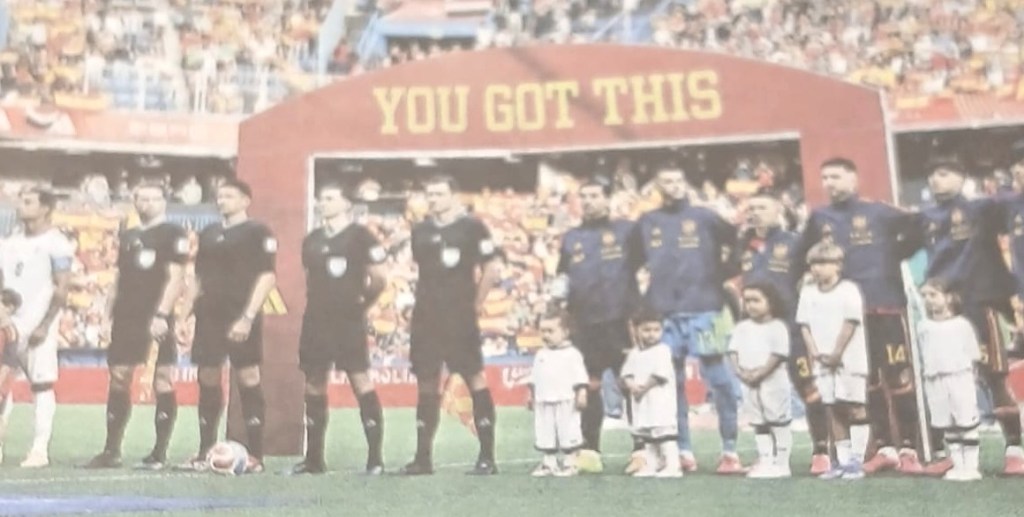
But it turns out to be from Adidas. I guess it makes sense to their target clientele.
Did you know?
The prophetic Titanic cat . . .
You Have to Laugh
Another uncomfortable Finn . . .
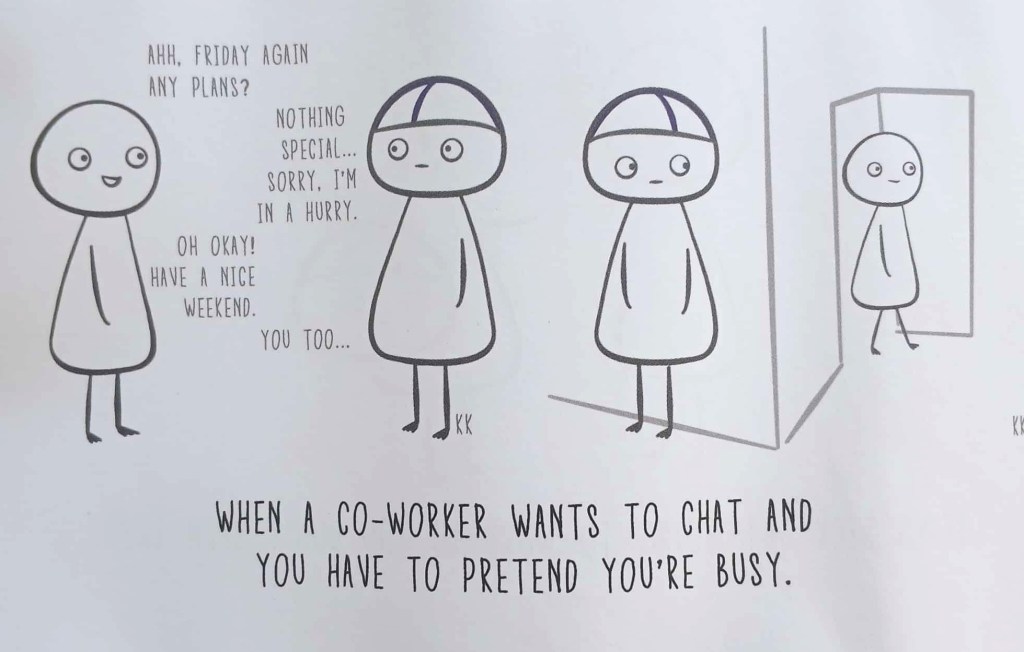
Finally . . .

OK. And then what?
El País editorial
There are ghosts that Latin America thought were buried. One of them is the idea that Washington can decide what happens south of the Rio Grande – which governments are acceptable, which threats justify unilateral action, and which of its own interests supersede the sovereignty of others. The attitude of the US government under Donald Trump evokes that past that was so hard-won, a world -view that harks back to the worst reflexes of imperialism and threatens the international order built to prevent the law of the strongest from becoming the only rule.
Latin America knows all too well the consequences of this logic. The region’s history is marked by episodes in which external interference, especially from the United States, was presented as a solution to urgent problems and ended up generating instability, polarization, and profound institutional deterioration. Recent signs are too explicit to ignore. In Mexico, the investigations opened by the U.S. Department of Justice against local politicians and the insinuations about possible unilateral actions against drug cartels point to the Mexican state’s power to exercise authority over its territory. In Brazil, warnings directed at judicial and political institutions regarding decisions that fall exclusively within the country’s internal sphere fuel the confusion between diplomatic influence and interference. In Colombia, Trump’s unwavering support for one of the candidates on the eve of the second round of elections demonstrates the extent to which he considers it legitimate to condition sovereign decisions according to his will and interests. These are different contexts, but united by the same premise: the idea that Washington retains some kind of prerogative to intervene in, pressure, or oversee processes that belong exclusively to Latin American democracies.
What is unsettling is not only the pressure coming from the US. It is also the speed with which some leaders in the region seem willing to relegate basic principles, such as the defense of human rights and the advancement of freedoms, to the background, subordinating them to a political agenda that finds one of its strongest champions in the current US administration. Behind this phenomenon looms the rise of an increasingly internationally coordinated far right, capable of sharing strategies and objectives. Its strength lies not only in the electoral victories it may achieve, but also in its ability to shift the public debate and force other actors to adopt some of its tenets. When ideas that challenge established rights, relativize democratic principles, or spread exclusionary ideologies cease to be marginal and become accepted norms, the threat transcends any single government.
What is worrying is that these temptations originate from the world’s leading power, which arrogates to itself the right to condition others according to its own interests, thus contributing to the erosion of what it once promoted: an order based on rules and institutions. Imperialism is not acceptable simply because it adopts new arguments or wraps itself in the flag of security. Latin America does not need tutelage or guardians. The notion that a foreign power should reserve for itself a supervisory role over sovereign countries belongs to an era that shames any democracy. Resurrecting that vision is a step backward toward forms of domination that the continent knows all too well, and which should never return.
My thanks to those readers who take the trouble to Like my posts.
The Usual Links . . .
Each of these US commentators issues at least one podcast a week, usually 2, sometimes 3. All available on Podbean and most on YouTube for free. So, take your pick. I’ve asterisked those new to me today. You should get the latest episode when you click on the link, though YouTube videos seem to come out a bit earlier:-
- The Daily Beast Podcast or Video
- Inside Trump’s Head* Podcast or Video
- The Daily Blast with Greg Sargent Podcast
- The Rest is Politics US Podcast or Video
There are also the excellent late-night shows, of course. And SNL.
You can get my posts by email as soon as they’re published. With the added bonus that they’ll contain the typos I’ll discover later. I believe there’s a box for this at the bottom of each post. If you do this but don’t read the posts, I will delete your subscription. So perhaps don’t bother if you have other reasons for subscribing . . .
I no longer post on Facebook. But I can be readon X at Thoughts from Galicia. And on Substack here
For new readers: If you’ve landed here looking for info on Galicia or Pontevedra, try here. If you’re passing through Pontevedra on the Camino, you’ll find a guide to the city there.
If you´re thinking of moving to Spain, this link should be useful to you.


The nature of things to come.
https://www.twz.com/sea/this-is-the-corsair-drone-boat-that-plucked-the-downed-apache-crew-out-of-the-gulf-of-oman
Probably?
Perry
LikeLike
¡ojalá! A shortened version of ‘un ojo a Ala.
LikeLike