Awake, for morning in the bowl of night has flung the stone that puts the stars to flight
And, lo, the hunter of the east has caught the sultan’s turret in a noose of light.
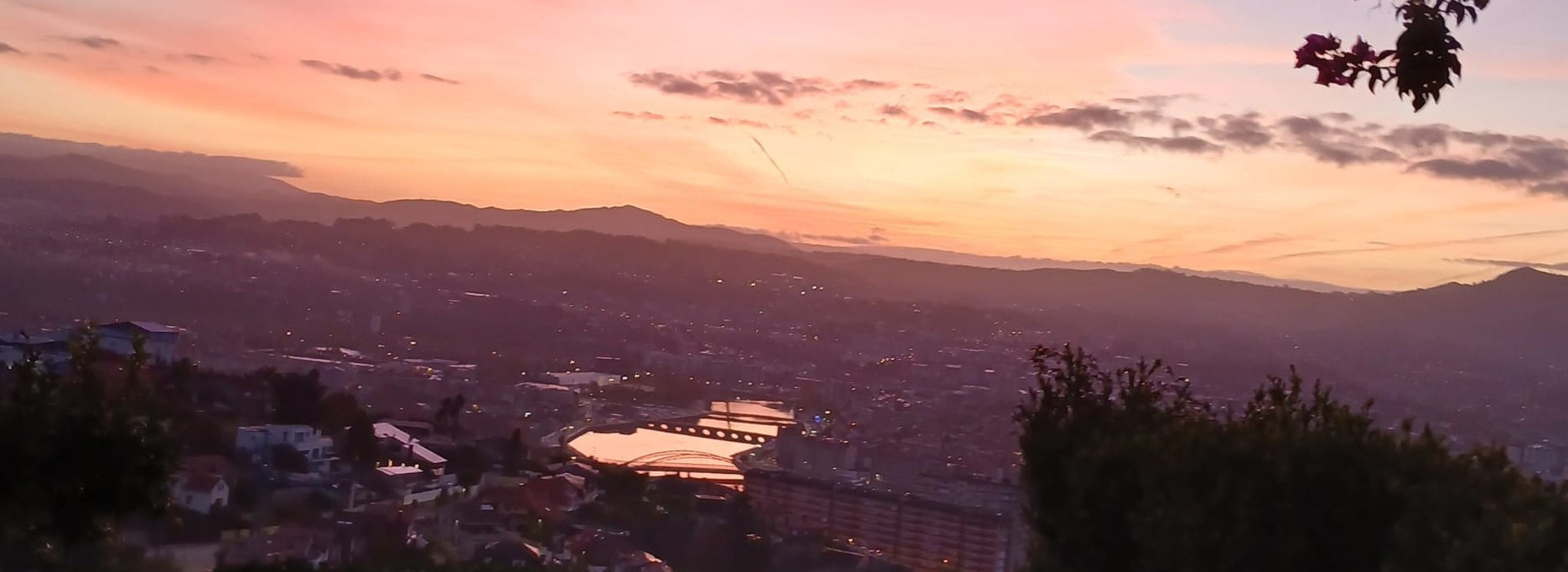
Spanish life is not always likeable but it is compellingly loveable – Christopher Howse: ‘A Pilgrim in Spain’.
Cosas de España/Galiza
Mark Stücklin returns here, with evidence, to the theme of what political meddling/tinkering does to the housing market. For some reason, I’m reminded of Galicia’s 3 almost useless ‘international’ airports.
Reading yesterday’s article on the reasons for the serious housing shortage here in Spain, I was reminded of the utterly crazy boom years of 2002-2007, when banks were throwing money at anyone and everyone, encouraging them to take out – on low interest rates – far larger mortgages than they needed – to finance a car or a boat as well as the property they wanted. This was because they were flush with cash after the removal of exchange risk via the introduction of the euro led German and French banks to invest heavily in Spain in the easiest way possible. Which was surely not what Brussels intended. And it didn’t end well, with lots of bankruptcies, bank foreclosures and evictions of defaulters. Plus decimation of the construction industry, from which it has never fully recovered. Meaning properties now can’t be built at the speed required, even in the funds are available.
This is not the first time I’ve seen this claim re children in poverty in Spain. I do find it difficult to believe, almost certainly because I never see any of it. Despite extensive travel around the country. Of course, I don’t usually drive or walk through poor barrios.
Portugal
Curiouser and curiouser . . . A friend advised Nando’s is Portuguese but this was queried by another friend who’d thought it was South African. Trying to find where I could try their chicken in Spain or Portugal, I got this AI advice: There is no Nando’s in Portugal. Despite its strong Portuguese branding and peri-peri chicken, Nando’s is actually a South African chain that doesn’t operate in Portugal. And it only has places in Madrid and Barcelona in Spain.
The Middle East War
The latest update from Naked Capitalism. No good news. And we get closer and closer to a massive hike in oil prices.
The United States of Trump America
Quotes
- I got a bigger crowd size for my speech than Marin Luther King. If it doesn’t look like that in the fotos, it’s because my supporters were packed more tightly together.
- Kaitlin Collins is a corrupt reporter who never smiles when talking to me. Why doesn’t she smile? [He means kowtow/suck up/arse lick].
This a (tendentious) podcast/video for which a number of other adjectives can be suggested. Apart from ‘long’, the 3 that spring to my mind are astonishing fascinating and plausible. Plus possibly vitriolic. I guess I might lose a few US readers by citing it here but I rather suspect not. Anyway, here goes . . . In keeping with its titles, it claims that (US)Americans, though no less intelligent than any other people, frequently act – across a very broad range – as if they really are stupid. Much to the astonishment and irritation of the rest of the world. Most obviously by twice electing Donald Trump as president. The blame for this is laid at the door of an alleged long-standing and deliberate failure to inculcate critical thinking in children – the consequences of which are spelt out in some detail. Not to mention speed. As the presenter points out, it’s a major irony that only Americans who, in the face of a culture which minimises it, have developed critical thinking who will listen to the podcast and, very possibly, agree with it. These presumably include the many who are reported to have left or to be leaving the country.
The podcast naturally got me thinking about own childhood, with the question arising of whether – at Catholic primary and secondary schools – I was taught critical thinking. I can’t say that I recognise that I was but, then, I did start questioning my faith in my teenage years and gave it up when I was 19. My elder daughter achieved this at 11, despite (because of?) having been to a Catholic primary school.
Understandably, one of the points made is that the rest of the world has become very aware of what the US is – not what it thinks it is and pretends to be. And is fed up with it.
Almost inevitably, I turned to an AI engine to ask how critical thinking can be taught to kids and the answer is below. If you listen to the podcast and its complaints about what the consequences are of the US failure to imbue its children with this facility, you will recognise the irony that this answer uses US spelling . . .
Somewhere along the way, I learned a dictum which goes: The five core interrogative words are Who, What, When, Where, Why but the best of these is Why. (Some folk add a 6th – How.
BTW . . . A phrase which occurs more than once in the podcast is ‘epistemic tribalism’. I had to look this up and this is the essence of the answer: This is the tendency for individuals to align their beliefs and what they accept as “truth” based on loyalty to their social, political, or cultural group (their “tribe”) rather than on objective evidence or shared standards of reasoning. Epistemic tribalism contributes to epistemic chaos (breakdown of shared reality) and epistemic exhaustion (mental fatigue from navigating conflicting truth claims). It’s particularly relevant in polarized political environments where people on opposite sides can’t even agree on what counts as evidence. The concept contrasts with epistemic liberalism—the idea that society should hold common principles for evaluating truth (like scientific method, peer review, logical consistency) regardless of political affiliation. This phenomenon is increasingly discussed in relation to modern political polarization, social media echo chambers, and the erosion of shared factual foundations in public discourse.
Back to normal podcasts . . . Each of these US commentators issues at least one podcast a week, usually 2, sometimes 3. All available on Podbean and most on YouTube for free. So, take your pick. You should get the latest episode when you click on the link, though YouTube videos seem to come out a bit earlier. I’ve asterisked the ones which were new to me today:-
- The Daily Beast* Podcast or Video
- Inside Trump’s Head* Podcast or Video
- The Daily Blast with Greg Sargent* Podcast
- The Rest is Politics US* Podcast or Video
The DSR Network Podcast
The Politics Girl Video. Amusing
There are also the excellent late-night shows, of course. And SNL.
Spanish
- Palmario: Glaring, blatant
- Por ende: Therefore, consequently, etc.
- Esposa: Handcuff. And also wife/spouse . . . .
Did you know?
Why the most dedicated fans are not going to this year’s World Cup.
You Have to Laugh
The Close – an adult comedy cartoon from the BBC
Finally . . .
CRITICAL THINKING
This is inculcated in children through daily interactions that encourage questioning, exploration, and independent problem-solving rather than simply giving them answers. It’s built gradually by creating environments where children feel safe to think deeply, make mistakes, and learn from them.
Key Strategies for Parents and Educators
Ask open-ended questions
Instead of answering directly, ask “What do you think is happening?” or “What ideas do you have?”
Encourages children to generate their own reasoning without fear of being “wrong”
Pause and wait
Give children ample time to think before responding or intervening
Allows reflection and refinement of thoughts rather than gut reactions
Encourage curiosity
Support the “why” phase by helping them form and test theories, experiment, and explore
Natural curiosity lays the foundation for critical thinking
Promote play-based learning
Build with blocks, act out roles, play board games, follow their interests deeply
Play is active learning that builds meaning through first-hand experience
Teach hypothesis formation
Ask “If we do this, what do you think will happen?” during play
Exercises prediction and causal reasoning
Help evaluate information
Teach them to consider where information comes from, how it relates to what they know, and whether to trust it
Essential skill in an age of information overload
Model critical thinking
Verbalize your own decision-making process: “I’m thinking… because…”
Children learn by observing how adults think
Let them solve problems
Don’t intervene immediately; wait and watch, then offer gentle guidance if needed
Challenges are necessary for growth; failure is part of learning
Use the 6 critical questions
Encourage “who, what, where, when, why, how” about topics they encounter
Builds habit of deeper understanding and independent thinking
Praise effort, not just accuracy
Create a supportive environment where wrong answers are okay if explained thoughtfully
Reduces fear of failure that leads to memorization instead of analysis
In School Settings: Teachers use critical challenges, display question prompts in classrooms (“Is it fair?”, “How would someone else feel?”), design tests that require explanation rather than memorization, and encourage group work so children see multiple problem-solving approaches.
The core principle is knowing how to think, not what to think—developing children’s ability to analyze, evaluate, and reason independently.
The Usual Links . . .
You can get my posts by email as soon as they’re published. With the added bonus that they’ll contain the typos I’ll discover later. I believe there’s a box for this at the bottom of each post. If you do this but don’t read the posts, I will delete your subscription. So perhaps don’t bother if you have other reasons for subscribing . . .
I no longer post on Facebook. But I can be read on X at Thoughts from Galicia. And on Substack here
For new readers: If you’ve landed here looking for info on Galicia or Pontevedra, try here. If you’re passing through Pontevedra on the Camino, you’ll find a guide to the city there.
If you´re thinking of moving to Spain, this link should be useful to you


There were pitfalls and learning curves with regards to the euro for Spain. But it hasnt at all been the disaster predicted by many. On the contrary the euro has been, is and will continue being a boon for spain. Not a single doubt.
LikeLike
Come Summer us locals in Corun̈a will struggle to walk the streets, get a table in a bar or restaurant, or find somewhere to park.
The other day 4 cruise ships docked. It was a tad frustrating getting around.
Still the council claims its good business. That might be true if the shops opened well before 10.30am, say at 9 ish, when all the pre-diabetic white sock sandal wearing cruceristas hit the town en masse.
LikeLike
i dont have the energy to debate the euro with you. Just one thing. Simply look at the rate at which britain has to finance its public debt and then ask yourself who is winning.
LikeLike
btw i did not say the euro was the only reason why spain is doing well. When britain’s economy grew in the past nobody ever mentioned it was due to a grat extent to the very significant population growth, although that was the case for quite a while. I have always maintained that britain’ s attitude to europe would end up in tears. And things are only going to get worse. Much worse.
LikeLike
Colin,
I think the poem by Kipling could ring a bell with you.
“I Keep six honest serving men (They taught me all I knew)
Their names are what and why and when
and how and where and who.
LikeLike
Buen análisis.
Me encanta como Trump habla tan bien de si mismo.
LikeLike