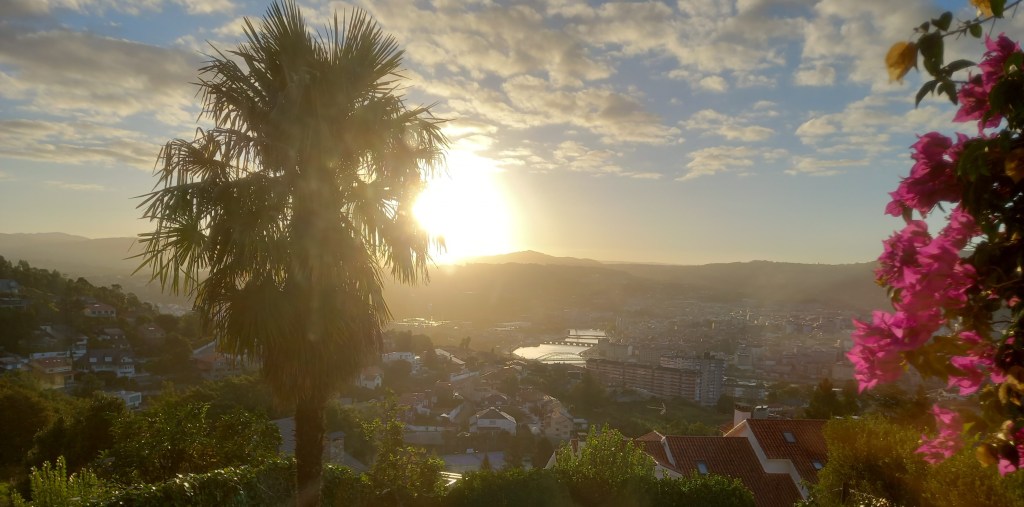
Awake, for morning in the bowl of night has flung the stone that puts
the stars to flight.
And, lo, the hunter of the east has caught the sultan’s turret in a noose of light.
Spanish life is not always likeable but it is compellingly loveable – Christopher Howse: ‘A Pilgrim in Spain.
Cosas de España/Galiza
Despite the proliferation of artisanal bakeeiess, bread consumption in Spain has plummeted by 80% since the 1960s, from 134 to 28 kilos per person per year. And 40%of bakeries have closed since the beginning of the century. The decline is is said to be a reflection of a profound social transformation: changes in eating patterns, persistent nutritional myths, new lifestyles and a loss of traditional gastronomic culture in the context of modernisation. Well, maybe. All I know is that, my Spanish dinner guests get edgy at the table until I bring out a basket of barra slices, most of which I will throw to the birds the next morning. This is because, while the bread might act as some sort of comfort blanket, not much of it gets eaten It’s just the way things are. At least no butter gets wasted, as this isn’t a Spanish thing. Here’s the article I read on the subject this morning.
Spain’s cheapest cities to live in. Not an easy thing to decide on, apparently, but a Galician city takes the biscuit.
Here’s Lenox Napier on T-shirts and other things.
The Diaro de Pv runs a regular feature on Galician legends and myths, penned by Rodrigo Cota. His latest was on The Enormous Octopus of Rianxo. Trying to find this one for you, the net sent me down a rabbit hole, in which – while failing to find that particular tale – I did come across 2 fascinating sources of Galician myths and legends:-
- Galicia Histérica, and
- Mitos y Leyendas de Galicia: Explorando el mágico mundo gallego. There’s a nice table of these at the end of this article and I’ve appended it below, in English.
One of the legends cited gave rise to a popular saying that Whoever goes to Sevilla loses his seat – meaning that, if someone leaves a place or position, they risk losing it to someone else. See here.
Talking of things that might not be true . . . The Galician Xunta says that the housing problem will be eased by the availability of more land and by less bureaucracy. The latter possibly relates to the conversion of empty retail places into ground floor flats. Which hasn’t exactly been proceeding at breakneck speed. Or even with a sense of urgency.
Portugal
A lovely Cota bit on the Portuguese, then and now. . . . El Shakespeare portugués era gallego. An amusing comment therein re my barrio of Poio.
The UK
On the BBC, the FT says: The problem isn’t that we have a deliberately biased BBC, it’s that we have a BBC that has been consciously reduced in its scope and bullied into dumbing down and retreating.
My own view is that, as with the NHS, the model and its financing are wrong. I believe this will change for the BBC but not for the sacrosanct NHS. One is politically do-able, the other isn’t.
The mad, bad world of MAGA
Perhaps the very biggest of Trump’s endless lies, which he surely can’t not know is untrue: We have massive Tariff Income pouring into our Country from foreign countries. Not a penny, in fact.
Trump is threatening to sue the BBC for at least 1bn dollars for the sin of making comments that have caused him financial and reputational harm. If Trump sued everyone who caused him reputational harm, he’d surely go bankrupt many times over suing himself.
Quotes of the Day
He has become more authoritarian and has pursued macho (and increasingly pathetic) photo opportunities. Not Trump but Putin.
Russia
- Putin’s nepotism.
- Putin’s madness: Putin still thinks he’s a genius. All the naysayers are gone. The Russian leader was once willing to listen to his critics. But now he surrounds himself with yes-men and is obsessed with his legacy. . . Like so many ageing autocrats — he has become a caricature of himself. [But isn’t this true of all of us, if we get to old age? Witness Trump.]
The Way of the World
In the face of anti-immigrant sentiment in many countries – complete with rhetoric about being ‘swamped’ by people of ‘alien’ cultures – there was a conference of 32 nations in France, to discuss the growing international phenomenon of migration. It attempted to impose generally agreed guidelines . . . Not recently but in 1938.
Spanish
- Prota: Protagonist
- Gesta: Exploit
- Cintarazo: A strapping. Like the ones I frequently got from the Christian Brother masters in my grammar school.
English
The meaningless slang that has taken over the conversations of Gen Alpha.
Did you know?
At the height of its dominance, the Roman Empire included over 55m million people, stretching from Britain to Egypt and Syria and covering nearly 4m square km. In many ways, it was the most impressive Empire in human history. The Romans got many things right, but infrastructure is where they were particularly advanced for the time. In addition to the sea routes, the network of roads across the Empire enabled everything from trading and travel to tax collection. Without it, the Roman Empire couldn’t have lasted. A monumental new study, years in the making, has just presented the most comprehensive, high-resolution digital map of the entire Roman road network ever created.
Finally . . .
Something more for phone-users to worry about.
Some Galician Myths and Legends – with associated locations
The Santa Compaña: A procession of tormented souls that roams the Galician roads at night, foreshadowing death. Rural routes and ancient roads throughout Galicia.
Mount Pindo: Sacred mountain where mythical creatures are said to dwell and ancestral treasures are hidden. Carnota, A Coruña
The Lady of Arinteiro: A woman of unparalleled beauty who seduces men, leading them to a tragic fate. O Carballiño, Ourense
The Treasure of Santiago Cathedral: It is said that incalculable riches protected by spells are hidden beneath the cathedral. Santiago de Compostela
Mouras: Mythical female beings, guardians of treasures and ancestral knowledge, associated with megaliths and historical sites. Dolmens, hill forts, and other archaeological sites.
The Sack Man: A feared character who wanders through Galician villages capturing disobedient children. All of Galicia
Queen Lupa: A pagan ruler who, according to legend, converted to Christianity and helped bury the Apostle James. Padrón, A Coruña
The Misarela Bridge: A bridge that, according to legend, was built by the devil in exchange for the soul of the first person to cross it. Ribadavia, Ourense
Meigas: Witches with knowledge of sorcery who can bless or curse people and control supernatural events. All of Galicia, especially in rural areas and forests.
O Xacio: Spectre or ghost of a dead person who appears at night to scare the living or to ask for masses for their soul. Mainly in the rural area of Lugo and Ourense.
Lobishome: Werewolf or lycanthrope from Galician mythology who transforms into a wolf at night. Stories widespread throughout Galicia, with a particular presence in the province of Ourense.
The Holy Body: Souls of saints or virtuous people who appear in the sea to guide sailors and protect them from dangers. Galician coast, especially in areas with a seafaring tradition.
My thanks to those readers who take the trouble to Like my posts.
The Usual Links . . .
You can get my posts by email as soon as they’re published. With the added bonus that they’ll contain the typos I’ll discover later. I believe there’s a box for this at the bottom of each post. If you do this but don’t read the posts, I will delete your subscription. So perhaps don’t bother if you have other reasons for subscribing . . .
I can also be read on Facebook.
For new readers: If you’ve landed here looking for info on Galicia or Pontevedra, try here. If you’re passing through Pontevedra on the Camino, you’ll find a guide to the city.
If you´re thinking of moving to Spain, this link should be useful to you.

