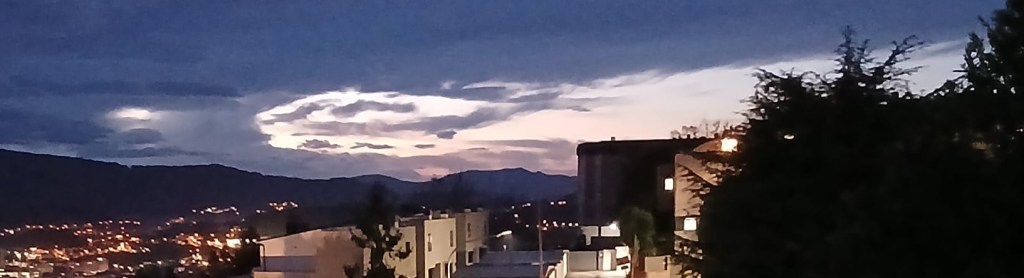
Awake, for morning in the bowl of night has flung the stone that puts
the stars to flight.
And, lo, the hunter of the east has caught the sultan’s turret in a noose of light
Spanish life is not always likeable but it is compellingly loveable – Christopher Howse: ‘A Pilgrim in Spain.
These disturbing statistics came as a surprise to me, as poverty in Spain is not very obvious around the country. At least not where I’ve driven over the years. And that’s despite the fact I regularly stress there’s a big difference between Spain’s macro and micro economic performances.
I’m guessing that few of us knew that: Before the prime meridian was established at Greenwich, there was a Spanish site that had served as the global reference line of longitude.
Cousas de Galicia
The VdG today: Galicia leads in naturalising immigrants: Galicia has seen the greatest growth in the number of foreign residents who’ve obtained Spanish nationality. In 2016, nearly 2,700 foreign residents were registered as Spanish citizens. Eight years later, the figure exceeds 6,600. In total, in the last 10 years, 33,175 people have been naturalised here, against 1.5m nationally. In Galicia, most come from Latin America, so there’s a higher percentage able to obtain nationality quickly, as they need to reside here for fewer years and don’t need to take the language exam.
The main cause of train delays between Madrid and Galicia turns out to be problems with the pantographs which connect with the overhead electric rails. Specifically, at a place called Taboadela just before/after Ourense, where they stop to have their bogies changed. Which won’t be necessary once – by the 12th of Never? – high-speed track is installed around Ourense. And apparently isn’t necessary for the appalling Talgo S106 train I’ve written about. But what a price is paid for the dual-purpose undercarriage on that!
I went to this place years ago, hoping to see at least one wolf, bear, eagle or vulture. Or even just a humble rabbit. In the event, my partner and I didn’t even see a sparrow. But it’s pretty. And we had a nice lunch and heard a singer whose DVD I bought when we got home. And we did see a palloza or two. So, not a complete waste of time, after a long car journey there and back.
Europe
A significant development . . . The EU council’s secretary-general says that the ECHR must adapt to face growing backlash against migration, adding that There should be ‘no taboo’ about changing the convention’s rules.
France
Doubtless gutted by last night’s result and the ultimate failure of their great comeback. I almost sympathise.
Trumpworld/LA LA Land
Only the ferocity of the exchanges can be a surprise about the Trump-Musk divorce and its aftermath. And we now wait to see if any Epstein-related proof emerges. And just how insane Trump’s tweets get. I’d say no one would believe these developments in the plot of a novel but, of course, we passed that point a long, long time ago. Now, we can start to speculate how and when Vance takes over from Trump. Which is surely being game-planned by the former and his mates. Who might include Bannon. So . . . Interesting times, that well-known Chinese curse.
No surprise to read that The vultures are circling. But will there be two corpses or only one?
Quote of the Day
Elon Musk claims to be inspired by The Hitchhiker’s Guide. But did he understand the book? Our future may depend on it.
Russia v. Ukraine
Putin’s plan for the summer? Ignoring Trump and his threats along the way.
The Way of the World
Our world is experiencing seismic change with the rise of power-mad leaders, spiralling conflicts and climate chaos. At such times, the big questions of life are brought into sharp relief. And so amid this turmoil, religious leaders are hoping for a return to faith, while ideologues of all stripes are seeking to exploit anxiety by offering purpose and certainty. How should we navigate questions of meaning in our increasingly secular society, and how might a humanist approach serve as a guide? In this first edition of our new Voices section, we asked 6 diverse people for their perspectives.
Spanish
- Carroña: Carrion.
- Raudal: Stream, flood, torrents.
- A raudales: In abundances, in spades, etc.
- Punzante: Sharp, stabbing, throbbing.
- Seguido: Following.
- En seguido: Immediately, right away. [Cf. Enseguida, said to be proper Spanish. Not the SA variety]
English
On a podcast yesterday, I heard 2 Americans say eminent when they meant imminent. Not once but several times. Assuming my hearing isn’t at fault, the question arises of whether this was a mistake or merely different pronunciation.
Did You Know?
I checked with the American Mirriam Webster dictionary, which says: Imminent bears a close resemblance to eminent, and native English-speakers can be excused if they sometimes have to check their spelling. No surprise, really, since the two, despite their very distinct meanings, come from near-identical sources. The Latin minēre means basically “to project, overhang,” and it forms the root of other Latin words. One added the prefix e-, meaning “out from,” to produce eminēre, “to stand out”; another took the prefix im-, meaning “upon,” and became imminēre, “to project.” The difference between “stand out” and “project” is obviously small. Still, even when eminent and
Imminent first appeared in the 15th and 16th centuries respectively, they were clearly distinct in meaning, imminent’s prefix having strengthened the “overhang” sense of minēre to give the word its frequent suggestion of looming threat.
You Have to Laugh
The new name for Trump’s Florida palace –Tac-O-Largo.
Finally . . .
Last night, Spain beat France 5-4, in what some say was a game of footbasketball. Sadly, I didn’t, see the second half, having left the bar at half time, when the score was only 2-0 to Spain. But I did say to reader David in La Coruña that the first half had been enjoyably ‘free-flowing’. Nowhere near as much as the second half it transpired.
Finally, Finally . . .
Surely, the penultimate set of extracts from The Pillow Book of Sei Shonagon.
I think that by now we can be pretty sure of how she dealt with nocturnal loneliness.
Wind Instruments
- I love the sound of the flute: it is beautiful when one hears it gradually approaching from the distance, and also when it is played near by and then moves far away until it becomes very faint. There is nothing so charming as a man who always carries a flute when he goes out on horseback or on foot. Though he keeps the flute tucked in his robe and one cannot actually see it, one enjoys knowing it is there. I particularly like hearing familiar tunes played on a flute.
- It is also very pleasant at dawn to find that a flute had been left next to one’s pillow by a gentleman who has been visiting one; presently he sends a messenger to fetch the instrument and, when one gives it to him carefully wrapped up, it looks like an elegant next-morning letter.
- A thirteen-pipe flute is delightful when one hears it in a carriage on a bright, moonlit night. True, it is bulky and rather awkward to play – and what a face people make when they blow it But they can look ungraceful with ordinary flutes also.
- The flageolet is a very shrill instrument, the autumn insect it most resembles being the long cricket. It makes a terrible noise, especially when it is played badly, and it is not something one wants to hear near by. I remember one of the Special Festivals at Kamo, when the musicians had not yet come into His Majesty’s presence. One could hear the sound of their flutes from behind the trees, and I was just thinking how delightful it was when suddenly the flageolets joined in. They became shriller and shriller, until all the ladies, even those who were most beautifully groomed, felt their hair standing on end. Then the procession came before the Emperor with all the string and wind instruments playing in splendid unison.
In the Fifth Month I love going up to a mountain village. When one passes a marsh on the way, a thick covering of weeds hides the water and it seems like a stretch of green grass; but as the escort walk across these patches, the water spurts up under their feet though it is quite shallow. The water is incredibly clear and looks very pretty as it gushes forth. Where the road runs between hedges, a branch will sometimes thrust its way into the carriage. One snatches at it quickly, hoping to break it off; alas, it always slips out of one’s hand. Sometimes one’s carriage will pass over a branch of sage brush, which then gets caught in the wheel and is lifted up at each turn, letting the passengers breathe its delicious scent.
I cannot stand a woman who wears sleeves of unequal width. If she has several layers of robes, the added weight on one side makes her entire costume lop-sided and most inelegant; if she is dressed in thick wadded clothes, the uneven balance prevents them from closing properly in front, and this too is very unsightly. When a woman wears a robe with sleeves of different width, all her robes must be cut in the same style. The smartest robes, after all, are those with evenly matched sleeves that people have worn since ancient times. I don’t mind if both the sleeves are very wide, but such robes are rather awkward for Court ladies in ceremonial dress. The fashion of unequal sleeves is just as unattractive for men as for women, since it produces the same lop-sided effect. Yet nowadays everyone seems to have his clothes cut like this, whether he is wearing a fine ceremonial robe or a light summer garment. Fashionable, good- looking people really dress in a most inconvenient way.
The way in which carpenters eat is really odd. When they had finished the main building and were working on the eastern wing, some carpenters squatted in a row to have their meal; I sat on the veranda and watched them. The moment the food was brought, they fell on the soup bowls and gulped down the con tents. Then they pushed the bowls aside and finished off all the vegetables. I wondered whether they were going to leave their rice; a moment later there wasn’t a grain left in the bowls. They all behaved in exactly the same way, so I suppose this must be the custom of carpenters. I should not call it a very charming one.
A young bachelor of an adventurous nature comes home at dawn, having spent the night in some amorous encounter. Though he still looks sleepy, he immediately draws his inkstone to him and, after carefully rubbing it with ink, starts to write his next-morning letter. He does not let his brush run down the paper in a careless scrawl, but puts himself heart and soul into the calligraphy. What a charming figure he makes as he sits there by himself in an easy posture, with his robe falling slightly open! It is a plain unlined robe of pure white, and over it he wears a cloak of rose-yellow or crimson. As he finishes his letter, he notices that the white robe is still damp from the dew, and for a while he gazes at it fondly. Then he makes arrangements for delivering his letter. Instead of calling one of the ladies in attendance, he takes the trouble to get up and select a page-boy who seems suitable for the task. Summoning the boy to his side, he whispers his instructions and hands over the letter. The page leaves for the lady’s house, and for some time the gentleman watches him disappear in the distance. As he sits there, he quietly murmurs some appropriate passage from the sutras. Now one of his servants comes to announce that his washing water and morning gruel have been prepared in the neighbouring wing. The gentleman goes there, and soon he is leaning against the reading-desk and looking at some Chinese poems, from which he now and then reads out a passage that he has particularly enjoyed— altogether a charming sight. Presently he performs his ablutions and changes into a white Court cloak, which he wears without any trousers. Thus attired, he starts reciting the sixth scroll of the Lotus Sutra from memory. A pious gentleman indeed – or so one might think, except that at just this moment the messenger returns (he cannot have had far to go) and nods encouragingly to his master, who there upon instantly interrupts his recitation and, with what might strike one as sinful haste, transfers his attention to the lady’s reply.
My thanks to those readers who take the trouble to Like my posts.
The Usual Links . . .
You can get my posts by email as soon as they’re published. With the added bonus that they’ll contain the typos I’ll discover later. I believe there’s a box for this at the bottom of each post. If you do this but don’t read the posts, I will delete your subscription. So perhaps don’t bother if you have other reasons for subscribing . . .
I can also be read on Facebook at https://www.facebook.com/colin.davies.752861 or on Substack at https://doncolin.substack.com/
For new readers: If you’ve landed here looking for info on Galicia or Pontevedra, try here. If you’re passing through Pontevedra on the Camino, you’ll find a guide to the city there.
For those thinking of moving to Spain:–
- This is an extremely comprehensive and accurate guide to the challenge, written by a Brit who lives in both the North and the South and who’s very involved in helping Camino walkers.
- This post of mine contains several relevant articles from ThinkSpain.
- This article ‘debunks claims re wealth and residency taxes’. Probably only relevant if you’re a HNWI. In which case, you’ll surely know what that stands for.
- Getting a mortgage in Spain: Some advice on this challenge.
- A comparison of UK and Spanish living costs.
- And here’s a personal guide to moving to Spain – to work, not to retire.


A mi, tampoco me gustan las mangas desiguales y anchas, me parecen incómodas y poco elegantes.
LikeLike