Awake, for morning in the bowl of night has flung the stone that puts the stars to flight
And, lo, the hunter of the east has caught the sultan’s turret in a noose of light.

Spanish life is not always likeable but it is compellingly loveable – Christopher Howse: ‘A Pilgrim in Spain’.
Cosas de España/Galiza
A trio of items purloined from Lenox Napier’s latest edition of of Business Over Tapas
- Spain is one of the three countries—the others being Italy and Australia—in the Organisation for Economic Co-operation and Development (OECD) where wages have fallen the most since the COVID-19 pandemic. Although real wages have grown by 2% over the past year, they’re still 2% below the level of the first quarter of 2021, and a rebound in Spain is not expected in either 2026 or 2027
- It’s reported that almost a third of Romanians and Bulgarians have left the country due to stagnant wages and high housing costs. In 2012, Romanians here numbered nearly 900,000 but only 609,000 remain. Money, they say, goes further in their home country.
- Over 6 out of 10 Spaniards are reported to believe that ‘lawfare’ exists and that judges are influenced by their political ideology. A majority believe the judiciary acts slowly, guided by economic or partisan interests, and without sufficient oversight or controls.
María writes here of Spanish help given to the revolting English who wanted to be independent Americans. Eventually. Nobody liked the English back then. Which is a surprise when you consider how well they’re loved now. Especially by the Scots and the Welsh.
The 7th bull-run today in Pamplona was the usual length – c.2mins 30 – but eventful for 2 reasons: 1. The herd was led down to the bullring by some of the bulls, not the cows (las cabecestras), which is unusual and seen as more dangerous, and 2. All the bulls and a single cow decided to take a tour of the bulling before being led out of it by the cow. And everyone then applauded, as usual.
The Voz de Galicia today: Seafood Scarce and Very Expensive: “It’s through the roof.” That’s how the owner of one Galician restaurant reacted when asked about seafood this year. There is some, but it’s very expensive and scarce, especially white clams, cockles, clams, and other species that were once common on Galician summer tables. Mussels have also disappeared due to the red tide. Foreign seafood, mainly from Portugal, Italy, and France, is gaining ground in the markets. The competition is particularly fierce for the scallop: it’s going for 50 euros, while its rival, the Pacific scallop, is only 12.What’s the betting that some places are charging the same price for the cheap stuff as they have previously charged for the dearer stuff. In fact. I know they are. I’ve seen the boxes being carried to the kitchens. A practice not unknown in other countries too, where local products have a premium.
The UK
Thanks, largely, to the films(movies) . . All (US)Americans allegedly believe all of these myths about the UK:-
- It rains all the time [The Spanish say the same about Galicia]
- Everyone has a posh, refined accent
- British food is always bland [Tell that to my stomach!]
- Everyone drinks tea constantly.
- The UK is just London
- Brits are always polite and reserved
- Healthcare is free and always perfect
- It’s always cold and grey
- Everyone loves the royal family
- The UK is old-fashioned and traditional
The Middle East War
The latest update from Naked Capitalism.
The United States of Trump America
Quotes
I cited an article the other day about how the decline of the US empire compares with that of the UK. Now a comparison with that of the Spanish empire has come along, courtesy again of Lenox:- From Jacobin here: The US umpire Is Ending Much Like Spain’s Did. As the US celebrates its 250th, it has begun to resemble the decadent Spanish Empire it replaced: producing nothing while collecting rents, sacrificing its interior to enrich a bloated elite, and embracing exclusionary nationalism to exploit its underclass’.
- Why Trump’s Top Legal Goon Can Never Lead DOJ
- Texas ICE Killing Takes Damning Turn as Even MAGA Judges Abandon Trump
- A relevant dissertation from Michael Jochum: Not Just a Drummer: Reflections on Art, Music, Politics, Dogs, and the Human Condition
The Double Death Standard
I’ve spent the last day watching a fair amount of pearl-clutching over my reflections on the death of Lindsey Graham. Apparently, some people have concluded that my unwillingness to suddenly rewrite history reflects some profound moral failing on my part. I heard about Graham’s death around one o’clock in the morning. I had been getting ready to call it a night, but instead I sat down and wrote. Furiously. Not because I celebrated his passing, but because death does not erase a lifetime of decisions. It does not erase the wars championed, the lies defended, the principles abandoned, or the damage done in pursuit of power. Death may close a life, but it does not close the historical record.
What fascinated me wasn’t the criticism itself. It was who it came from. Many of the very people insisting that we should never speak ill of the dead have spent years defending a man who has repeatedly done exactly that. Their outrage isn’t rooted in principle. It’s rooted in politics.
When former FBI Director Robert Mueller died, Donald Trump didn’t offer the customary condolences expected of a President of the United States. He didn’t choose silence. He didn’t simply move on. He posted, “Good. I’m glad he’s dead.” Those seven words told us everything we needed to know about the man occupying the Oval Office. Mueller was a decorated Marine who earned the Bronze Star and Purple Heart in Vietnam, prosecuted John Gotti, led the FBI through the aftermath of September 11, and devoted more than half a century to public service. Trump reduced that entire life to a childish expression of personal vengeance because Mueller had the audacity to investigate him. If that didn’t offend you, then I doubt anything I write today ever will.
Nor was Mueller an isolated example. Donald Trump mocked John McCain for being captured in Vietnam while McCain was alive, and he continued belittling him after his death, unable to set aside his petty grievances long enough to acknowledge the service of a man who spent more than five years as a prisoner of war. Even death wasn’t enough to interrupt Trump’s resentment. He has shown the same instinct toward countless political opponents, including Rob Reiner and others he perceives as enemies. If he cannot insult them after they’re gone, he simply refuses to acknowledge them with even the smallest measure of grace. His moral compass has always pointed in one direction: himself.
Yet somehow I’m expected to suspend my own opinions because Lindsey Graham has died.
That’s where the hypocrisy becomes impossible for me to ignore.
When Charlie Kirk was murdered, I watched the same political movement elevate him almost overnight into something resembling sainthood. He became a martyr. Every ugly word he had spoken, every divisive speech, every incendiary remark was wrapped in patriotic language until criticism itself became taboo. I said then, and I still believe today, that murder is never justice. His killer deserves to answer fully for his crime. But refusing to canonize Charlie Kirk is not the same thing as celebrating his death. Those are two entirely different moral positions. Apparently, nuance is no longer welcome in our political discourse.
The same transformation happened almost immediately with Lindsey Graham. Suddenly we are expected to forget that he once accurately warned America about Donald Trump before deciding that personal ambition was more valuable than personal integrity. We’re expected to forget the years of enabling, the endless rationalizations, and the extraordinary political contortions that turned one of Trump’s harshest Republican critics into one of his most loyal defenders. Death, apparently, now functions as an instant reputation laundering service, but only for certain people.
The irony would almost be funny if it weren’t so revealing. The people demanding reverence for Graham have remained remarkably quiet while Donald Trump publicly celebrated Robert Mueller’s death. They ask me to extend a courtesy their own political leader has never once demonstrated. They ask for civility while applauding cruelty. They demand grace while excusing vindictiveness. They insist history should pause out of respect for the dead, except when the dead happened to oppose Donald Trump.
That isn’t a principle.
It’s tribalism masquerading as morality. It’s the double death standard.
Ironically, I actually agree that there is dignity in restraint. Most of us learned as children that not every thought deserves to be spoken aloud. Disney managed to teach the lesson through Thumper in Bambi: “If you can’t say something nice, don’t say nothin’ at all.” There is wisdom there. I understand why many people choose silence when someone dies.
What I reject is selective silence. Silence is and always has been complicity. Agreement.
If we’re going to invoke decorum, then let’s invoke it for everyone. If we’re going to condemn speaking ill of the dead, then condemn Trump for celebrating Robert Mueller’s death. Condemn the years of insults directed at John McCain. Condemn every juvenile outburst directed at political opponents whose only crime was refusing to kneel before him. Don’t suddenly discover your moral compass only when someone on your side dies.
My opinion of Lindsey Graham’s political legacy didn’t begin the day he died, and it didn’t end because he did. Just as my admiration for Robert Mueller didn’t begin because Trump mocked his death, nor did my criticism of Charlie Kirk disappear because he was murdered. Murder is wrong. Political opportunism is wrong. Historical amnesia is wrong.
The only thing more disturbing than a politician who cannot stop speaking ill of the dead is a movement that condemns everyone else for doing precisely what it excuses in its own leader.
That isn’t respect.
That’s hypocrisy.
Spanish
- Vayas donde vayas: Wherever you go
- Por las nubes: Sky high, as in prices
- Zanfona: Hurdy-Gurdy.
Did you know about?
The famous London ‘knowledge‘. . .
Finally . . .You Have to Laugh
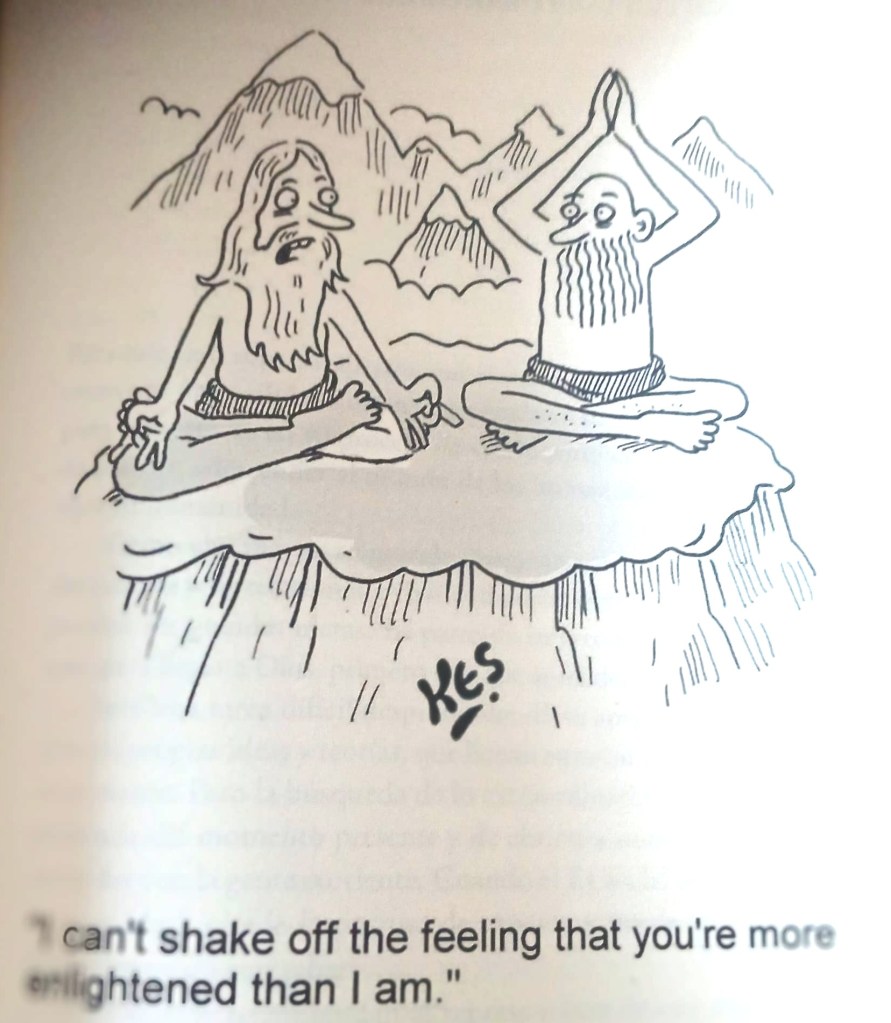
My thanks to those readers who take the trouble to Like my posts.
The Usual Links . . .
Each of these US commentators issues at least one podcast a week, usually 2, sometimes 3. All available o
You can get my posts by email as soon as they’re published. With the added bonus that they’ll contain the typos I’ll discover later. I believe there’s a box for this at the bottom of each post. If you do this but don’t read the posts, I will delete your subscription. So perhaps don’t bother if you have other reasons for subscribing . . .
I no longer post on Facebook. But I can be readon X at Thoughts from Galicia. And on Substack here
For new readers: If you’ve landed here looking for info on Galicia or Pontevedra, try here. If you’re passing through Pontevedra on the Camino, you’ll find a guide to the city there.
If you´re thinking of moving to Spain, this link should be useful to you.
 Thoughts from Pontevedra, Galicia, Spain
Excelente análisis.
LikeLike
London cabbies. I remember watching this.
(8086) The Knowledge (1979) – YouTube
LikeLike