Awake, for morning in the bowl of night has flung the stone that puts
the stars to flight
And, lo, the hunter of the east has caught the sultan’s turret in a noose of light.
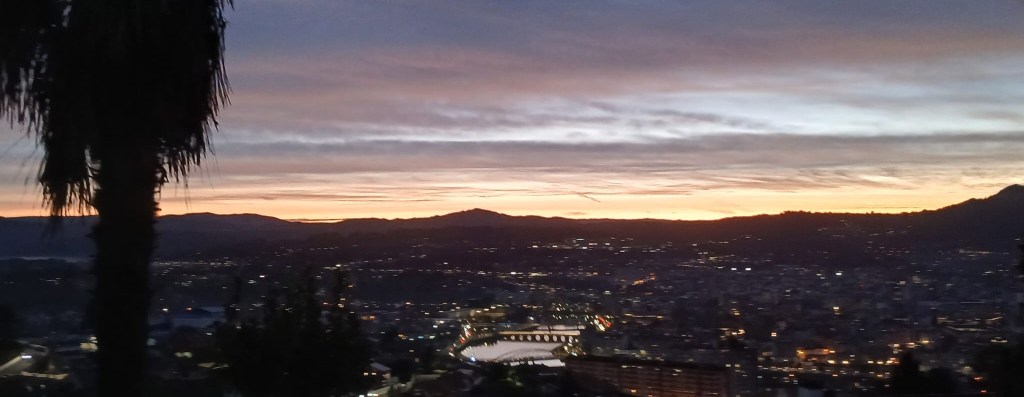
Spanish life is not always likeable but it is compellingly loveable – Christopher Howse: ‘A Pilgrim in Spain’.
Cosas de España/Galiza
More on the 50 women whom Madrid plans to pardon.
Surprised to see a Galician province included here . . . The number of property sales in Spain has hit its highest level in nearly 2 decades with some areas even surpassing the record-breaking highs of the 2006 real estate bubble. Home seekers in 12 cities – including Sevilla, Cordoba and Granada in Andalucía – bought more properties in 2025 than at the height of the 2006 market frenzy. The same trend is seen in Badajoz, Bilbao, Caceres, San Sebastian, Ourense, Pamplona, Segovia, Teruel and Vitoria – as well as in the provinces of Cordoba, Granada, Toledo, Caceres, Ourense, Alava, Gipuzkoa and Bizkaia.
A study questions the price premium of branded properties in Spain.
Very possibly of greater relevance/interest . . . A new €60 a month travel pass is announced.
The US-Iran War.
Desperate times, they say, call for desperate measures. Trump has suddenly become a would be-team player as regards opening the Hormuz Straits. Which might prove a tad late in the day. See my earlier post on the delusional, bellicose president.
The trouble for Trump is that his Iran war has not just divided Europe but has also shattered the Atlantic alliance. Rather than post a link to an article arguing this I’ve appended it to this post – shorn of a large bit specifically on the UK. [The link is here, if you want to read that].
A States-side view of the current ‘state of ply’ . . . Trump Administration officials besides Trump are starting to behave erratically – a sign that the fact that the war is not developing necessarily to US advantage is beginning to penetrate their embubblement and the belief in American superiority. However, the reality that the US has [firstly] put the global economy at risk of a potential depression and [secondly] is on track to having its military largely, if not entirely, run out of the Middle East is still likely beyond what key figures in the Administration can accept, cognitively and practically. Admittedly, it seems likely that some, perhaps many, top members of the armed services are better able to grasp what is happening and could help Administration leaders work through what will come at an epic shock. Points made in the text that follows:-
- The US MSM seems less confident of victory, witness Bloomberg and WSJ reporting.
- The WSJ reports that Trump was warned about the Iran closure of the Hormuz Straits but ignored it.
- Trump is deep into fantasy land, having lost touch with reality.
- Iran doesn’t need Kharg Island to continue exporting oil
- Trump’s lie about devastating Kharg Island might be the start of a PR campaign to gaslight the American public into believing Iran is defeated, which would allow Trump to declare victory and start withdrawing US forces.
- Alternatively, he really believes the lie and is convinced that this latest strike will convince the Iranians to surrender.
- Maybe it would suit both Iran and Israel for the 2,000 troops on the way from Japan to put their boots on Kharg Island.
- The new US attempts at escalation might appear confident but this is to be contrasted with signs of Administration officials, other than Trump, looking as if they are coming unglued.
- Reports continue to suggest Iran is even more punishment.
- Reports that the US Treasury trying to intervene in oil futures markets to lower prices have been met with horror by investors. Fears of a systemic shock to the banking system.
The USA
It’s a commonplace view that the besetting vice of the Brits is hypocrisy. There’s something in that. But you don’t have to read much about the activities of the USA empire since the last century to conclude that this allegation is even more true of the USA. Here’s a quote from Colossus:The Rise and Fall of the American Empire by Niall Ferguson: The most damning verdict of all on American policy [in Central and South America] came from General Butler, the most decorated marine of his generation, in a1935 article: “I helped make Haiti and Cuba a decent place for the National City Bank boys to collect revenues in. I helped in the raping of half a dozen Central American republics for the benefit of Wall Street. The record of racketeering is long. I helped purify Nicaragua for the international banking house of Brown Brothers in 1909–1912. I brought light to the Dominican Republic for American sugar interests in 1916. I helped make Honduras “right” for American fruit companies in 1903…. Looking back on it, I feel I might have given Al Capone a few hints. The best he could do was to operate his racket in three city districts. We Marines operated on three continents”. To this confession, Ferguson adds: This would always be the most damaging allegation against American imperialism: that for all its high-minded statements of intent, it boiled down to a Wall Street racket. The discrepancy between high-minded ends and means was perfectly encapsulated in Mexico.
Spanish
- Cobertizo: Shed, boathouse, barn, lean-to, shelter, woodshed, hut, outhouse, toolsshed, shack.
- Soez: Foul, coarse.
- Aguijón: Sting, thorn
Did you know?
Returning to the issue of the US empire . . . . I was surprised to learn of these inter-empire shenanigans around Mexico in last century . . . In the 1830s–1840s, Britain tried to limit US expansion while also avoiding a direct clash with Washington, particularly over Texas and the Pacific coast. On the Texas question, Britain mediated between the USA, Mexico and Texas, hoping to preserve an independent Texas as a buffer and to protect British commercial interests without provoking war with either side. In May 1846, the Mexican president suggested transferring California to Britain as security for a loan, seen as an indirect offer of sale, but British policy had already turned against acquiring California, and London did not act on it. US leaders like President Polk were very conscious of possible British moves in Mexico and the Pacific and one reason he hurried to settle the Oregon boundary with Britain in 1846 was to free American hands for confrontation with Mexico.
You Have to Laugh
A confused MAGAman . . .
Finally . . .
The Iran war has divided Europe and shattered the Atlantic alliance.
The war against Iran unleashed by the United States and Israel two weeks ago brings to the boil the clash of civilisations that has been simmering since the Islamic Revolution in 1979.
Despite the efforts of the mullahs to incite the entire Muslim world against the West, that conflict has so far been largely contained. Iran’s sporadic drone and missile strikes on the Gulf states, Saudi Arabia and Jordan have failed to provoke these states to distance themselves from the US, while the “Arab street” has remained quiescent.
Among the most important indirect consequences of the war, however, is the deepening rift between Europe and the US. The Atlantic alliance, on which the global Pax Americana has relied since 1945, has been exposed as a hollowed-out shell. Neither Europeans nor Americans see any obligation either to support the other, or to take account of the other’s interests.
The regime’s massacre of 20,000 to 40,000 Iranian protesters in a matter of days in January is one of the worst crimes against humanity of our time. That atrocity alone would justify the attack on Iran, on the grounds of “responsibility to protect”. Yet it has played only a subordinate role in the rationale offered by Donald Trump and his administration.
Nor has there been any consistency about the war aim. Is it regime change? Trump has toyed with the idea, but Benjamin Netanyahu ruled it out this week. Rather, Israel is intent on eliminating the military capabilities of the Iranian theocracy and its Lebanese terrorist branch, Hezbollah.
Trump initially seemed to think that electing a new supreme leader acceptable to him would be enough to end the war. But that hope was quickly dashed.
In other moods, he suggests that unless the Iranians accept unconditional surrender, the country could be so badly hit that it “could never be built back again”. Given that Japan was speedily rebuilt even after Hiroshima and Nagasaki, this implies a threat to leave Iran as a radioactive moonscape — which would be a step too far for the US military. An almost equally unpalatable but more likely scenario is Iran reduced to a failed state.
In that case, the endgame may be nigh – but only if oil tankers can be guaranteed safe passage through the Strait of Hormuz. The Pentagon admits that it cannot do this alone and has called on other interested parties to provide escorts.
On Saturday, Trump explicitly called on China, France, Japan, South Korea and the UK to send ships to escort commercial vessels. Would playing this necessary but subordinate role be sufficient for the Europeans to be reconciled with Trump?
Not only did Trump make no attempt to prepare European public opinion for his onslaught, his attitude to the EU throughout his second term has been consistently hostile. The president has even threatened to annex or compulsorily purchase Greenland, the sovereign territory of Denmark, a Nato ally.
The Danes have not forgotten how Bismarck seized their province of Schleswig-Holstein in 1864, nor Hitler’s occupation in 1940, but they never expected to be menaced by an American president.
Both Europe and America are, of course, divided on this war, just as they are on Ukraine. Opinion polls suggest that whereas a majority of Americans still back Ukraine and disapprove of Trump’s rapprochement with Putin, only a minority support his attack on Iran. This week Joe Rogan voiced the misgivings of Maga about this “crazy” war: “A lot of people feel betrayed,” the president’s favourite podcaster declared.
But the divisions inside the European Union are both more obvious and run deeper than in America. Insofar as there is a European consensus on the Iran war, it is the predictable one of timidity and equivocation. There has been broad agreement on the need to protect Cyprus, a fellow EU (but not a Nato) member state, from bombardment by the Iranian proxy Hezbollah.
A divided Europe
Of the two largest powers in the EU, France has taken a much more active role than Germany – despite the fact that Emmanuel Macron says the war is illegal. In both countries public opinion is sceptical on Iran, as it has been on Gaza.
Friedrich Merz stands out among European politicians as a principled hawk: he believes the attack on Iran is justified by Israel’s right to self-defence.
The German chancellor did not dissent when, as he sat next to Trump in the Oval Office, the president denounced the soft-Left Sir Keir Starmer and his Spanish counterpart, Pedro Sánchez, for their squeamishness about the US-Israeli operation. Merz, a tough-minded conservative, has no time for fence-sitters. For him, going along with Trump’s Middle Eastern adventure is a price worth paying to keep the US from abandoning Ukraine. Iran is primarily about Realpolitik.
Together with the other regional EU nations – the Greeks, Italians, Dutch and Spanish – they have formed a naval task force to patrol the eastern Mediterranean. France is also sending warships to join the US Sixth Fleet in the Gulf and the Red Sea, where they will play a symbolic role in keeping the Strait of Hormuz open, so that oil and gas may continue to flow to supply the world.
This show of force by Macron is designed not just to serve a strategic purpose, but to appeal to patriotic sentiment at home. “Your presence demonstrates the power of France,” the president declared in a video, posing with sailors and airmen in the aircraft hangar on board the Charles de Gaulle against a backdrop of the Marseillaise. Nothing lifts the spirits at home quite like la gloire de la France.
Germany, by contrast with France, has maintained its focus relentlessly on the forgotten war in the heart of Europe: Ukraine. Only this week, the defence minister Boris Pistorius announced that 35 Patriot missiles would be dispatched to defend Kyiv and other Ukrainian cities.
Yet the Iran war has brought succour to Vladimir Putin in at least two significant ways.
The sharp rise in oil and gas prices will be a huge boost to the Russian war machine, all the more so the longer the war continues. And in order to offset potential shortages caused by the closure of the Strait of Hormuz, Trump has now lifted sanctions on Russian oil. Although Scott Bessent, the US treasury secretary, insists this concession is for a limited period, Ukrainians suspect that this will quietly be extended.
Here again, the Nato allies are at odds. Macron immediately declared that the oil shock did not justify abandoning sanctions on Russia, which are virtually the only means by which pressure can still be exerted by the West on Putin.
Yet most Europeans are united by the fear of alienating Trump and being left to defend themselves against Putin without American help. Offering at least token support against Iran is being treated by the US administration as a test of loyalty.
One leader who certainly failed that test is the Left-wing Spanish prime minister Sánchez, who denounced the war as illegal and has permanently withdrawn his ambassador from Israel. In response to Trump’s threat to cut off all trade with Spain, Sánchez was defiant: “We will not be complicit in something that is bad for the world and is also contrary to our values and interests, simply out of fear of reprisals from someone.”
How big a problem is it for Europe that on Trump’s war against Iran, each EU member state has a different position?
Giorgia Meloni, the Italian prime minister, is perhaps the US president’s closest friend on the Continent. Unsurprisingly, she has refrained from criticising him directly. Yet even Meloni told her parliament that the attack on Iran was contrary to international law and that Italy would not be taking part.
One problem for any European leader who supports the war is that Trump is widely and deeply unpopular. The Spanish conservatives have never quite recovered from the Iraq war, when José María Aznar was the only European leader apart from Tony Blair to offer George W Bush wholehearted support.
Being associated with Trump is toxic, as Merz found last Sunday when his party lost a state election in Baden-Württemberg. By the same token, being denounced by Trump provides a sure-fire boost in popularity.
A striking example of this effect is Britain. Sir Keir’s prestige at home and abroad might be expected to suffer irreparable damage from his hand-wringing and about-turning on the war, plus his failure to provide adequate defences for our sovereign bases at Akrotiri in Cyprus and our troops in Iraq. Yet the British public is as wary of being drawn into the Iran war as the Prime Minister. The hard-Left is driven by anti-Americanism and anti-Zionism which, increasingly, is mutating into full-blown anti-Semitism. Centrists are alarmed by the impact of the war on the global and domestic economy, the apparent absence of an exit strategy and the fear of escalation. Even on the Right, there has been little sign so far of disaffected Conservatives rallying around Kemi Badenoch’s principled support for our allies, the United States and Israel, against Iran, a long-standing enemy of Britain. The Leader of the Opposition has boldly exploited the military flaws exposed by the crisis to make the case for a much stronger commitment to defence. But in the Commons the Prime Minister has misrepresented her justified critique as a lack of respect for the Armed Forces. It is as though Ethelred the Unready were lecturing Alfred the Great about the dangers of the Danegeld.
By aligning himself with the European consensus on Iran, Starmer has evidently found his comfort zone: fence-sitting. He seeks to evade accusations from the Right of betraying our allies and from the Left of joining an illegal war by the convenient legal fiction of permitting the use of British facilities by US aircraft solely for “defensive” operations. No less implausibly, he insists that we are quite capable of defending our sovereign bases in Cyprus, Akrotiri and Dhekelia, which are vital for the RAF and for intelligence.
Migration threat
Despite the Russian invasion of Ukraine, the disparity between European and US levels of defence expenditure has only grown. In 2024, the US spent just under $1tn (£750bn) on defence, almost five times as much as Germany, the UK and France combined. In defence expenditure, all three lag far behind the American figure of 3.5% of GDP, with Poland as the only major EU military power to exceed 4%.
What would it take to force Europe to pay for a serious increase in military capabilities?
The political trade-offs necessary to follow the Polish example – cutting welfare, for example – are seen as impossible in Western Europe. Macron failed to persuade the French to accept a modest rise in the pensionable age. He and Merz face threats from parties on both Left and Right who favour deals with Putin on Ukraine and are either sympathetic or indifferent to Iran.
What does move the most immovable European electorates, however, is immigration. A hitherto unmentionable peril could easily emerge if the Iran war topples the clerical regime but leads to the kind of anarchy formerly seen in Iraq, Syria and Libya. It is the spectre of mass migration from a fissiparous nation of 92m people, perhaps bigger than the wave that arrived from Syria a decade ago.
Several European countries — notably Germany, Britain, France and Sweden— are already home to the million-strong Iranian diaspora, many of whom are highly educated, well-integrated and secularised. Most of these émigrés support the US and Israel, but this might quickly change if large numbers began to arrive from a potentially chaotic Iran. Some of the new arrivals would inevitably have hardline Islamist views. An unknown percentage would be regime loyalists, affiliated to the Iranian Revolutionary Guards Corps (IRGC) or the paramilitary Basij —well-versed in propaganda, subversion and terror.
The fallout from the Iran war could thus have a profoundly destabilising impact on Europe – even more so than the Arab Spring, Isis and Gaza. It is unclear whether Trump and Netanyahu understand this, still less whether this dire prospect particularly concerns them. Unlike George W Bush and his neoconservative allies two decades ago, the Maga movement is isolationist and viscerally opposed to exporting democracy.
Neither Trump nor his administration understand that Iran will need a huge and costly Western effort if it is to become a liberal democracy, not another failed state. There are too few like the former Russian dissident and Israeli minister Natan Sharansky, who argued that helping Middle Eastern peoples to create democracies serves Western interests as well as their own.
Trump started it, but can he end it?
The present war in Iran has placed the Atlantic alliance under unprecedented strain. Defeating the Islamic Republic and deposing its leadership are desirable, justifiable and long overdue war aims. Many Europeans recognise this, but are nevertheless desperate to stay out of the conflict. Europe’s perennial ingratitude and resentment towards America are facts of life.
But Trump has cut off US military aid for Ukraine, leaving Europeans to help Zelensky stave off the Russian threat. He has simultaneously embarked on a new war without consulting his allies or considering the impact on them of a protracted interruption of oil supplies.
The defiant message on Thursday of the new Iranian supreme leader, Mojtaba Khamenei, makes it clear that closing the Strait of Hormuz is still seen by the regime as its best survival strategy.
Trump’s boast that the US, as the world’s largest oil producer, stands to profit from a rise in fuel prices will reassure neither European leaders, who are already reeling from the political backlash of high inflation, nor American consumers, who have also noticed a sharp rise in petrol prices as mid-term elections loom later this year.
Trump told a Maga rally in Kentucky last week that he was proud of having chosen the name for his “little excursion” in Iran: Operation Epic Fury. Yet in the words of Bill Kristol, one of his most eloquent conservative American critics, “It’s a ridiculous and embarrassing name.” Unlike the 10-year Trojan War, which inspired Homer’s Iliad, this conflict has, Trump claims, already been won after a fortnight – hardly an epic victory. As for “fury”: the ancient Greek Furies (or Erinyes) were terrifying female deities who pursued those who committed murder or broke their promises, punishing them with madness. “Epic Fury” may have inflicted justified vengeance on Ayatollah Khamenei and his entourage, but “fury” normally implies irrational rage — the opposite of the humane use of proportionate force that a just war requires.
On both sides of the Atlantic, though, people are asking whether Trump, having begun this “Epic Fury” of a war, has any idea how to end it. END
My thanks to those readers who take the trouble to Like my posts.
The Usual Links . . .
You can get my posts by email as soon as they’re published. With the added bonus that they’ll contain the typos I’ll discover later. I believe there’s a box for this at the bottom of each post. If you do this but don’t read the posts, I will delete your subscription. So perhaps don’t bother if you have other reasons for subscribing . . .
I can also be read on Facebook.
For new readers: If you’ve landed here looking for info on Galicia or Pontevedra, try here. If you’re passing through Pontevedra on the Camino, you’ll find a guide to the city there.
If you´re thinking of moving to Spain, this link should be useful to you.
 Thoughts from Pontevedra, Galicia, Spain
El Canciller alemán se vio con Trump sin capacidad ce respuesta. El.minisyro de asuntos exteriores español dijo: esto no lo haría, el anterior canciller, ni Merkel.
Europa no puede seguir dividida, es complejo.
Buen análisis.
LikeLike
Rory Stewart and Alistair Campbell interviewing Pedro Sanchez today. Should be interesting.
On Hyprocrisy&UK. I was reminded of something after hearing Conar O’Brian today at the Oscars praise the UK for arresting child molesters (as opposed to the US). I always wonder why Jimmy Saville’s and Mohammed Al Fayeed’s misdemeanors were only exposed to the public after they were dead and buried – and presumably rotting in hell?
LikeLike