Awake, for morning in the bowl of night has flung the stone that puts
the stars to flight.
And, lo, the hunter of the east has caught the sultan’s turret in a noose of light.
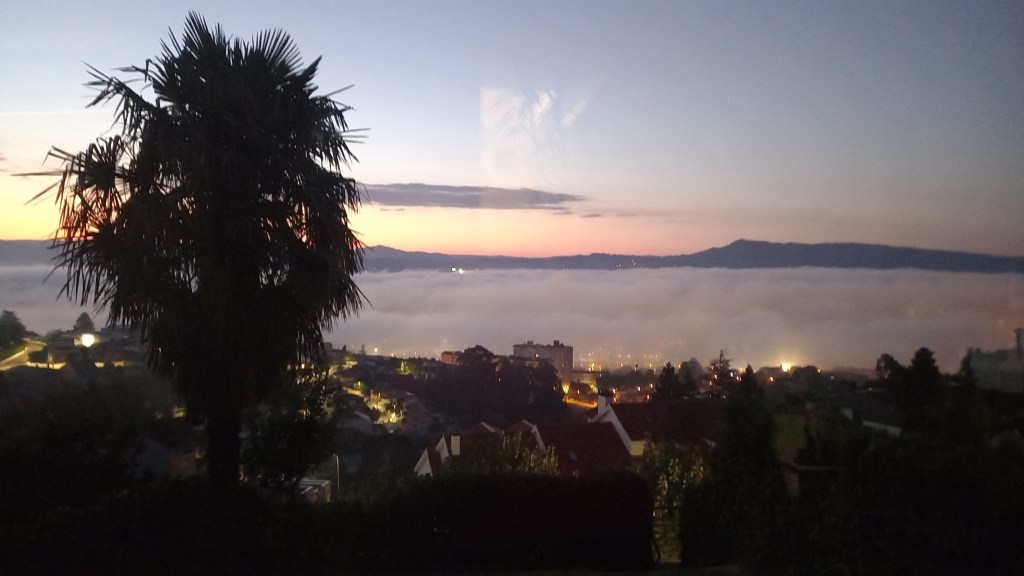
Spanish life is not always likeable but it is compellingly loveable – Christopher Howse: ‘A Pilgrim in Spain.
Cosas de España/Galiza
Over the last two decades, the wealth of Spanish households has grown significantly, but in a highly uneven manner. . . However, this progress has been concentrated in the highest percentiles: the richest 1% today accumulates over 21% of the total wealth, compared to 13% in 2002 . . . a deep generational fracture: cohorts born between 1956 and 1975 (end of the baby boom and early Generation X) have consolidated high levels of wealth thanks to a context of stable employment, accessible credit, and strong real estate appreciation. In contrast, Millennials (born after 1986) accumulate less wealth than previous generations at the same age, face greater barriers to housing access, and have a homeownership rate of less than 40%.
It’s against this background that the young have lost faith in democratic parties responsible for this and turned towards the charlatans of far-right parties who make false promises to help them by reversing this situation.
The EU says it will defend Spain against any action taken by Trump because Spain won’t agree to moving to 5% of GDP for defence spending. I’m not sure I know how they’ll do this.
Reader and blogger María has posted this linguistic map of Spain. Of it, she writes: This map is for those who think in Spain we only speak Spanish. This is a breakdown of different languages and dialects of those languages. There are further distinctions which are not shown here, especially of vocabulary and pronunciation. For example, I live in the area of Western Galician. But I pronounce the soft C’s like an S, just like most people along the coast northward, but not very far inland in the same section. Also, around the area of Vigo, on the south coast of our language section, people will use “mirar” (look) instead of “ver” (see).

The Camino: The theory most frequently advanced for Compostela bit of Santiago de Compostela, is that originated in the Campus Stellae (“field of stars”) legend. But the more scholarly theory is that it comes from the Vulgar Latin expression composita tella, which means “well-arranged land”. This phrase seems to have been used as a euphemism for a cemetery or burial site, describing an area where the dead were laid “in order” rather than burned. This fits well with archaeological evidence that the site of Compostela was once a Roman necropolis (cemetery) before the Christian shrine of Saint James was founded there. I’m not sure I knew this before a Galician friend told me last night.
Which reminds me . . . You can read a chap called Rodrigo Cota on Galician myths and legends among his articles here. There’s quite a lot of them.
ALICE IN MAGAWORLD
Inside The Racist Republican Group Chat – The latest episode of the podcast The Rest is Politics: US. It addresses the questions: Are political norms ever coming back? What was inside the leaked Young Republican group chat? Could a Supreme Court ruling reshape the political map in favour of the Republicans?[Spoiler: The answer is Yes, significantly. Unless . . .]
Given how often the current president of the USA insults and humiliates European leaders, it’s not hard to envisage global loyalties changing, to the ultimate disbenefit of the USA. Not that Trump will give a jot about that, so long as he can play the big man and, along the way, pocket obscene sums of money.
Gaza:
This is an interesting podcast, featuring the views of an Palestinian-American entrepreneur based in Ramallah. The upfront views of the presenter probably won’t be shared by the majority of folk with opinions on Gaza. But this, of itself, doesn’t mean they’re wrong, of course.
Spanish
- Bravuconada: Bravado.
- Masoca: Masochist.
- Viruta: Chi, shaving. Wool.
- Miedoso: Fearful
English
Having seen spelt in a British paper, I looked into the subject of alternative past participles and got this: Several verbs have 2 accepted past participles, often reflecting a difference between British and American usage. Some verbs can be either regular (with “-ed”) or irregular (with vowel or consonant changes). Below are the main verbs with alternative past participles according to standard grammar sources.
| Verb | Past Participles | |
| spell | spelled/spelt | Spelled is preferred in American English; both forms are common in British English . |
| learn | learned/learnt | Learnt is traditional in British English learned dominates in American English. |
| burn | burned/burnt | Burned is more common in the U.S burnt appears in idioms (“burnt toast”) . |
| dream | dreamed/dreamt | Dreamt (pronounced/drɛmt/) is more British dreamed more American. |
| smell | smelled/smelt | Smelt often used in British English smelled in American . |
| spoil | spoiled/spoilt | Spoilt usually describes figurative use (“spoilt child”); spoiled for literal past. |
| kneel | kneeled/knelt | Both accepted; knelt is slightly older and more literary. |
| lean | leaned/leant | Leant is British; leaned is general or American. |
| light | lighted/lit | Both correct; lit more frequent in “lit up,” lighted in formal or older usage. |
| gild | gilded/gilt | Gilt is rare today except in “gilt-edged.” |
| get | got/gotten | Gotten is American, used for possessive or completed actions (“He has gotten better”) . |
| shave | shaved/shaven | Shaven only used adjectivally (“clean-shaven”); otherwise shaved. |
| show | showed/shown | Shown is used for completed passive participles showed occasionally in dialect. |
| hang | hung/hanged | Hanged only for execution context (“He was hanged”) hung for objects . |
| mow | mowed/mown | Mown traditional mowed now more common. |
Notes on Variation
- In general, -t participles (spelt, learnt, burnt) are older and more British, while -ed forms are newer and more American.
- Both forms are correct in modern standard English unless used in fixed expressions. For example: The lights were lit (idiomatic), but He lighted the candle (less common).
Did you know?
People living in close proximity to their relatives are more likely to support the death penalty.
Finally . . .
When I looked up the word Bravuconada(Masochist), I got a warning saying the definition and examples might offend me. And I was asked if I wanted to proceed. What a world.
My thanks to those readers who take the trouble to Like my posts.
The Usual Links . . .
You can get my posts by email as soon as they’re published. With the added bonus that they’ll contain the typos I’ll discover later. I believe there’s a box for this at the bottom of each post. If you do this but don’t read the posts, I will delete your subscription. So perhaps don’t bother if you have other reasons for subscribing . . .
I can also be read on Facebook.
For new readers: If you’ve landed here looking for info on Galicia or Pontevedra, try here. If you’re passing through Pontevedra on the Camino, you’ll find a guide to the city.
If you´re thinking of moving to Spain, this link should be useful to you.
 Thoughts from Pontevedra, Galicia, Spain
Buen artículo.
LikeLike