Awake, for morning in the bowl of night has flung the stone that puts
the stars to flight.
And, lo, the hunter of the east has caught the sultan’s turret in a noose of light.

Spanish life is not always likeable but it is compellingly loveable – Christopher Howse: ‘A Pilgrim in Spain.
Cosas de España/Galiza
Depressing news . . .. Visitors to Galicia rose by an astonishing 44% between January and June this year, compared with the same period of 2024. The Camino pull factor (el tirón) is surely significant.
A propos . . . HT and thanks to Lenox Napier of Business Over Tapas for this article on the awful decline of Santiago de Compostela, with which I agree 100%, having seen it happen over much the same period as the writer has. The article’s in Spanish but there’s a Google translation below.
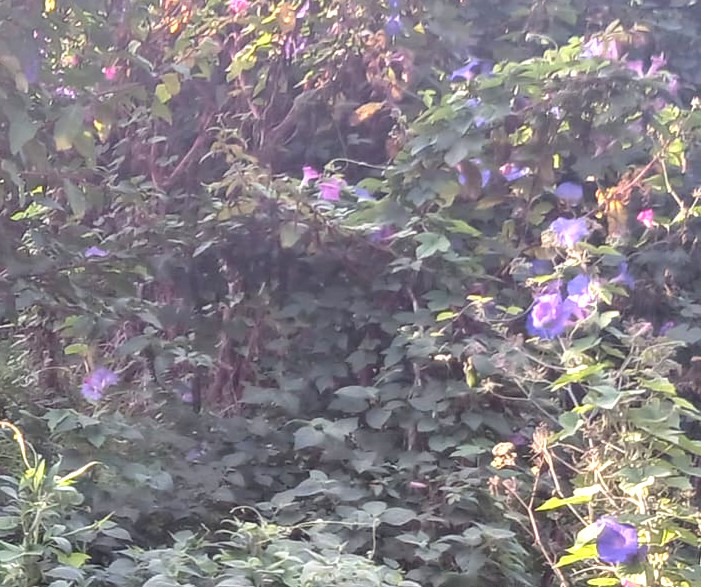
Our weather continues to be hot and rainless, thoroughly confusing Mother Nature. María points out that the gorse thinks it’s spring; and I’ve seen both heather and my bougainvillea acting likewise, in full bloom. I also noticed this proliferating trumpet vine – an invasive weed – on an plot near my house this morning.
I saw that you can now book a Japanese-style pod in London for 30 quid a night and decided to see if Madrid offers these – for when my daughter tells me she’s stressed out by having me in her flat, as I get up too early and am ‘noisy’ when I make coffee. It certainly does, with a price of €40 for tonight but 50% more in early November. I suspected ‘dynamic pricing’ but it might be that there’s a public holiday on the date I chose.
Talking of places in which to stay, I see that Pv heads the Galician list of illegal tourist flats.
Europe: France

ALICE IN MAGAWORLD
Trump forgot that he was president on the day of the attack on the Capitol – seen by some as incontrovertible evidence of his mental decline.
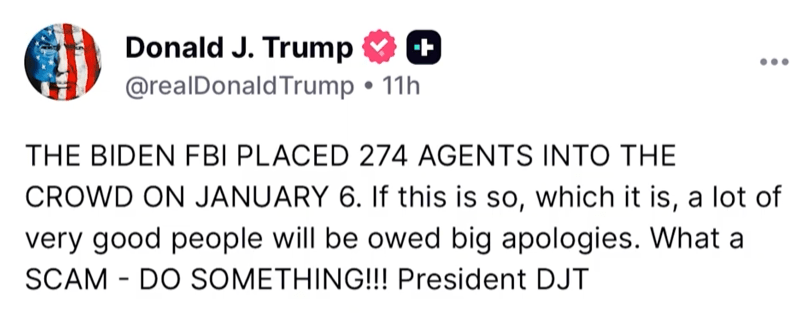
The next autocracy step? Vance confirms that the Trump administration is considering ways to invoke emergency powers, including utilising the Insurrection Act of 1807.
Unsurprisingly, the folk on The Rest is Politics USA ask: Is Trump destroying US democracy – in a video here and a podcast here. On the latter, avoid the initial ads by starting at minute 3.
In the light of Trump and the Evangelical Christians, another parallel . . . The German Evangelical Church seemed to the Nazis to offer an almost ideal vehicle for the religious unification of the German people. And also as a vehicle for Nazi philosophy, of course.
I mentioned Marxism the other day. In the USA, right-of-centre politicians like the Republican Speaker love to accuse anyone to the left of them of being ardent/lunatic supporters of this. In contrast, one rarely hears the word levelled at opponents in, eg, the UK. But, then Americans are terrified of `socialism’, apparently not recognising that they actually live in a social democratic state.
Quote of the Day
J D Vance: Chicago has been given over to lawlessness and gangs and has a murder rate that rivals the worst places in the 3rd world. [In fact, violent crime are reported to have been falling at an unprecedented rate in Chicago over the past 2 years. And it isn’t in the top 4 large US cities with the highest murder rates – all of which are in Republican-controlled states.]
The Way of the World
- A cautionary tale . . . Dating app fatigue is nothing new; for all its promise of convenience and unlimited choices, the gamified nature of finding love in the app age has, over the years, left many users feeling disposable. And, as AI becomes an ever more present feature of modern life – embedded into everything from healthcare systems to online grocery shopping – and it’s adding yet another layer of digital artifice to the search for love.
- For every story published in the legacy media, dozens are spiked. And with the media concentrating their shrinking resources on fewer stories, the breadth of coverage has not only been shrinking, the rate at which coverage is contracting seems to be accelerating. This happens especially when there’s obsessive coverage of a high-profile issue such as Gaza, while space (and time) is increasingly devoted to soft-focus human-interest stories, plus the torrent of click-bait trivia and celeb worship.
Spanish
- Correoso: Leathery, chewy sinewy. Tough (of a football match)
- Manda las huevos: An exclamation of surprise or anger.
- El coliving: Guess
- El cohousing: Ditto
- El build to rent: Ditto
- El senior living: Ditto
English
Situationship: A romantic connection that exists in a gray area, neither strictly platonic nor officially a committed relationship.
Did you know?
- English collective nouns. (I wonder what the collective noun is for a list of collective nones).
- Teaching English . . . I asked an AI engine what the difference is between ESL (English as a Second Language) and TEFL (Teaching English as a Foreign Language) and got an answer which stressed the residence of pupils: ESL focuses on students who learn English to function in daily life within an English-speaking society, where English is all around them. TEFL relates to teaching English to students in countries where English is not used daily.
You Have to Laugh
Is this a new marketing fashion, asks a columnist? Is inane sustainability tat an inevitable stage of our civilisation?
- Shower cap: Live a greener life.
- Sports socks: Follow your heart.
- Lithium ion batteries: Discover a land of tradition.
- Coffee machine: Tackling climate change from cup to farm with innovative efforts.
Finally . . . The article cited above.
I’m leaving Santiago de Compostela (and not because of the rain)
I came from Barcelona almost 32 years ago. For love. Not for the city, although I ended up loving it too, but for a person. I left the Mediterranean sun for perpetual rain, the bustle for stony silence, and the familiar for the unknown. And for years, many years, I thought it had been the best decision of my life.
Now I’m leaving. And I’m leaving disenchanted.
I’m not leaving Galicia, but I am leaving this city I no longer recognize. This Santiago that has sold itself to the highest bidder, that has sacrificed its soul on the altar of mass tourism and real estate speculation. I’m leaving because after more than two decades here, I feel the city is expelling me with the same indifference with which it now treats its residents.
The city we lost
Gentrification and touristification aren’t abstract words when you experience them first-hand. They’re the neighborhood bar that closes to become a souvenir shop. These are the lifelong residents who are leaving because they can no longer afford the rent. It’s the streets of the historic center turned into a theme park for pilgrims in a hurry and for selfie-taking tourists.
Santiago has become a postcard, a stage set. And those of us who lived here have gone from being citizens to annoying extras in the staging of a World Heritage city that is now only meant to be consumed, not inhabited.
Where has the Santiago of long conversations in bars, of wines at the Franco, of lively food markets, of neighborhoods with their own identity? They’ve buried it under layers of paint for touristy facades and invasive terraces. Of illegal Airbnb apartments. Of rudeness and incivility.
Political failure (with one exception)
And municipal management… I’m not going to be hypocritical: it has been disastrous. With a few honorable exceptions. Xerardo Estévez was, without a doubt, the best mayor this city has ever had. The only one who understood that Santiago needed to modernize without losing its essence, that progress is not at odds with memory, and that a city is, above all, its people.
The rest has been a succession of mediocrities, short-term decisions, and policies that prioritized immediate profit over the long-term city project. They have allowed Santiago to become hostage to private interests, the historic center to be emptied of authentic life, and the outlying neighborhoods to be abandoned to their fate.
They have managed Santiago as if it were a business, not as if it were a home for thousands of people.
The real power: the lobbies that rule
But let’s be honest: municipal politicians have not been alone in this disaster. Behind every calamitous urban planning decision, every ordinance that prioritizes business over coexistence, are the lobbies. And most especially, the hospitality industry.
The hospitality industry has hijacked Santiago. It has managed to force the city to think exclusively from the perspective of the terrace, of consumption, of the tourist who arrives, spends, and leaves. They have turned public space into an extension of their private businesses, filled the streets with noise and garbage, and have pressured everyone to see any minimal regulation as an attack on the local economy.
Pedestrianization? Only if it benefits bars. Reasonable hours? Impossible; it harms the sector. Protection of local businesses from tourist franchises? No way. The result is a city held hostage by a few who have confused private interests with the common good, and politicians too weak or too complicit to stand up to them. Tourist taxes? They have tried to prevent them by land, sea, and air. Is it possible that France is wrong to apply tourist taxes?
And in this alliance of money, we cannot forget the Archbishopric. That shadowy power that manages an immense heritage and coexists perfectly with the tourism and hospitality industry. After all, both live off the same thing: the exploitation of the Camino, the commercialization of spirituality, and the transformation of Santiago into a consumer product.
The Church controls much of the land and buildings in the historic center, but when has it ever spoken out against the city’s degradation? When has it ever defended residents against speculation? Never. Because the model suits them. Pilgrims who spend, tourists who consume, hostels and souvenir shops in church buildings. A perfect symbiosis between the cross and business, while Santiago bleeds dry.
Memorable Places
I take with me Quintana de Mortos. That square where time seems to stand still, where the stone tells stories of centuries, and where I’ve spent hours watching the light change on those stones. I take with me the endless afternoons in Bonaval Park, that space that is simultaneously cemetery and garden, death and life intertwined, the most honest place in the entire city.
Those spaces gave me what municipal management never knew how to give: a sense of belonging, a place to be myself, where the city spoke in a low voice and I had to know how to listen.
What I leave behind and what I take with me
I leave with anger and indifference, yes. But also with gratitude for the good years, for the friendships that remain, for everything I learned in this city of rain and stone. Santiago didn’t give me much, but there comes a time when you have to know when to leave.
I’m not leaving Galicia because my life, my family, my people, my roots of the last 32 years are still here. But I’m leaving Santiago because I can no longer watch them continue to destroy what little remains of the city I once loved.
To those who stay, to those who resist: don’t let them defeat you. Keep fighting for a Santiago that becomes a city again and no longer a business. Reclaim the neighborhoods, the squares, the streets. May the memory of what was give you the strength to build what can be.
I’m leaving. But I’m taking with me the real Santiago, the one I knew, the one I lived. No one can take that away from me.
Santiago de Compostela. A place where everything changes so everything stays the same. I hope and pray that one day this saying will no longer be a reality.
My thanks to those readers who take the trouble to Like my posts.
The Usual Links . . .
You can get my posts by email as soon as they’re published. With the added bonus that they’ll contain the typos I’ll discover later. I believe there’s a box for this at the bottom of each post. If you do this but don’t read the posts, I will delete your subscription. So perhaps don’t bother if you have other reasons for subscribing . . .
I can also be read on Facebook.
For new readers: If you’ve landed here looking for info on Galicia or Pontevedra, try here. If you’re passing through Pontevedra on the Camino, you’ll find a guide to the city.
If you´re thinking of moving to Spain, this link should be useful to you.
 Thoughts from Pontevedra, Galicia, Spain
Espero que no tengas que ir a una cápsula de esas, no creo que molestes tanto a ti hija.
Con respecto EE. UU, vuando oigo hablar del comunismo, allí, me da risa, es un país con un capitalismo salvaje donde ni siquiera hay una cobertura sanitaria pública medio normal, von los reporta ges que veo cada día de allí,tampoco veo que na socialdemocracia, porque habría una mayor igualdad y no tanta desigualdad, es el país del dinero.
Con respecto a Santiago, rs cierto que ya no es esa ciudad universitaria con los paseos por El Franco, y otras calles cercanas a La Catedral, ya masificada pero que hoy, por el negocio religioso y hostelero es agobiante. Faltan cosas que antes estaban como El Hospital general de Galicia donde algunos hemos estudiado ,sustituído por El Clínico que queda alejado de la ciudad, lo más bonito es La plaza del Obradoiro, La Catedral y la preciosa facultad de Medicina. También La Alameda es bonita y la calle donde yo he vivido, General Pardiñas, es grande céntrica y con buenos edificios. La Plaza de Galicia sigue igual y otras zonas que ahora no sé como están porque hace tiempo que no voy a Santiago. En las afueras hay mucho monte , zona arbolada y en algunos sitios bonitas casas pero el mar queda un poco lejos y eso resta.
Me cuesta entender que alguien de Barcelona se pueda venir y quedar en Galicia, sobre todo en ciudades interiores pero es comprensible cuando es por amor, como el caso que aquí se menciona. Siento que después de buenos años, se sienta a disgusto y se marche con pena, supongo.
LikeLike