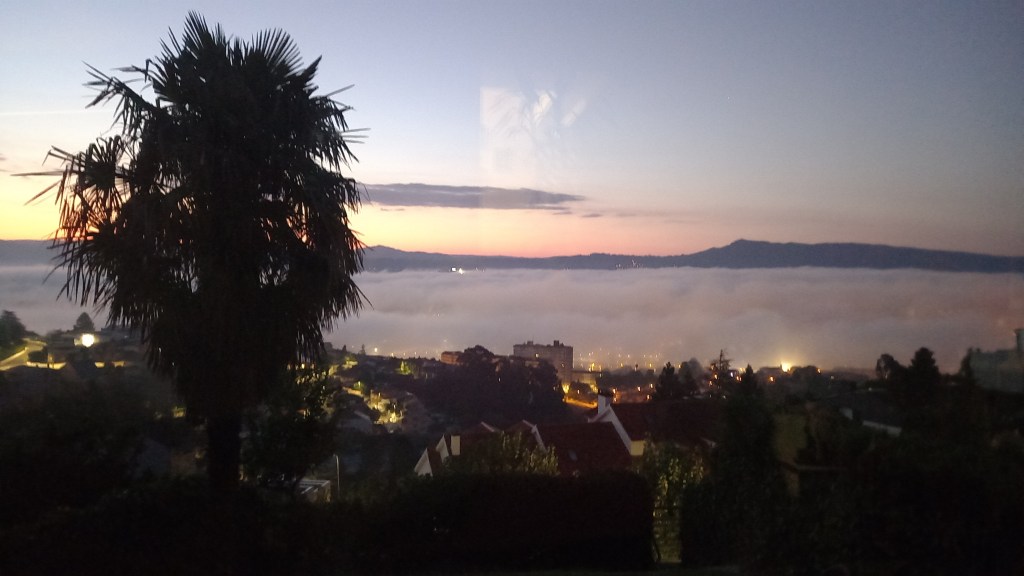
Awake, for morning in the bowl of night has flung the stone that puts
the stars to flight.
And, lo, the hunter of the east has caught the sultan’s turret in a noose of light
Spanish life is not always likeable but it is compellingly loveable – Christopher Howse: ‘A Pilgrim in Spain.
Cosas de España
The current construction and real estate boom reflects growing confidence in Spain’s property market after years of uncertainty.
The proposed law on smoking outdoors . . .
- Oddly . . . Absent are requirements for plain packaging on tobacco products, a measure already adopted by 25 nations.
- It might cost Spain the business of some of those tourists who’ve appreciated the availability of duty-free tobacco products and lower cigarette prices.
Cousas de Galiza
Not a lot of foreigners purchase property in Pontevedra province, and the surprising news is that these are now led by US folk. Stats tomorrow.
Portugal
Good to see that Portugal has finally got round to criminalising the sort of semi-rigid speedboats used by Galicia-based narcos. Seven years after Spain did. Possibly because they were being made in Portugal. And money talks.
Europe
Bit of a surprise . . . Germans have an even larger ‘footprint’ in Spain than Brits.
THE USA
1. The economy
I was reminded by this FB post that all autocratic leaders know little about economics. And that the wiser ones leave the management of their economy to experts, while others – eg Franco and Trump – manage it themselves on the basis of crazy notions of their own. In Trump’s case, the damage done will extend for years and will be global.
The New York Times characterises Trump here as a meddling socialist who is intervening in the American economy on a whim, as if it were an extension of his family business, to the detriment of us all. Bottom line: Trump evidently believes that his haphazard, self-centered approach to policy makes him look tough and decisive. In reality, it introduces more chaos to our economy, including to an industry at the center of 21st-century life.
In the Trump asylum, no inmate seems to be more insane than the Commerce Secretary Howard Lutnick, who claims that the Trump economy will begin next year. Meaning we’re supposed to believe that this year’s setbacks are all down to Biden. But I guess the MAGA faithful will swallow this.
2. Society
HT to Lenox Napier for this article: The Martyrdom of Charlie Kirk. Martyrs are used by messianic movements to sanctify violence. To show any mercy or understanding toward the enemy is to betray the martyr and the cause the martyr died defending.
Shootings are now a feature of polarised America . . Targeted killings have been part of US political life for generations but political violence has become a growing feature in recent years, alongside the country’s deepening polarisation and lax gun laws. . . The fear now will be that, in a country all too accustomed to violent episodes puncturing political life, Kirk’s killing will fuel another darker turn rather than soul-searching, or a de-escalation of the political rhetoric of recent years.
America is gripped by political violence – and Trump’s vitriol is part of it. As someone summarised his TV message: Fellow Americans, we must come together to destroy each other.
For what it’s worth, here’s my conspiracy theory . . . As the only person helped by Kirk’s murder. it’s Putin who was behind it.
By the way, there was another school shooting this week, the 100th this year.
No wonder so many Americans are self-exiling themselves.
3. The USA and NAZI Germany
At the end of this post is is a longish list of quotations taken from Richard Evans’ book The Coming of the Third Reich: How the Nazis Destroyed Democracy and Seized Power in Germany . It is meant to show the Nazis’ direction of travel in 1933 and to draw more suggested parallels with Trump’s quest for autocratic power in the USA. This can be taken too far, of course. As I’ve said, Trump is no Hitler and the Republicans are not Nazis. But they certainly seem to be people on a quest for undemocratic, autocratic power. At least to some of us. These selected quotations should give some food for thought and, as a Preface to them, I offer these 3 statements:
- By the author: It is in the nature of democratic institutions that they presuppose at least a minimal willingness to abide by the rules of democratic politics. Democracies that are under threat of destruction face the impossible dilemma of either yielding to that threat by insisting on preserving the democratic niceties, or violating their own principles by curtailing democratic rights
- By Joseph Goebbels: The stupidity of democracy. It will always remain one of democracy’s best jokes that it provided its deadly enemies with the means by which it was destroyed.
- By the South American philosopher George Santayana: Those who cannot remember the past are condemned to repeat it.
The Way of the World
Pessimism is rife worldwide. But is it justified?
Net Zero
The man has a point . . . A fantastic exercise in continental hypocrisy.
AI
Now we need to worry about AI-driven agentic browsers . . .
Spanish
- Gatillo: Trigger
- Perla: Bead
As you might have guessed, Preumir yesterday should have been Presumir. [Happily, I managed to restore my spellcheck this morning]
Finally . . .
THE NAZIS’ RISE TO POWER AND THE DESTRUCTION OF DEMOCRACY
- The widespread intimidation of the population provided the essential precondition for a process that was in train all over Germany in the period from February to July 1933: the process, as the Nazis called it, of ‘co-ordination’, or to use the more evocative German term, Gleichschaltung, a metaphor drawn from the world of electricity, meaning that all the switches were being put onto the same circuit, as it were, so that they could all be activated by throwing a single master switch at the centre.
- Almost every aspect of political, social and associational life was affected, at every level from the nation to the village. The Nazi takeover of the federated states provided a key component in this process.
- Just as important was the ‘co-ordination’ of the civil service, whose implementation from February 1933 onwards had put such powerful pressure on the Centre Party to knuckle under. Within a couple of weeks of Hitler’s appointment, new State Secretaries – the top civil service post – had been appointed in a number of ministries. From March onwards, the violence of the stormtroopers was forcing politically unacceptable city officials and local mayors out of office Laws eliminating the autonomy of the federated states and providing for each one to be run by a Reich Commissioner appointed in Berlin meant that there were few obstacles left after the first week of April to the Nazification of the civil service at every level.
- This massive purge was given legal form by the promulgation in April of one of the new regime’s most fundamental decrees, the so-called Law for the Restoration of a Professional Civil Service, which allowed for the dismissal anyone whose previous political activity did not guarantee political reliability. [Think of Trump’s numerous sackings]
- There was a massive and wide-ranging purge of social institutions. Pressure-groups and associations of all kinds were quickly brought into line.
- Big business was not too worried. Hitler had gone out of his way to reassure its representatives that he was not going to interfere with their property and their profits. With the trade unions smashed, socialism off the agenda in any form, and new arms and munitions contracts already looming over the horizon, big business could feel satisfied that the concessions it had made to the new regime had made to the regime were largely worth it. [Think Tech Bros and tax reductions].
- The scale and scope of the co-ordination of society were breathtaking. And their purpose was not simply to eliminate any space in which opposition could develop. The new regime wanted to make Germany amenable to indoctrination and re-education according to the principles of National Socialism.
- Why had Germany fallen into the hands of the Nazis with such apparent ease? The simplest, and, if you looked deeper, nearly always the most basic reason was fear. [Think of Trump’s threats against members of his own party to `Primary’ them.]
- Disorder was fomented by the Nazis themselves, a neat illustration of the dialectic that drove the seizure of power onward from both above and below.
- The government’, Hitler declared, ‘will embark upon a systematic campaign to restore the nation’s moral and material health. The whole educational system, theatre, film, literature, the press, and broadcasting – all these will be used as a means to this end. They will be harnessed to help preserve the eternal values which are part of the integral nature of our people.’ Nazi revolution was not just about eliminating opposition; it was also about transforming German culture. [Think the Kennedy Centre etc,]
- The Catholic Franconian Press was forced to carry a front-page declaration in March 1933 apologizing for having printed lies about Hitler and the Nazis. [Think Trump’s legal actions for defamation and the constant allegations of fake news.]
- It has been estimated that around 2,000 people active in the arts emigrated from Germany after 1933. They included many of the most brilliant, internationally famous artists and writers of their day.
- The damage done to German cultural life was enormous. Scarcely a writer of international stature remained, hardly an artist or painter. A whole galaxy of leading conductors and musicians had been forced to leave, and some of Germany’s most talented film directors had gone.
- The Nazi leadership had a relatively easy time with the universities because these were all state-funded institutions and university staff were civil servants. [Think Harvard and Columbia]
- Hitler: ¨From now on it is not up to you to decide whether or not something is true, but whether it is in the interests of the National Socialist Revolution¨. [Think of Trump’s approach to truth.]
- Hitler openly described the stories of atrocities against Jews as ‘smears’. [Think ‘Fake news’]
- Hitler’s cultural revolution, the key, in the Nazi mind, to the wider cultural transformation of Germany aimed at purging the German spirit of ‘alien’ influences such as communism, Marxism, socialism, liberalism, pacifism, conservatism, artistic experimentation, sexual freedom.
- Crucial to the whole process was the way in which democracy’s enemies exploited the democratic constitution and democratic political culture for their own ends.
- At every point, Hitler and his associates sought a legalistic fig-leaf for their actions.
- Hitler placed so much importance on the post-Reichstag fire Emergency Decree. Article 48 of the Weimar constitution gave the President the power to rule by decree in time of emergency but this had never been intended to be the basis for any more than purely interim measures; the Nazis made it into the basis for a permanent state of emergency that was more fictive than real. [Think Trump’s numerous ‘national emergencies’ and his endless Executive Orders]
- The Nazis did not just violate the spirit of the existing constitution, they also transgressed against it in a technical, legal sense too. At every point in the process, the Nazis violated the law.
- The opposition responded with technicalities. But they were far outdone by the massive, sustained, and wholly illegal violence perpetrated by Nazi stormtroopers on the streets that already began in mid-February. Violence was a central, indispensable part of the Nazi seizure of power [Think ICE]
- Hitler and the Nazis at every level were very much aware that they were breaking the law. Their contempt for the law, and for formal processes of justice, was palpable, and made plain.
My thanks to those readers who take the trouble to Like my posts.
The Usual Links . . .
You can get my posts by email as soon as they’re published. With the added bonus that they’ll contain the typos I’ll discover later. I believe there’s a box for this at the bottom of each post. If you do this but don’t read the posts, I will delete your subscription. So perhaps don’t bother if you have other reasons for subscribing . . .
I can also be read on Facebook.
For new readers: If you’ve landed here looking for info on Galicia or Pontevedra, try here. If you’re passing through Pontevedra on the Camino, you’ll find a guide to the city.
If you´re thinking of moving to Spain, this link should be useful to you.
 Thoughts from Pontevedra, Galicia, Spain
Thanks. Thought provoking, therapeutic, and today particular thanks for the forewarning on agentic browsers.
LikeLike
Buen análisis.
La verdad que da mucho miedo, ser optimista rs difícil.
Esa frase del que olvida la historia tiende a repetirla es bastante acertada.
Buen artículo el de los votantes o compradores de otros países en España.
Ya veo que en Galicia compran poco.
Con respecto a precioso hace pocos años, se vendió un ático en Barcelona que era la vivienda más cara de España ( no recuerdo ahora el precio ) sólo se supo que el comprador fue un británico.
A Gerona llevan yendo tantos años los holandeses, los franceses y también los británicos,.que conocen esa provincia mejor que muchos españoles.
LikeLike