Awake, for morning in the bowl of night has flung the stone that puts
the stars to flight.
And, lo, the hunter of the east has caught the sultan’s turret in a noose of light.

Spanish life is not always likeable but it is compellingly loveable – Christopher Howse: ‘A Pilgrim in Spain.
Brussels is demanding that the government do more about corruption here. Which is hardly surprising.
Unrelatedly, Brussels is withholding cash from Madrid because reform of the tax system has been inadequate.
Mark Stücklin of Spanish Property Insight cites someone who claims that the worst is yet to come in the property rental market.
You might have wondered why I wrote yesterday that a judge has made accusations against a couple of politicos, rather than the police. This is because the Spanish judicial system is very different from the Anglo system. See this point from the primer at the end of this post: Spanish judges have an investigative role in criminal matters: they actively gather evidence, question witnesses, and control the preliminary investigation (“Diligencias Previas”). In contrast, British judges act more as impartial arbiters in an adversarial system: they oversee proceedings, test evidence presented by the parties, but do not investigate.
A couple of other points . .
- In Spain, you can become a judge through study and examination. This doesn’t happen in the UK, where judges are appointed after a career as a lawyer.
- For one reason and another, lawyers don’t have the status (and income) they have in the Anglo world.
- As you might expect, the mark you need to get in a pre-university exam to study for a law degree is a lot lower here than in, say, the UK.
Cousas de Galicia
The J Lo concert went off well last night, I’m told. I certainly heard it – though rather indistinctly – between 9.30 and 11.30 and I could see the stage from my eyrie – the red dot here. . . Better with my high-quality binocs . . .

Sadly, even brighter was a fire which destroyed an entire building in the centre of the city not long after the concert ended.
France and the UK
Things have changed significantly, claims AEP here.
MAGALand
Trump’s (constantly repeated) biggest lie of the moment: Billions of dollars are coming INTO our country. [They come, of course, from American importers and so are already in the USA]
Another day, another clutterfuck . . .Trump threatens to escalate the trade war amid confusion over new tariff rates. The US president announces tariffs of up to 200% on foreign drugs and 50% on copper, as he continues to shift plans.
That tariff letter to Japan . . . It’s a confusing grammatical nightmare but his fans don’t care.
This is a foto of Trump’s occasional reality TV show Love Cabinet.

Have you ever seen a more unimpressive line-up of contestants?
I’m not sure if it’s Netanyahu who’s nominated Trump for a Nobel Peace Prize or the other way round. Either way, you’d have to be away with the fairies to think it will happen. As many in the MAGAsphere are, I guess.
Quote of the Day
Trump is the stupidest president, assisted by a stupid White House Press Corps. Not to mention the most ridiculous Cabinet ‘accessories’.
Spanish
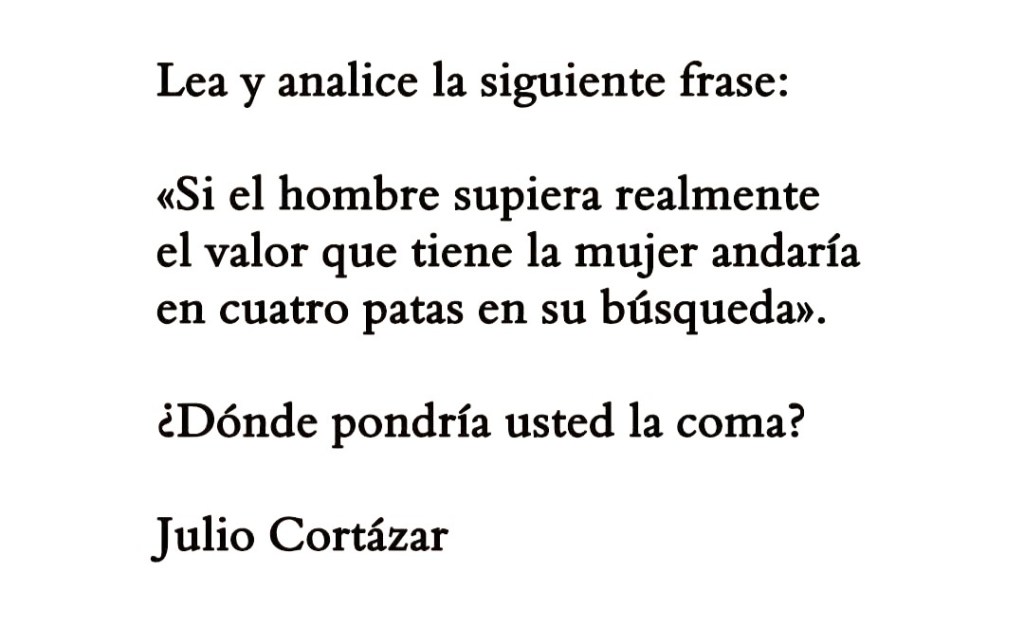
For Spanish sentences – because of an absence of pronouns and the fact that su means both his and hers – the punctuation can be even more important than in other languages. Here’s an example kindly provided by a reader:-
English
Clutterfuck: Acomplex and utterly disordered and mismanaged situation: a muddled mess.
The famous English example of the importance of a strategic comma, assisted by a couple of homonyms . . .
- Eats shoots and leaves
- Eats, shoots and leaves.
Finally . . . You Have to Laugh

The British and Spanish systems of justice differ fundamentally in their legal traditions, court procedures, and the roles of legal professionals.
1. Legal Tradition and Sources of Law
Britain (specifically England and Wales) uses a common law system where laws evolve through judicial decisions and precedents, alongside statutes. Judicial interpretation and previous rulings (case law) are central.
Spain operates under a civil law system derived from the Roman-Germanic tradition, heavily reliant on comprehensive legal codes and statutes. Judges interpret and apply these codes.
2. Court Procedures and Pleadings
In the UK, pleadings are shorter and less detailed initially, with a “skeleton argument” outlining only the main points. Evidence and full arguments are developed later in the process.
In Spain, initial court documents (demanda) must contain a full argument, all facts, evidence, and legal basis from the outset. The process is more formal and front-loaded.
3. Role of the Judge
British judges act more as impartial arbiters in an adversarial system: they oversee proceedings, test evidence presented by the parties, but do not investigate.
Spanish judges have an investigative role in criminal matters: they actively gather evidence, question witnesses, and control the preliminary investigation (“Diligencias Previas”).
4. Jury System
In the UK, juries (in criminal cases) decide both on the facts and the legal verdict (guilty or not guilty).
In Spain, juries are rare and, when used, only decide on the facts (guilt or innocence regarding the facts), while the judge determines the legal classification and sentence.
5. Representation
In the UK, individuals can represent themselves in civil and family cases, and legal representation is not mandatory.
In Spain, parties generally must be represented by both an abogado (lawyer) and a procurador (court representative) in most proceedings, except minor criminal cases. Self-representation is not allowed in most cases.
6. Court Costs
UK courts have long charged fees for civil and family cases, though typically not as high as in Spain.
Spain recently introduced court fees for civil and family proceedings, calculated partly as a percentage of the claim’s value.
7. Criminal Justice and Youth Justice
The age of criminal responsibility is higher in Spain (14) than in England and Wales (10). Spanish youth sentences are capped by age, while the UK allows longer sentences for minors.
8. Property and Inheritance Laws
UK law allows more flexibility in property ownership and inheritance, with fewer mandatory shares.
Spain has strict rules (e.g., “legítima”) requiring a portion of an estate to go to children, limiting testamentary freedom.
My thanks to those readers who take the trouble to Like my posts.
The Usual Links . . .
You can get my posts by email as soon as they’re published. With the added bonus that they’ll contain the typos I’ll discover later. I believe there’s a box for this at the bottom of each post. If you do this but don’t read the posts, I will delete your subscription. So perhaps don’t bother if you have other reasons for subscribing . . .
I can also be read on Facebook at https://www.facebook.com/colin.davies.752861 or on Substack at https://doncolin.substack.com/
For new readers: If you’ve landed here looking for info on Galicia or Pontevedra, try here. If you’re passing through Pontevedra on the Camino, you’ll find a guide to the city there.
For those thinking of moving to Spain:–
- This is an extremely comprehensive and accurate guide to the challenge, written by a Brit who lives in both the North and the South and who’s very involved in helping Camino walkers.
- This post of mine contains several relevant articles from ThinkSpain.
- This article ‘debunks claims re wealth and residency taxes’. Probably only relevant if you’re a HNWI. In which case, you’ll surely know what that stands for.
- Getting a mortgage in Spain: Some advice on this challenge.
- Buying a property ‘off-plan’.
- A comparison of UK and Spanish living costs.
- And here’s a personal guide to moving to Spain – to work, not to retire.
- What to do if your visa application is rejected
- Finally, from a tax lawyer: Everything you need to know about taxes and healthcare when retiring to Spain.
 Thoughts from Pontevedra, Galicia, Spain
Como bien dices, el derecho anglosajón es diferente que el romano, que en España concretamente. Para acceder a ser juez en UK hay que tener una carrera de abogado, en España es por oposición, excepto algunos del tercer o cuarto turno.
Hay quien dice que el sistema más justo son las oposiciones.
por otra parte, se exige una nota más alta en UK para acceder a la carrera de derecho que en España, pasa aquí y supongo allí que se exige una nota muy alta para estudiar medicina, por ejemplo, eso no garantiza que vayan a ser mejores profesionales. Por ejemplo, es España tenemos dos casos, uno es Santiago Ramón y Cajal , al que echaban de todos los centros cuando estudiaba bachiller estudió medicina, fue pionero en el sistema nervioso central compartiendo Premio Nobel con un italiano. Otro que fue mal estudiante en el bachiller fue Gregorio Marañon destacando después en su carrera de medicina y en su desarrollo, premiado en Francia, etc…
Ya aparte de esto. Por ejemplo, es mucho más fácil hacer un bachiller en EE.UU que en España, gente que no podía terminarlo, aquí fue a hacerlo allá. Sin embargo, trabajan mucho en investigación… Yo entiendo que hay que hacer una selección para acceder a La Universidad pero pienso que gente que no puede acceder a ciertas carreras podrían ser magnificos profesionales.
LikeLike