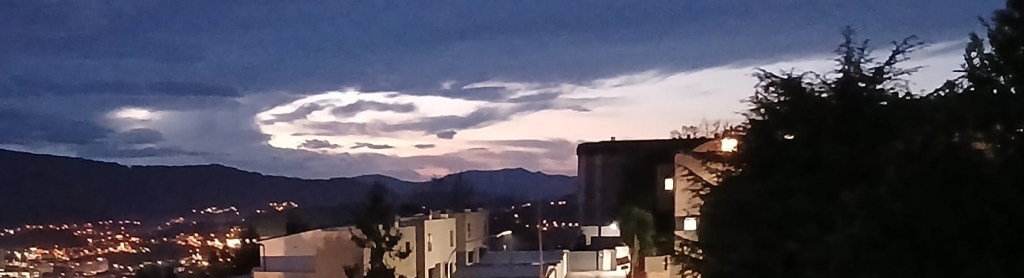
Awake, for morning in the bowl of night has flung the stone that puts
the stars to flight.
And, lo, the hunter of the east has caught the sultan’s turret in a noose of light!
Spanish life is not always likeable but it is compellingly loveable – Christopher Howse: ‘A Pilgrim in Spain.
Travel Notes
Another day, another city, and another temporary bullring . . .
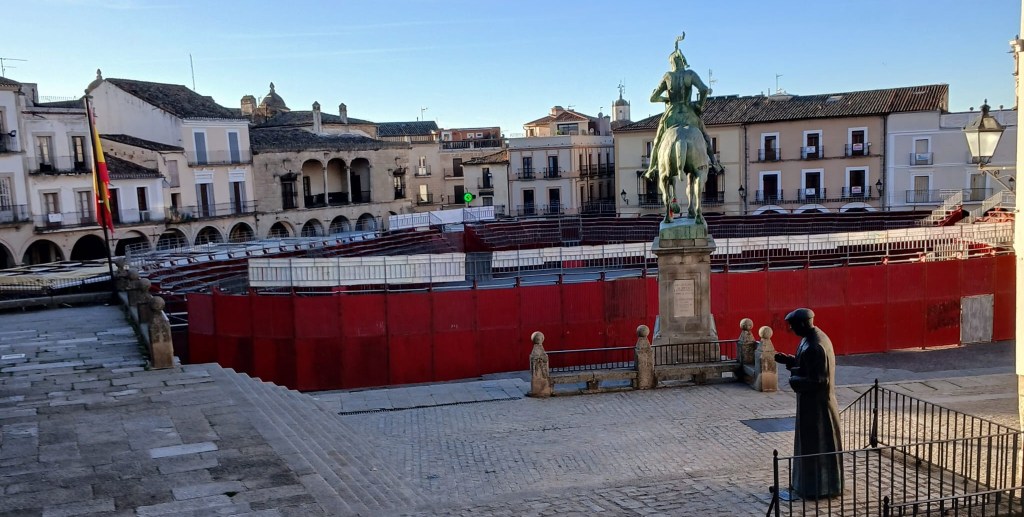
This one in Trujillo. With the corrida scheduled for the coming Saturday, while the one in Ciudad Rodrigo will be on 7 March – I suspect with the same toreadores.
The view from my bedroom window, with the Plaza Mayor and the bullring in the top left corner.
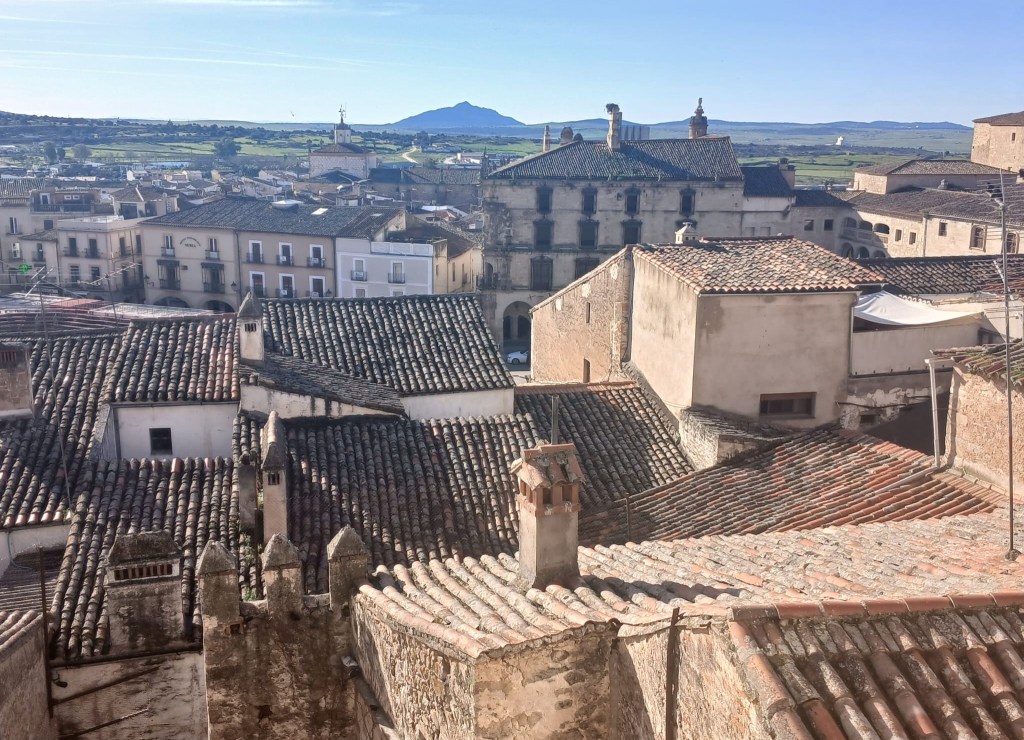
Having see traders’ vans and then a large truck arrive in said Plaza Mayor a few metres from our hotel, I realised that it had been totally unnecessary – and senseless – to be sent by Google to our hotel via the narrow, steep alleys of the Old Quarter. The hotel receptionist obliged me with a map showing both the route of the vans and trucks and, more importantly, our route out of the city.
But, inevitably, getting away from the hotel’s car park and out of the city was via a different route because of the one-way system in operation. This was to be around the outskirts of the oldest part of the city and was scheduled to take 10 minutes – as opposed to 1 minute by foot. But Google naturally screwed up and I found myself facing the prospect of another earth-and-stone track. So, I backtracked, switched off my satnav/GPS and followed my nose. With success.
I’d advise anyone with a hotel in any of Spain’s medieval quarters to do what we did in both Cáceres the other day and Mérida today – get a hotel on the edge of the quarter and either walk in for the sights or drive to a car park there. Better for your blood pressure.
Anyway . . . Considerably less prosaically . . . Here’s a nice account by English travel writer H V Morton of his arrival in Trujillo in 1955: As I approached the hill town of Trujillo, I saw that the ramparts which appeared intact from a distance were crumbling walls, and that the Moorish Alcázar was an empty shell. Steep streets containing many fine renaissance palaces, now in decay, ascend to the upper level of the town. I saw a coalman filling his sacks from a dump in the once splendid entrance to a palace; the delicious smell of new bread led me to another where, by the glow of wood fires, I watched a woman with an iron rake drawing loafs from an oven constructed in a once palatial courtyard. All these palaces had been built with the wealth of Peru. Their foundations were the gold of the Incas and the mortar that binds their stones was blood and luck. Yet how few of the conquistadors made anything out of their adventures. They were killed in battle or they found when the sharing-out time arrived that their portion would hardly buy a new horse or a sword. But the palaces of Trujillo prove that a few, at any rate, managed to get their hands on gold that did not vanish at a touch. The magnificent palaces in the lower part of the town contains a splendid row of mediaeval houses built above stone arches; and on the opposite side [of Plaza Mayor] is the most ornate palace in the town, with a coat-of-arms about two storeys high carved on the facade. Many visitors are told that this was the House of Pizarro but this is not so. He never retired to Trujillo but remained in Peru where he was eventually murdered. As I sipped a glass of manzanilla, I thought that Trujillo, like many a town in the Midlands and the North of England, reflects the wish of the newly-rich to model their lives on those of the nobility. The self-made conquistadors and their descendants used the wealth of Peru to construct palaces which were modelled in every way on the knightly palaces of Spain, just as rich brassfounders and others during the Industrial Revolution patterned themselves on the county families of England. We can imagine with what pride the self-made peasants and swineherds of Extremadura returned as rich noblemen to their home towns, and how the presence of a coat-of-arms above the main gate must have seemed to them more miraculous than anything that had happened to them in the Indies.
To say the least, Trujillo is no longer as dilapidated as it was 70 years ago and is very well worth a visit.
Morton also gave us a few words on this chap . . . Francisco Pizarro

Pizarro and his brothers were a brutal crowd – cruel, treacherous and vengeful. The death of Montezuma was a pathetic tragedy for which Cortés was, of course, to blame; but it was not a foul crime like the judicial murder of the Inca. Pizarro invited this monarch to dinner, captured him, slew his unarmed followers, and agreed to release him if he would fill a room with gold. When the Inca had done so, Pizarro sentenced him to be burned to death on a trumped-up charge, and remitted this to strangulation when the poor creature accepted Christianity at the stake – a horrible parody of the Inquisition and surely the foulest act in the history of the New World. These Pizarros and their followers were the first American gangsters and their bloody disputes with each other seem to have set the pattern for all South American revolutions.
But he brought a lot of wealth to Trujillo, so clearly deserved a big statue.
Cosas de España
Morton quotes an English lady be met in Mérida saying: It’s wonderful to find a country where people are not always expecting tips. This is the last country where people are courteous, though Spaniards can also be very rude. They can forget to answer letters; they can be late for appointments or even forget them all together; and they can be very inquisitive; but face to face they are delightful. Some would say things haven’t changed all that much.
Mark Stücklin writes here on Madrid’s crackdown on tourist flats.
And Lenox Napier treats us here to his overview of Spain and Trump.
Trump’s betrayal opens a window of opportunity for the Spanish PM, says Voxpópuli here.
The USA
Introducing an imminent Golden Visa scheme – to be called Golden Card – Trump said:-
- 1. It had never been done before, which would come as a surprise to both Portugal and Spain, who’ve had them for years and are actually phasing them out.
- 2. They would need an investment of 5m dollars in the USA, and
- 3. Yes, Russian oligarchs could well qualify – regardless of the source of the 5m one assumes.
Trump’s latest promotion from the Oval Office is a baseball cap bearing the legend: Trump was right about everything. You really couldn’t make it up,
Meanwhile . . . Economists are starting to worry about a serious Trump recession, says Ambrose Evans-Pritchard here. One commentator even gives the Trump administration only 30 days.
Quote of the Day
Trump is uncannily like his fellow agent of insurrection, Mao Zedong, who also revelled in permanent havoc as a governing method.
The Way of the World
Spanish
- Pecuaria: Livestock
- Estar en la gloria: To be content, happy. “La gloria” was the name given to a medieval subterranean heating system developed in the Meseta Central region. It was a descendant of the Roman hypocaust and was designed to heat rooms using smaller fuels like hay and twigs. The system consisted of an external firebox, ducts under the floor, and a chimney to distribute heat, warming the floors and walls of one or two rooms. And was clearly a comfortable place to relax in. And to be content.
Finally . . .
I sometimes type Sapin instead of Spain but it’s never highlighted by my spellcheck. This is because the word exists, in English as well as in French. In English it’s A fictional kingdom from the game ‘Ace Combat Zero: The Belkan War’. But you probably knew that . .
My thanks to those readers who take the trouble to Like my posts.
The Usual Links . . .
- You can get my posts by email as soon as they’re published. With the added bonus that they’ll contain the typos I’ll discover later. I believe there’s a box for this at the bottom of each post. If you do this but don’t read the posts, I will delete your subscription. So perhaps don’t bother if you have other reasons for subscribing . . .
- For new readers: If you’ve landed here looking for info on Galicia or Pontevedra, try here. If you’re passing through Pontevedra on the Camino, you’ll find a guide to the city there.
- For those thinking of moving to Spain:– This is an extremely comprehensive and accurate guide to the challenge, written by a Brit who lives in both the North and the South and who’s very involved in helping Camino walkers. And this is something on the so-called Beckham Rule, which is beneficial – tax-wise – for folk who want to work here. Finally, some advice on getting a mortgage. And this article ‘debunks claims re wealth and residency taxes’. Probably only relevant if you’re a HNWI. In which case, you’ll surely know what that stands for.
 Thoughts from Pontevedra, Galicia, Spain
Está muy bueno el articulo de ese señor. El Presidente Sánchez , sabe contenerse y sopesar, lleva mucho tiempo lidiando en España contra todo y contra rodos. Es un tipo muy inteligente porque gobernar así es muy difícil, siempre lo es pero así mucho más. Sí, apoya a Ucrania y junto a los otros países de Europa verán que hacer.
Cuando consiguió la excepción Iberica , se levantó de una reunión en Bruselas y la consiguió.
No tardaré mucho en tener un encuentro con él, además de saludarlo, tengo preguntas para hacerle. Y otras cosas.
LikeLike