Awake, for morning in the bowl of night has flung the stone that puts
the stars to flight.
And, lo, the hunter of the east has caught the sultan’s turret in a noose of light!
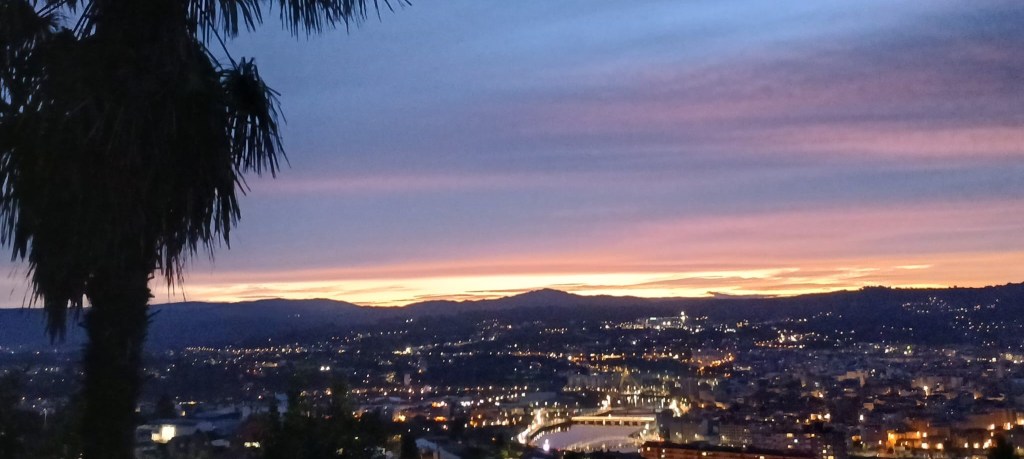
Spanish life is not always likeable but it is compellingly loveable – Christopher Howse: ‘A Pilgrim in Spain.
Cosas de España
The estimable Mark Stüklin brings us 2 bits of advice:-
- An overview of the Spanish Visa system.
- Why you might be able to get a mortgage refund.
And here the Bank of Spain give advice on the use of bank cards.
Conscious that it’s very rare for me to be invited to the home of Spaniards who’ve dined in mine, I raised this issue with an Irish friend who’s married to a Gallego’, with whom she frequently socialises with Spanish friends. “Do you ever dine in their homes?”, I asked her. Almost never she replied. “It’s always in a bar or restaurant”. So, not a Spanish thing, then. For one reason and another.
What very much is a Spanish thing is Goodbyes that take 20–30 minutes. I recall my very first one many years ago when I stood in the cold, wondering what it was all about. I don’t do that any more. After dinner with Spanish friends last night, I wished them all season greetings outside the tapas bar and promptly left them to it.
Reader David in La Coruña tells me that his favourite turrón bar this Xmas is 40% up on last year. I love the stuff but wait patiently for a local supermarket which has overstocked to reduced the price of a packet from €4.50 – or possibly 6.50 this year – to only a euro, or even 50 centimos. Mind you, the progress downwards does tend to take several weeks. If not months.
Cousas de Galicia
A real Xmas treat for you – A short treatise on the important Galician word carallo . . . Castellano (Spanish) is famous for the ruggedness (and frequency) of its swearwords. But in respect of one word, it can’t hold a candle to Gallego (Galician). In Spanish, the word is Carajo and in Galician it’s Carallo. Here’s how it’s described in the document I have in front of me:-
- CARALLO: Pronounced smoothly and clearly, without emphasis or stress, it means the male member.
- !!!CARALLO!!!: As an exclamation, it can indicate astonishment, admiration, and, especially, assent.
An on-line dictionary gives this for Carajo: Fuck! Damn it! (Very informal).
And Google Translate is very specific with Carallo:- Cock.
Below are examples of the very many common (!) usage of carallo among Gallego speakers. Plus a nice article I got on it years ago,
Special Finance Section
Years ago, when I told a financial adviser that I wanted to make a voluntary payment of back tax, she looked at me as if I were mad, and asked if I’d been contacted by the Hacienda. When I said I hadn’t, she advised me not to do this. When I asked why not, she replied “Because they’re crooks and, given the chance will take you to the cleaners.’ I ignored her advice, made a declaration, paid the tax and was given a large fine, the size of which was later declared illegal by the EU court. I wasn’t dumb enough to try to reclaim it.
I also recall that, in the years when the Hacienda mailed you a copy of all the financial data they had on you, the letter would include, every year, a standard statement to the effect they’d received information after the letter had been prepared, so they would be aware of the (in)accuracy of your tax declaration. Which I always believed was a bluff of dubious honesty/morality.
I’ve been reminded of all this by these 3 articles, which confirm my long-standing view that the Tax Office is unscrupulous and that its officers regard foreign residents as low-hanging fruit, via the plucking of which they can increase their income via commissions on the eventual – and very possibly unjustified – tax take.
- 1. Mark Stüklin’s article above cites the Beckham law. This writer warns of how the tax office (mis)treats holders of this visa. The final comment is that: The solution is not to crack down on those who accepted Spain’s invitation [to seek a visa], but to address the underlying corruption and greed within the tax administration itself. Spain’s profit-driven enforcement mechanism must be dismantled, and its pay-to-appeal policy reformed.
- 2. Part 1 of Battling against the Tax Office
- 3. Part 2 of Battling against the Tax Office
I’d say these are essential reading, at least for foreign residents whose pensions are taxed in their home country. Luckily for me, I chose to have mine taxed here. Turns out to have been a wise thing to do. Accidentally.
HT for my UK friend, David – ho is not my friend David in La Coruña – for alerting me to these articles.
Portugal
The VdG this morning: The car sector punishes Portugal: Ten years ago, Portugal was the centre of investment from multinational car component companies, especially for Stellantis. The situation was inversely proportional to that in Galicia, where the inflow of funds was plummeting. Now, the global automotive crisis, the slowdown in electric cars and Chinese competition are taking their toll. According to the Portuguese INE, there are 2,200 unemployed in the Portuguese sector, but another 2,000 more layoffs are expected from factories that go bankrupt or close. A third of the Portuguese automotive industry’s sales are exported to Spain.
Looking for a Monocle article on the country’s 10 Virtues – not found – I came across this guide, which might be of interest to some. Maybe it lists said virtues.
The USA
At last some good news from there . . . The Northern giant hornet – more commonly known as the ‘The murder hornet’ – has been eradicated. When the species first arrived in the USA it was known as the Asian giant hornet, which we still have in Spain, as I wrote recently.
The Way of the World/Social Media
What is brain rot? How modern life is turning our minds to mush. We all need to get our digital consumption in balance – or face the mental consequences.
Quotes of the Day
- Here the dead open the eyes of the living: Inscribed over the door of the library at Murcia,
- One of the many curses of a life listening to politicians is that the soundbites eat you alive like a school of piranhas.
Net Zero
Something I will certainly look further at, my next door neighbour having just paid c.€7,000 for roof panels.
Spanish
Belén: 1. Crib 2. Bethlehem
Did you know?
I continue down the Franks rabbit hole, this time around their language . . .
Frankish, also known as Old Franconian or Old Frankish, was the West Germanic language spoken by the Franks from the 5th to 9th century. It played a significant role in shaping modern European languages, particularly French.
Characteristics and Evolution
- Frankish was closely related to other West Germanic languages, with its modern descendant being Dutch
- The language underwent the High German consonant shift between 600 and 700 AD, leading to a divergence in dialects
- After this shift, the non-affected variants became known as Old Dutch or Old Low Franconian
Frankish had a substantial impact on the development of the French language:
- Vocabulary: Modern French incorporated approximately 1000 stem words from Old Franconian
- Phonology: The Frankish accent influenced the pronunciation of Gallo-Romance, especially in Northern France
- Lexical domains: Frankish words in French often relate to agriculture, war, and social organization
Examples of Frankish influence include:
- French words ending in “-ard” and “-ange”, like “canard” (duck) and “mélange” (mixture)
- Common words such as “garçon” (boy), “bateau” (boat), “robe” (dress), and “marcher” (to walk)
- The name “France” itself, derived from “Francia” meaning “land of the Franks”
The Franks were initially the elite ruling class in what would become France. While they eventually adopted the local Gallo-Romance language, their influence on its development was significant. This contributed to French becoming the most Germanic of the Romance languages in terms of sound and certain syntactical elements.
Finally . . .
I’ve mentioned typos . . . One of them is certainly not my fault. My laptop’s keyboard has difficulty with the apostrophe. Often, when it does appear in my draft in Word it doesn’t appear in the C&P’d text in WordPress. I look out for this, of course, but don’t always see it. I crave indulgence.
Finally . . . Finally
Enjoy!
Carajo/Carallo – and its variants . . .
These are the examples of common (!) usage among Gallego speakers:-
- Carallazo – Blow. Annoyance.
- Carallada – Drinking spree. Binge.
- Carallán – Joker
- Caralludo – Denotes quality
- Escarallado – Broken. Dislocated
- Escarallación -Peak, height.
- Escarallar – To damage. Dying with laughter.
But the variety and richness of the meanings of Carallo are almost limitless, given that it’s used to both praise and denigrate. To say something is good and to say quite the opposite. It can also express tiredness, resignation, amusement and an infinity of states of mind, depending on the context. Here’s some examples[all in Gallego]:-
- Resignation: Ay que carallo!
- Joke: Bueno, carallo bueno!
- Rudeness – Vai o carallo!
- Enquiry – Que carallo e iso!
- Contrariness – Tócache o carallo! [Touch your cock]
- Offence – Iste carallo é parvo! [Your prick is a fool!]
- Temperance – Cámate . . . carallo! [Calm down, prick]
- Threatening – Ven . . . C . . . Ven! [Come on, prick. Come on!]
- Denial – Non carallo. Non!
- Rotund denial – Nin carallo nin nada![Neither prick nor nothing!]
- Oath making – Me cago no carallo! [I shit on my prick]
- Anger – Me cago no carallo . . . carallo
- Praise – É un home de carallo [He’s a man of prick]
- Doubt – O carallo vintenove! [The 29th prick]
- Strangeness – Pero . . . Que carallo pasa? [But . . . What the prick is happening?]
- Contempt – Pásame por debaixo do carallo! [It passes me below the prick! (?)]
- Animation – Dalle, carallo. Dalle. [Go for it, prick. Go for it!]
- Whimsy – Salíume de carallo! [????]
- Evaluation – Non vale un carallo! [It’s not worth a prick]
- Fatality – Ten carallo a cousa! [Have prick the thing! (???)]
- Frustration – Xa estou o carallo! [Now I’ve had it up to my prick]
- Meteorology – Fai un tempo de carallo! [It’s prick weather!]
- Distance – No quinto carallo [In the 5th prick]
On many occasions, it’s used as a conversational catchphrase or as a wildcard in a long phrase or in difficult situations:- Entón, chegou Pepiño e un servidor díxolle: carallo, Pepiño. Que carallo fas aquí?: Then Pepiño arrived and a waiter said to him: carallo, Pepiño, what the carallo are you doing here?
To finish, and as a concession to the rich and flourishing literature of South America, here’s a fine phrase: MANDA CARALLO NA HABANA!!, which was apparently uttered by Christopher Columbus himself, when the Catholic Kings: LO MANDARON AL CARALLO! [Sent him to prick]
Finally . . . Here’s a few phrase from a Spanish dictionary:-
- Me importa un carajo – I couldn’t give a shit
- Irse al carajo – To go down the tubes
- ¡Vete al carajo! – Go to hell!
The article: Saying ‘carallo’
On my previous newspaper, I met the person who probably said carallo more times than anyone. His name was Santiso, he was in his fifties and an institution. He was in charge of the television and hobby pages. He liked to improvise horoscopes aloud, which he later wrote boldly, convinced that that section too should reflect the truth. When letters came to the director one day, he wrote them himself. Often the opinion pieces that collaborators sent through the fax or mail, stung him and he would be heard to mumble things like pff, chst, gggh, boh. Over time, these disturbing sounds became almost poetic. They said a lot about those columns.
Santiso used to come to the newspaper in a maroon Opel Frontier with two enormous German bulldogs in the trunk. His wife had abandoned him years ago and the dogs were his family. He parked the SUV in the back of the building to see them from his chair. He had brought to the office the cats who occasionally climbed the tables with a mouse in their mouths, half-dead. Every day he was in charge of giving them drink and food. He liked to open the windows in winter and close them in summer. He was the perfect antagonist. He seldom stayed more than 5 minutes in silence, perhaps for fear of suicide of the words if they stayed inside him. His hair and moustache were white, and his skin possessed that decadent, tender tone that strawberry chewing gum gets when you chew it for too long.
“Tallón, carallo, good afternoon, carallo, how about the weekend, carallo?”, he greeted me every Monday. The word carallo was embedded in a natural way in all his sentences, at the beginning, in the middle, at the end. He no longer heard it, and after time, you did not either. You acclimated to it and it became a phantom sound, without repercussion. Impressed, at first I was amused to look at the clock and calculate in secret how many times he spoke it in five minutes. On one occasion I counted seventy-three. Some comrades, who thought they were better at communicating with more correctness, played at imitating him, but when they said carallo the world became truly ugly, artificial and inhospitable. Santiso did not bother. He did not hear them, and after a laconic silence he resumed his phrases with his carallos.
Those days made me think of Mr. Colborne, the well-spoken man whom Joseph Mitchell immortalized in a chronicle of the New Yorker in 1941, now recovered along with many others by the publisher Jus. Mitchell had run into him in an Irish tavern, during a day when it was raining cats and dogs. The journalist had his feet wet and he thought he was going to die of a cold, when he lamented aloud about “the weather of the devil.” A potbellied man, who wore a white mustache and gray hair, like Santiso, turned to him and warned him that “The weather will not change because you swear, young man.”
He then handed him an Anti-Blasphemy League card which included an invitation not to mouth obscenities. They had a prolific conversation. Colborne had been cleaning the world of profanity for forty years, he explained. “My partners and I have distributed six million cards like the one I just gave you.” Exterminators of blasphemies, we call them, “Six million!” He seriously believed that sooner or later they would eradicate them. He did not know my ex-partner.
Santiso worked for more than 3 decades on that newspaper. One day they threw him out like a dog. I was glad when he took the paper to court. The last thing I learned of him, 3 years ago, was that he was sick. I have not seen him again. I always remember the day he asked me: “Let’s see, carallo, What sign of the zodiac are you, carallo?” I clarified that it was Aquarius. He looked at the ceiling, full of stains from the leaks, and at the end he said, “It’s not your best time. Take control. If you can close a deal, do not hesitate. Move fast .You will come well out of this.” We looked at each other. “What do you think, carallo?” I nodded and the next day this horoscope was published as it was.
My thanks to those readers who take the trouble to Like my posts, either after reading them on line or in my FB group Thoughts from Galicia
The Usual Links . . .
- You can get my posts by email as soon as they’re published. With the added bonus that they’ll contain the typos I’ll discover later. I believe there’s a box for this at the bottom of each post. If you do this but don’t read the posts, I will delete your subscription. So perhaps don’t bother if you have other reasons for subscribing . . .
- For new readers: If you’ve landed here looking for info on Galicia or Pontevedra, try here. If you’re passing through Pontevedra on the Camino, you’ll find a guide to the city there.
- For those thinking of moving to Spain:– This is an extremely comprehensive and accurate guide to the challenge, written by a Brit who lives in both the North and the South and who’s very involved in helping Camino walkers. And this is something on the so-called Beckham Rule, which is beneficial – tax-wise – for folk who want to work here. Finally, some advice on getting a mortgage. And this article ‘debunks claims re wealth and residency taxes’. Probably only relevant if you’re a HNWI. In which case, you’ll surely know what that stands for.


Que bueno Colin.
Los españoles también podemos invitar a pasar La Navidad a extranjeros con nosotros siempre que tengamos confianza.
Mis padres tenían invitados cuando vivimos en París, es verdad que no era en España.
Muy interesante lo que nos ilustras sobre Francia y su idioma. Siempre dije, Francia tiene de latino el idioma, lo demás, no y resulta que tiene origen germánico… también la relación con el holandés.
Muy gracioso las acepciones de la palabra carallo suena más suave en castellano, carajo.
Estás muy puesto.
LikeLike
Buen día Colin,
With the coming solstice and related holidays, I want to wish you Felices Fiestas and to share with you another of my favorite stories and tunes for this season — this time something in English 😉 I am not sure whether this would have a special meaning to you, but, I hope you like it: “Christmas in the Trenches” – John McCutcheon.
Aleksandras
LikeLike
Many thanks, Alexs
Well, the solstice is here . . .
I reciprocate your good wishes, of course, and will now listen to that song,
All the best.
C.
LikeLike
In more than 5 years living in Vizcaya in the 70s I had many Basque friends and aquaintances, but the nearest I got to an invitation to eat at home was once in a txoko and once in a lock up garage which served as a private bodega. That was a night to remember. The host and I drank a bottle of sherry (about 40 years old) to begin and 2 bottles of 1962 Rioja. No hangover whatsoever. I was so impressed with the Rioja that I bought 20 cases a few weeks later.
LikeLike