Awake, for morning in the bowl of night has flung the stone that puts
the stars to flight.
And, lo, has caught the sultan’s turret in a noose of light!

Spanish life is not always likeable but it is compellingly loveable – Christopher Howse: ‘A Pilgrim in Spain’
Cosas de España/Galicia
An issue that Lenox Napier regularly highlights . . . Public institutions operate under a zero transparency policy when it comes to providing information about institutional advertising. There are many public entities (regional governments, provincial councils, municipalities, public companies…) suspected of using advertising discretionarily. As of today, it is impossible to know how all these entities use institutional advertising.
Here’s something scurrilously amusing on the disgraced ex-king, Juan Carlos/Juanca.
Something on Spain’s approach to the daylight saving time . . .Even though daylight saving time was established in Spain in April 1918 as a response to the demands of other Western countries, the truth is that the time change was managed in a considerably irregular way. The clocks did not change once from 1920 to 1923, and neither did they in 1925. The Spanish Civil War aggravated the chaos even more. In fact, the Republican faction of the Civil War had their clocks in a different position to the Francoist side. The following years were not better in this respect. From 1950 to 1973, the daylight saving time was not implemented. It was in 1973 that they decided not to ignore it anymore. Therefore, we could say that Spain definitely committed to changing the clocks in 1973.
A boat I’ve been on many times . .
As for the windy, wet weather . . . My barometer stayed firmly on Rain yesterday but finally fell to Stormy (28.5 inches, 965 millibars) some time before 7 this morning – when I discovered I’d left my front door open all night . . . Closing this, I heard a roof tile crash down onto concrete and concluded it was from a neighbour’s roof. The forecast was for a bit of sun after the hurricane-which-became-a-tropical storm and, around 4.30, this did appear, in a post-storm calm that was was quite eery.
The UK
The government has yielded to pressure and, for the first time, released figures on foreign-born criminals currently in UK jails. I suspect no one will be surprised that Albanians, who control the hash trade, top the list. But it’s said that: The figures are likely to understate the level of criminality, not least because many of the higher-level gang members have yet to be identified (much less caught), but also because an unspecified number of Albanians have been naturalised and hold UK passports. Thus, they do not show up in the official statistics.
The EU
Campaigners claim that Tesla’s Cybertruck is too dangerous for Europe’s roads. And that it .has sharp edges that break EU regulations
English
Was having a cauliflower land on a woman’s head, as she bent to get something from the bottom shelf, an “unflorettable experience”. Not one of mine . . .
Spanish
- Pleamar. High tide
- Dar plantón: Following on from Plantar . . . To snub, ignore, ‘cut’.
Quote of the Day
The more sugary and perfect the packaging, the more sour the filling. This was written of daytime TV but it possibly applies to other things too. And possibly some people.
Did you know?
In mid 18th-century England, the term “macaroni” referred to a fashionable subculture of young men known for their extravagant style and flamboyant behaviour. Yesterday, I got to musing on the question of whether, if still around, they’d wear false eyelashes, have their lips plumped and have their forehead Botoxed. Looking at this chap, I’ d say that was quite likely . . .

Finally . . .
This morning, I downloaded the latest version of my word-processing app, whereupon everything ceased to function. Eventually remedied by uninstalling the new version and re-installing the old, with the whole episode costing me almost an hour. Why do they do this?? Is it their fault or Microsoft’s
Finally, Finally . . ,
If you didn’t read the article by James Marriot yesterday entitled The Atheist age has spawned its own superstition, I recommend that you do. To make it easy for you, I’ve copied it at the very end of this post, after The Usual Links.
MY YEAR IN THE SEYCHELLES
- Episode 1: 12 September 2024: Why VSO?
- Episode 2: 13 September 2024: The Leaving of Liverpool
- Episode 3: 14 September 2024: An interlude: The Seychelles back then
- Episode 4: 14 September 2024: Departure, Nairobi and Arrival
- Episode 5: 15 September 2024: Arriving in Mombasa
- Episode 6: 16 September 2024: The YCWA in Mombasa
- Episode 7: 17 September 2024: The flight to Mahé
- Episode 8: 18 September 2024: Our Arrival
- Episode 9: 19 September 2024: Early Days
- Episode 10: 20 September 2024: My Colleagues and Some Early Adventures
- Episode 11: 21 September 2024: Mr Warren and Me
- Episode 12: 22 September 2024: Chris Green
- Episode 13: 23 September 2024 The Hotel des Seychelles
- Episode 14: 24 September 2024: A Night to Remember
- Episode 15: 25 September 2024: Visitors
- Episode 16: 26 September 2024: Dr McGregor and Me
- Episode 17: 27 September 2024: Dr McGregor and Me 2
- Episode 18: 28 September 2024: Teaching Duties
- Episode 19: 29 September 2024: The Watch
- Episode 20: 30 September 2024: The Sea and Me
- Episode 21: 1 October 2024: Fishy Tales
- Episode 22: 2 October 2024: Photos
- Episode 23: 3 October 2024: Photos Follow-up
- Episode 24: 4 October 2024: The Seychelles: History, Geography, Climate
- Episode 25: 5 October 2024: The Culture
- Episode 26: 6 October 2024: The Seychellois People
- Episode 27: 7 October 2024: The Language
- Episode 28: 8 October 2024: Politics and Politicians
Episode 29: Some People and Things
Note: This is likely to be the last episode. It’s a ragbag of memories that stand out now.
Mr X: This was a guest at the Hotel des Seychelles who took advantage of my ignorance and asked me if he could have the long front legs of the crayfish caught I’d caught and had prepared for me by the cook. I’d leave these on the side of the plate and he knew what I didn’t, viz. that these contained the tastiest flesh of the creature.
Noel Coward: For the short time he wasn’t on his sick bed with dysentery, he used to dine at a round table in the corner of the hotel’s dining room, usually alone. One evening, on a bet with Martin, I approached him and asked if he’d like my autograph. And was studiously ignored. I’ve told this story so many times over the decades that I’ve come to believe it might well be true. I do know I could well have done it. Anyway, I bought his wonderful autobiography – A Talent to Amuse – and noted that he did say he’d visited the islands to check they were a good alternative to the Caribbean but that – hardly surprisingly, after all the rain and his illness – he’d decided they weren’t. Disappointingly, there was no mention of me. So, it possibly didn’t happen . . . Maybe Martin and I only dared each other to do it.
The W C French boys: These were 2 lads – names forgotten – who were working for the British W C French construction company on some construction project and lived in the hotel. They were good fun. But not when they grabbed me in the sea and, per their plan, shaved off half the beard that I’d started to re-grow the minute I’d arrived on the island. I was on my last legs as a Catholic in late 1965 and decided to go to Mass the following Sunday, disguising my strange face by resting one side of it on one of my hands. Until I forgot to do so. The first member of the congregation to notice told his neighbour and eventually the whole church was engulfed in laughter. One doesn’t forget experiences like this.
The American couple Ron and Ginnie: Ron worked at the satellite/tracking station and they, too, were long-term guests in the hotel. I spent most evenings with them and came to like Ron a lot for his sardonic humour. His custom was always to introduce his wife, Ginnie, as his ‘first wife’. Then he’d point out he didn’t actually have a second wife but introducing Ginnie like this ‘kept her on her toes’. When, years later, I used to do this in respect of my own first wife, she was never at all amused. But, then, she was from London. I kept in touch with Ron and Ginnie for a few years, including after they’d gone home to Springfield, Illinois. The correspondence eventually stopped, I think after Ron became very ill. If I kept the letters, they surely went the way of the warehouse fire.
Phil Hunt: A fellow teacher, already mentioned. I’ve described how we – in vain – recorded Mr Warren doing his ablutions on Phil’s tape recorder and I’ve said that Phil taught me a few chords on the cheap guitar I bought. After I’d moved to a room in the place on the sands, I recorded myself playing the few tunes I could manage – Lemon Tree, Down the Way and The Leaving of Liverpool. But the playback had a strange gushing sound every few seconds that I couldn’t figure out. It was Phil who realised that it was the sound of waves breaking relentlessly below my wooden floor.
Bernardo d’Offay and his mother: This was a troublesome boy in my English class, who never turned in his homework on time. So one day I decided to teach him a lesson and do to him what a teacher had once done to me. When he finally handed in his work, I ripped it up in front of him, leaving him in tears. And me feeling pretty dreadful. Months later I was introduced to his mother at a cocktail party for some visiting dignitary and she confirmed how upset her son had been about this. Especially, she said, because Bernardo had – up to that point – admired me greatly. In fact, she confided that, as the homework had been an essay on The Person I Admire Most, her son had written about me. Only for me to destroy his work. Naturally, this left me saddened but also keen to know what Bernardo had written about me. So, for the end of term exam, I set an essay with the same title. Understandably, Bernardo didn’t rise to the bait.
Enid: This was a mixed-race bartender in the hotel on whom I had a crush. So was devastated to be told that a visiting plantation owner was sleeping with her in her room at the back of the hotel. He could do this, I was told, because – in that still feudal society – he had some sort of droit de seigneur. I was rather cold towards End after that but I very much doubt she noticed. And it got me nowhere.
Gérard Hoarau: Another of my pupils, who became ‘a prominent politician’ – in fact the leader of the Mouvement Pour la Resistance (MPR), a political group opposing the government of Albert René. He was assassinated on the doorstep of his London home in 1985.
Things
My straw hat: Very soon after I got to the islands, I had my head measured for my very own hat. And here it is, much repaired:
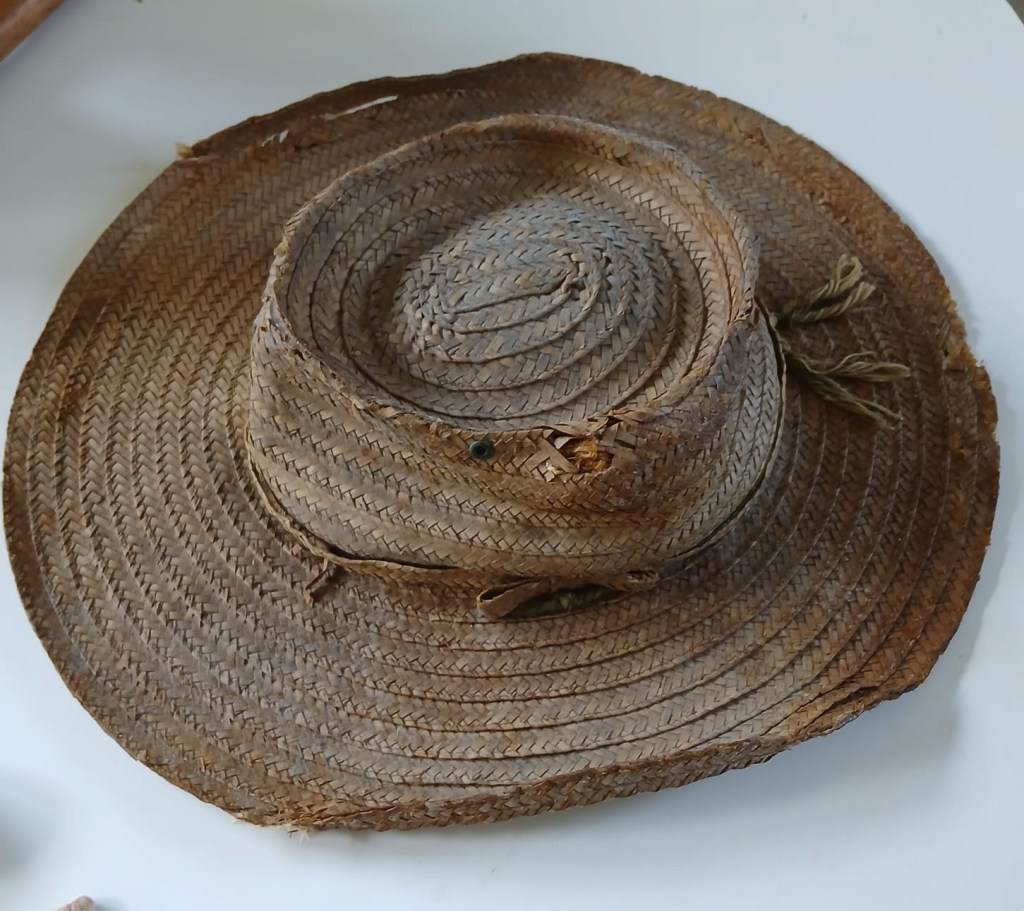
I certainly wore it on the trip to and from Anse de La Mouche on that fateful Good Friday. And I still sport it from time to time, most recently at a fiesta in Pontevedra city a short while ago, as part of my Spanish peasant outfit.
Souvenirs: You know that my coco-de-mer went up in flames, so the heading for this should be singular. For this walking stick is the only thing I have:

I did have a fancier one but you’ll know the fate of that. This one I gave to my brother but later begged it back. The rubber ferrule is Spanish, by the way.
Shells: I had a wonderful collection of these, all gathered by myself over several months. Also a victim of the warehouse fire. These are just a few that I gave to my mother on my return:

They’re much smaller than the ones I lost and less pretty, lacking the brilliant glaze that they keep if treated the right way after capture.
XXX
My thanks to those readers who take the trouble to Like my posts, either after reading on line or in my FB group Thoughts from Galicia.
The Usual Links . . .
- You can get my posts by email as soon as they’re published. With the added bonus that they’ll contain the typos I’ll discover later. I believe there’s a box for this at the bottom of each post. If you do this but don’t read the posts, I will delete your subscription. So perhaps don’t bother if you have other reasons for subscribing . . .
- For new readers: If you’ve landed here looking for info on Galicia or Pontevedra, try here. If you’re passing through Pontevedra on the Camino, you’ll find a guide to the city there.
- For those thinking of moving to Spain:– This is an extremely comprehensive and accurate guide to the challenge, written by a Brit who lives in both the North and the South and who’s very involved in helping Camino walkers. And this is something on the so-called Beckham Rule, which is beneficial – tax-wise – for folk who want to work here. Finally, some advice on getting a mortgage. And this article ‘debunks claims re wealth and residency taxes’. Probably only relevant if you’re a HNWI. In which case, you’ll surely know what that stands for.
The Atheist age has spawned its own superstition
Far from ushering in a new Enlightenment, our godless era is characterised by conspiracy theory, fake news and self-help
As a non-believer I confess to some embarrassment about the dawning of “the first atheist age” reported in The Times last week. For the first time in England’s long history, atheists outnumber believers. But the decay of faith has not, as freethinkers since Voltaire have blithely anticipated, ushered in an era of reason, rational thought and reverence for science. Instead of a second Enlightenment we have something like the opposite, a plague of secular fools: conspiracy theorists, astrology nuts, anti-vaccination fanatics, biology-deniers, climate-sceptics, homeopaths, believers in “personal truth” and fake news addicts. We have exchanged one age of unreason for another.
The human yearnings once answered by religion — for meaning, for community, for the glamour of the supernatural — have not been carried away on the ebbing tide of faith; they are welling up elsewhere. The bitter energies that once fuelled religious fanaticism are flowing into political partisanship (parts of the secularising US seem to have swapped Christian fundamentalism for a Trumpian version). Movements like wokeness provide a channel for feelings of moral righteousness once accommodated by the more puritanical Protestant sects. Our species’ ancient longing for meaning is increasingly dealt with by conspiracy theorists, astrologers and woo-woo self-help gurus who promise esoteric knowledge and cosmic significance.
For partisans of reason, the new age of irrationality poses new and difficult problems. When the Enlightenment philosophers faced down the Catholic Church, they were making an enemy of an institution that was unimaginably powerful but which nevertheless had a defined body of doctrine and a clear place in society. A towering foe but an excellent target, as Voltaire proved in essay after stinging essay.
Modern superstition is harder to fight because it is more diffuse, more widespread, more bewilderingly diverse. Not a standing army but a guerrilla force that is always melting back into the foothills. There is no central doctrine that can be disproved to final and devastating effect. It is not possible for a latter-day Darwin or Dawkins to score a direct hit on the enemies of reason because so little unites them. You may debunk anti-vaxers to devastating effect only to find a thousand more theories, delusions and madnesses rearing up around you.
Most disturbingly, modern forms of unreason challenge the western distinction between the claims of the sacred and the secular. Modern liberal societies have traditionally respected the supernatural claims of religion but permitted them no influence over science or commerce or policy or law. To westerners, the historian Tom Holland writes, faith is “personal, a private thing” with little business influencing public life.
The idea strikes us as obvious but it is historically unusual. Most other cultures have lacked this concept of a natural separation between the religious and the non-religious; in ancient Rome and pre-colonial India, the supernatural suffused society, shaping people’s understanding of and interaction with politics, law and nature.
The West owes much of its recent dramatic history of innovation and progress to the fact that inventors and scientists have, for the past few hundred years at least, been permitted to pursue their rational conclusions without the inhibiting influence of the irrational claims of religion. Most liberal Christians would be just as outraged as non-believers if a scientific journal published an article attributing natural phenomena to the intervention of the Virgin Mary or if a politician claimed the authority of his policies derived from divine revelation. But post-religious forms of unreason fail to respect the intellectual firewall that has long separated the rational and the irrational in the western mind.
Even ardent rationalists can become bewildered about where the line now lies. Recently, for instance, institutions such as the Natural History Museum and the journal The Scientific American have published material claiming that biological sex is not binary. A quite separate belief-based argument about gender identity in human beings (most properly a matter of personal conscience) intrudes on the once-separate domain of science.
On the political right, especially in America, unreason is endemic. Climate change deniers and anti-vaxers who openly prefer irrational fantasy to scientific evidence are active in public life. And unlike the best politicians of the old school, who were the inheritors of the secular idea that the sphere of personal faith can be separated from that of public action (think of the Catholic Joe Biden’s liberal position on abortion), their supernatural ideas inform the way they campaign and govern.
At the most extreme end are politicians such as the Republican congresswoman Marjorie Taylor Greene, who recently hinted that the Democratic Party controls America’s weather and is responsible for the devastation wreaked by Hurricane Helene on Republican-voting states. I think there is a plausible case that an equivalently insane religious statement (something along the lines of “God caused the hurricane to punish America’s sins”) would be more politically damaging. Secular society’s inherited suspicion of the unwanted intrusion of religion into public life is stronger than its vigilance towards post-religious madness.
The enemies of religion in the 18th century had a grand campaign on their hands. What is required of the partisans of reason in the 21st century is a vigilance that amounts to pettiness. Rather than a great war we must fight many small, stupid battles. Few would have imagined that such fights would ever have been necessary when Dawkins published The God Delusion almost two decades ago. But if the sleep of reason — to quote the title of the famous print by Goya — brings forth monsters so, it turns out, does the sleep of faith.
 Thoughts from Pontevedra, Galicia, Spain
The front door was open all night? I could have sneaked in…
LikeLike
I might have had a heart attack, for one reason or another.
LikeLiked by 1 person
https://www.thevintagenews.com/2022/03/11/yankee-doodle-dandy-song/
Farcically,
Perry
LikeLike