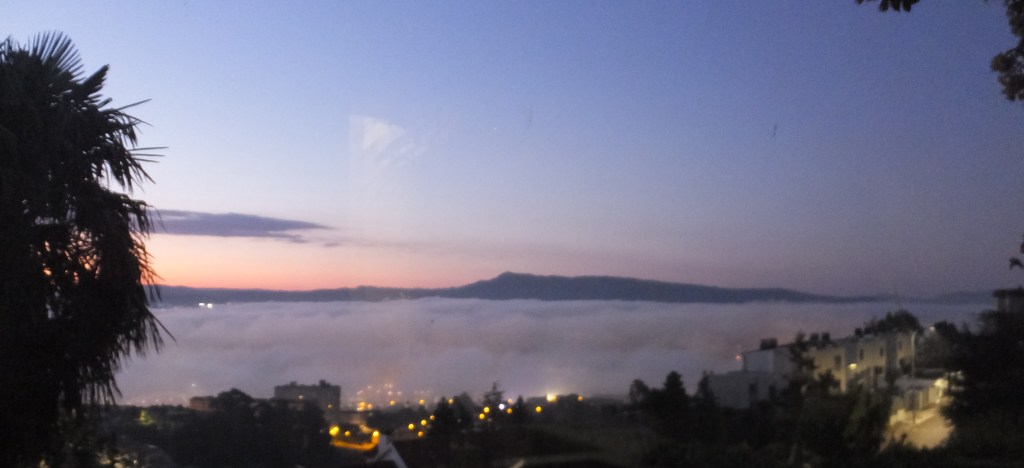
Awake, for morning in the bowl of night has flung the stone that puts
the stars to flight.
And, lo, has caught the sultan’s turret in a noose of light!
Spanish life is not always likeable but it is compellingly loveable – Christopher Howse: ‘A Pilgrim in Spain’
Cosas de España/Galicia
Spain is Different . . . The VdG today: La excepción ibérica, también en la vivienda Aunque el mercado inmobiliario está descontrolado en toda Europa, tanto en lo relativo a la escasez de oferta como en la escalada de precios, la situación es especialmente grave en España y Portugal, que lideran el encarecimiento de la vivienda, según S&P Global, duplicando el alza media de la UE y triplicando la de la eurozona. Los más castigados por la situación son los jóvenes: uno de cada cinco menores de 34 años se ven obligados a seguir viviendo con sus padres.
The incidence of no-shows by GP patients in Galicia is so high that consideration is being given to ‘penalties’. I suspect Hell would have to freeze over before such a (common-sense) thing could happen in the UK’s NHS.
For me, this has been the wettest October for years but, even so, Galicia’s reservoirs are only just over half full, reflecting a dry summer. With 7 days already gone, It’s going to be tough to achieve the (repeated) forecast of the driest October for years.
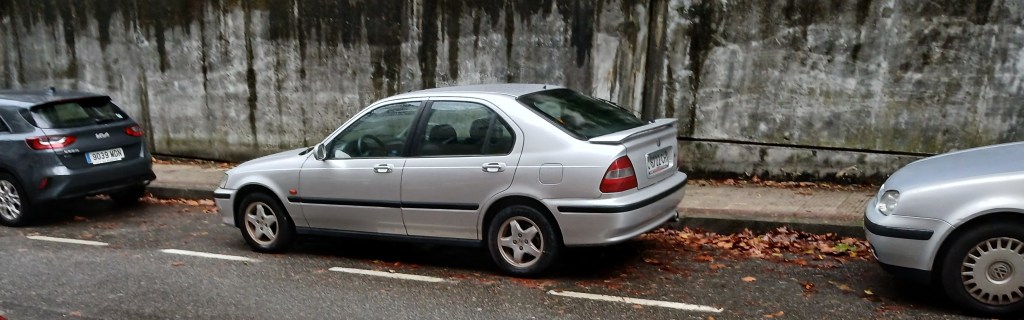
This is the sort of inconsiderate parking I occasionally rant against . . . Especially if it’s outside my house and the end result is me being fined for parking my car facing the wrong way:-
The UK
It takes some believing that Brits are not only twice as happy as Spaniards but also, in fact, the happiest folk in the capitalist world . . .As the article puts it: The UK‘s ranking is bolstered by high levels of happiness among older generations, although it contrasts with the World Happiness Report, which places the UK 20th out of 143 nations in 2024. Other global indexes, including those from the UN, show the UK in a similar position.
Ukraine v Russia
The Way of the World
The only possible solutions to the (intractable?) Palestine problem – a (non-Hamas run) Palestine state or a pre-emptive nuclear strike by Israel? I guess how you view this it depends on how much of an optimist or pessimist you are.
Quote of the Day
Reliability is essential for progress in life – Charlie Munger. I guess even Trump can be said to be reliable. In that nothing should ever surprise us.
Spanish
Plantar: To plant, etc.. And To let down; To stand up; To ‘no show’
Do you know?
Are you Islamophobic?
You Have to Laugh
The first ever Tree Hugging Tournament was recently held in Glasgow. The tournament’s organisers said they hoped it would encourage the public to connect with nature in a “playful and heartfelt way”.
Finally . .
MY YEAR IN THE SEYCHELLES
- Episode 1: 12 September 2024: Why VSO?
- Episode 2: 13 September 2024: The Leaving of Liverpool
- Episode 3: 14 September 2024: An interlude: The Seychelles back then
- Episode 4: 14 September 2024: Departure, Nairobi and Arrival
- Episode 5: 15 September 2024: Arriving in Mombasa
- Episode 6: 16 September 2024: The YCWA in Mombasa
- Episode 7: 17 September 2024: The flight to Mahé
- Episode 8: 18 September 2024: Our Arrival
- Episode 9: 19 September 2024: Early Days
- Episode 10: 20 September 2024: My Colleagues and Some Early Adventures
- Episode 11: 21 September 2024: Mr Warren and Me
- Episode 12: 22 September 2024: Chris Green
- Episode 13: 23 September 2024 The Hotel des Seychelles
- Episode 14: 24 September 2024: A Night to Remember
- Episode 15: 25 September 2024: Visitors
- Episode 16: 26 September 2024: Dr McGregor and Me
- Episode 17: 27 September 2024: Dr McGregor and Me 2
- Episode 18: 28 September 2024: Teaching Duties
- Episode 19: 29 September 2024: The Watch
- Episode 20: 30 September 2024: The Sea and Me
- Episode 21: 1 October 2024: Fishy Tales
- Episode 22: 2 October 2024: Photos
- Episode 23: 3 October 2024: Photos Follow-up
- Episode 24: 4 October 2024: The Seychelles: History, Geography, Climate
- Episode 25: 5 October 2024: The Culture
- Episode 26: 6 October 2024: The Seychellois People
Episode 27: The Language
While they might lack crafts, customs and music, Seychellois certainly have at least one claim to fame – a language all of their own. Well, almost all their own. Creole is spoken in Mauritius, parts of East Africa and even New Orleans but to the average Seychellois it is his very own secret language, neither, French, English, Indian nor Swahili but an amalgam of all four, twisted and stirred over the years so that now possibly only a Frenchman could understand it.
When I was new to the islands I took little interest in Creole. I’d been told it was a French patois, or more crudely pidgin or bastard French. Since it is very rarely written, I had little chance to study its grammar or syntax. But, as time passed and I found I had nothing to do in the evening but talk to the hotel bar staff, the language lost some of its mystique and I began to discover that the criticisms levelled against it were based on ignorance. It’s true to say that few self-respecting Frenchmen would regard it as a real language and even fewer would condescend to speak it but it,
nevertheless, has all the characteristics of an independent and true language and a lilting beauty all of its own.
The vast majority of Creole words are derived, or corrupted, from 18th century French but the Seychellois are not adverse to including scraps of English, Indian, Swahili and even Arabic in their conversation. The pronunciation, it need hardly be said, owes little to the French.
Perhaps the most illustrative example of altered pronunciation is the French J. But the letter with which the Seychellois have the greatest affinity is undoubtedly Z and it’s found in the most unlikely places. So that Les hommes and Les oiseaux, for example, become Lee zommes and Lee zoiseaux. It’s hardly surprising, therefore, that the ‘z’ sound had been substituted for the harsher ‘j’ sound of “Jules.
Not only that. Along with most non-French folk, the original islanders found the French U sound almost impossible to formulate and so they gave up. It became instead an ‘ee’ sound. So that in Creole ‘Jules’ is pronounced ‘Zeel’; ‘Plus’ is pronounced ‘Plee’; ‘Sucre is ‘Seek’ and so on and so forth.
If this were the only problem, then Creole would be readily intelligible to the French speaker after one or two pointers. Unfortunately, it isn’t that simple. Alongside perverse pronunciation, there’s an even more peculiar syntax and grammar.
The verb ‘To go’ (‘Aller ‘ in French, of course) is conjugated thus:-
- Mon alé
- Oo alé
- Ee alé
- Nous alé
- Oo alé and Lotes (from les autres, presumably) alé.
It must be stressed, however, that my spelling of Creole phonetics is completely arbitrary and unsubstantiated by any written document. The only written Creole I ever saw was a notice posted in the Police station in Victoria advising wives what to do should their husbands take to beating them daily.
The tenses of Aller/alé are As follows:-
- Mon alé: I go
- Mon ty alé: I went
- Mon ty pe alé: I was going
- Mon po alé: I shall go
- Mon pay alé: I am going
- Mon fee alé: I just went.
- All verbs are conjugated in this form, with only the auxiliary verb changing.
The imperative is usually merely the infinitive form e.g. ‘Alé! – Go! But if there are two verbs, e.g. ‘Go and see that’, then the first one will usually lose a syllable, so that ‘Go and see that’ becomes ‘Al voir ça’ – with the ‘v’ pronounced as a ”w”.
Creole nouns are virtually all French in origin, even the word for tree, which is ‘predjiboir’, is a corruption of ‘pied de bois’. The Creole for camera, however – ‘lee kodak’ – is of more modern origin.
The same generalisation applies to the adjectives, with only the pronunciation making them distinguishable from French. Again there are exceptions, so that ‘good’ is either ‘red” or ‘goo’. And ‘shattered’ is ‘cass-cassé’.
Creole possesses certain words and expressions which cover a multitude of situations. The very common ‘Na pas’, for example, can mean just about any negative you want it to – ‘No, I didn’t see him yesterday’, to ‘No, I didn’t do it’. The ubiquitous word “cote” is used in expressions such as ‘cote bousse’ -‘at the butchers’. ‘Cote la’ – Over there’ and ‘Cote moi’ – ‘at my house’.
I spent many an evening during the first few months of my stay adding to my knowledge and understanding of Creole. In my endeavour I was admirably assisted by the pupils of Seychelles College, who were always anxious to keep me up to date with current and long-revered obscenities.
Since the boys were forbidden to speak Creole during the school day, I would only be subjected to this “education” when I played badminton or football after school had finished. After four o’clock there wasn’t a word of English or French to be heard anywhere in or near the school precinct, even from me, their 8am to 3.45pm guide and mentor.
It didn’t take me long to realise that, though it was a little unsophisticated, Creole was far from being the gibberish that many English expatriates considered it to be.
Postscripts
1. I eventually wrote a grammar and vocabulary of Creole but you’ll know by now what happened to those. Quite recently, I was rather miffed to find that a later VSO chap had been credited with publishing the first grammar and dictionary of Seychelles Creole. Which might well be still on sale there and on cruise ships.
2. When I finally got to King’s College in London to study Law, I chose French Civil Law, as opposed to Roman Law. To be allowed to do this, I had to pass a test of my ability to understand French. This was done by the Professor and his (French) assistant. Appropriately, it was a French Farce. What came to my mind, when they asked questions in French, was Creole, not the language of Voltaire. Sadly, these words also came to my mouth. How they refrained from laughing, I never understood. But I was accepted for the course. Which to me, suggested a degree of desperation in respect of this first-ever alternative to Roman Law. In the end, there were only 6 or 7 of us. And despite the fact that we were all pretty bad at French – we had great fun taking taking the piss out of the young assistant. Especially when he told us that Zee jooges en France are seeting in trees . . . Which we got him to repeat several times. How we laughed.
XXX
My thanks to those readers who take the trouble to Like my posts, either after reading on line or in my FB group Thoughts from Galicia.
The Usual Links . . .
- You can get my posts by email as soon as they’re published. With the added bonus that they’ll contain the typos I’ll discover later. I believe there’s a box for this at the bottom of each post. If you do this but don’t read the posts, I will delete your subscription. So perhaps don’t bother if you have other reasons for subscribing . . .
- For new readers: If you’ve landed here looking for info on Galicia or Pontevedra, try here. If you’re passing through Pontevedra on the Camino, you’ll find a guide to the city there.
- For those thinking of moving to Spain:– This is an extremely comprehensive and accurate guide to the challenge, written by a Brit who lives in both the North and the South and who’s very involved in helping Camino walkers. And this is something on the so-called Beckham Rule, which is beneficial – tax-wise – for folk who want to work here. Finally, some advice on getting a mortgage. And this article ‘debunks claims re wealth and residency taxes’. Probably only relevant if you’re a HNWI. In which case, you’ll surely know what that stands for.
 Thoughts from Pontevedra, Galicia, Spain
Here up in’t North Don C, we had a wet winter, a wet spring, and a very wet summer. Autumn has continued the trend. Our local reservoir is bursting at the seams. On the upside, our drains, likely built before u-bends came in, don’t pong as much, albeit the plugs stay in when not in use.
I popped in to the CHUAC the other day. No wonder the clinics are empty, they all went to the big main hospital on the hill. Maybe its the views of Santa Cristina beach and Coruñas estuary that tempts people.
Street parking. Should be part of drivers learning school. But I doubt it will ever happen.
LikeLike
Hi, David. Well, all the Pv driving schools which are the bane of my life do teach parking. But maybe you meant parking sensibly, with a degree of consideration for others . . .
LikeLiked by 1 person
no blog today?
LikeLike
posted
LikeLike