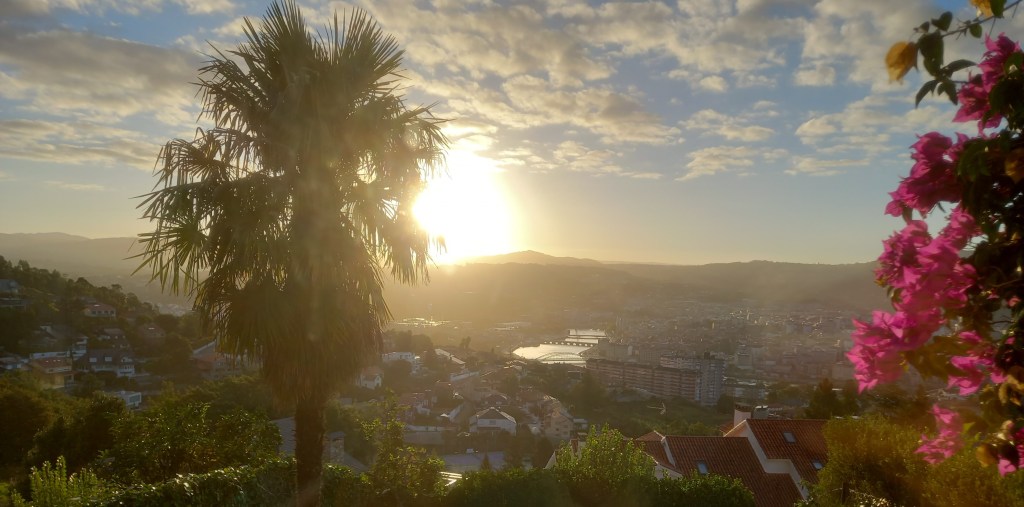
Awake, for morning in the bowl of night has flung the stone that puts
the stars to flight.
And, lo, has caught the sultan’s turret in a noose of light!
Spanish life is not always likeable but it is compellingly loveable – Christopher Howse: ‘A Pilgrim in Spain’
Cosas de España/Galicia
The economy continues to do much better than others, at the macro level at least.
I see the British PM is not taking up my plan for Gib but, instead, is declining to say that he won’t give it back to Spain. Which is logical, as the British government has wanted to get rid of it for at least 50 years, given that it costs money and has no strategic (or other) value these days.
The pre-sale need for energy certificates for properties. All you need to know.
Spain’s patriotic Sloane Rangers.
The Spanish public healthcare system is regarded by many as superior to the British system but it’s not without its problems and complaints. This week I waited 90 minutes to get a prescription renewed by my GP, only to then get a call telling me there was no doctor in my health centre to do this, so it was being done by phone. From I-don’t-know-where.
I am so paranoid now about the risk of getting yet another fine for a motoring offence that, after parking my car near Pv city station last Friday, I moved it backwards a tad to ensure it was within the box delineated by white lines. But despite doing this, I began to wonder on the train – and then later when arriving back at the station – if the (very officious) police would give me a ticket for having the very front of the bar touching the front white line. In the event, they hadn’t. But it’s good to know that my reserve fund for the inevitable next fine has reached €110.
The UK
- A new Groundnut Scheme in the making?
- Another dose of scepticism
The Way of the World
How and when we got Neanderthal genes.
Quote of the Day
Tact is not the quality by which you often please, but by which you seldom offend: Alice Wellington Rollins. Good to learn when young.
Net Zero
- An energy expert of many years experience opines: A lot of the plans for net zero are just a series of technically and economically illiterate fantasies designed to avoid the reality that reaching a target is probably infeasible and is certainly ruinous for any modern industrial economy.
- Someone else opines: The politics of carbon capture and storage are highly intriguing. Carbon capture and storage means you can, in theory, carry on burning fossil fuels guilt free. Climate scientists aren’t that keen on it, because there’s precious little evidence it can ever work on the scale that is required, but mainly because it can be, and is, clung on to with steely desperation by the fossil fuel industry, because it gives them licence to carry on. Which is precisely why politicians are keen on it.
Spanish
Lenox Napier has explained that the 3 stages of the bullfight are called tercios, or thirds. So, cambiar el tercio has come to mean ‘to change the subject’.
Did you know?
Some languages have two A sounds, a long one and a short one. These include English, Persian and Arabic. In English, there’s no indication how the A is pronounced and southerners will use the long version when northerners don’t. In Persian and Arabic, there’s a letter for the long A sound but but not for the short one. In Arabic, there’s a ‘diacritic’ to tell you where the short A occurs but not in Persian, where you need to know the (vowel-less) word to know how it’s pronounced. Spanish has no long A sound but this doesn’t stop (southern) Brits sometime inventing one – as in man-yarn-a (or even marn-yar-nar) for mañana. Which, of course, confuses Spaniards. Just sayin’. In case you do this.
Finally . . .
Coincidences do happen. . . I’m writing about my year in the Seychelles and am reading about the French Revolution. An organiser or early commemorations of the latter was one Heraut de Séchelles . . .
MY YEAR IN THE SEYCHELLES
- Episode 1: 12 September 2024: Why VSO?
- Episode 2: 13 September 2024: The Leaving of Liverpool
- Episode 3: 14 September 2024: An interlude: The Seychelles back then
- Episode 4: 14 September 2024: Departure, Nairobi and Arrival
- Episode 5: 15 September 2024: Arriving in Mombasa
- Episode 6: 16 September 2024: The YCWA in Mombasa
- Episode 7: 17 September 2024: The flight to Mahé
- Episode 8: 18 September 2024: Our Arrival
- Episode 9: 19 September 2024: Early Days
- Episode 10: 20 September 2024: My Colleagues and Some Early Adventures
- Episode 11: 21 September 2024: Mr Warren and Me
- Episode 12: 22 September 2024: Chris Green
- Episode 13: 23 September 2024 The Hotel des Seychelles
- Episode 14: 24 September 2024: A Night to Remember
- Episode 15: 25 September 2024: Visitors
- Episode 16: 26 September 2024: Dr McGregor and Me
- Episode 17: 27 September 2024: Dr McGregor and Me 2
- Episode 18: 28 September 2024: Teaching Duties
- Episode 19: 29 September 2024: The Watch
- Episode 20: 30 September 2024: The Sea and Me
- Episode 21: 1 October 2024: Fishy Tales
- Episode 22: 2 October 2024: Photos
- Episode 23: 3 October 2024: Photos Follow-up
- Episode 24: 4 October 2024: The Seychelles Islands
Episode 25: The Culture – or bits of it, at least.
The Seychellois of today can be either English, French, African, India, Chinese or any permutation of two or more of these.
In the staffroom of Seychelles College one day we attempted to coin a description that would fit the average Seychellois-just supposing for the moment that one exists – and, after several minutes of juggling with words and nationalities, we came up with INDOFRANCHIGRO. But even this is inadequate because it leaves out of account the entire British Navy.
It’s not uncommon to find mothers with children of various hues and shades, ranging from the jet black to the sunburnt white. Or, as we used to say, from the 3 of coffee to the 1 of coffee, two of milk. By far the most beautiful are the Eurasians and by far the most unusual, to me at least, are the negroes with fiery red hair.
It is said that whatever their colour, the Seychellois people all display one characteristic above all others, an abiding love of leisure. Some find it amusing, some irritating and some downright disgusting but there is no doubt there is more than a little truth in the allegation. Perhaps one could and should exclude the Chinese and the Indians who account for the entire mercantile class and who stayed open for business even on the day of Shastri’s death, albeit through the back door.
As indicated in my original notes, there are many theories propounded as to the reasons for this attitude of mind but the islanders themselves have no need for excuses. If it’s hard for us to understand why a fisherman who catches and sells 5 days’ fish in one day doesn’t save 4 days money, it’s even harder for the fisherman to figure out why he shouldn’t rest for the next 54 days or at least until the money runs out. After all, there’s nothing very much he needs to save for, beyond 3 daily meals and most of these come out of the sea.
But it would be a travesty to represent the Seychellois as idle layabouts, eternally scheming to fit the maximum amount of sleeping into the working day. If things needed doing urgently, they were done; if not, there was always mañana.
Of course, one man’s definition or urgency is not necessarily the Seychellois. There were frustrations. During the Easter vacation I worked for a week or two as an interpreter for the American company which was constructing a power plant for the satellite-tracking station. My job was to re-issue orders in Creole since the labourers had a nice habit of pretending not to understand English.
As on all building sites, there were some onerous tasks and some push-overs. The position after which all the labourers aspired was that of honourable nail remover. This entailed sitting in the shade and removing nails from the pieces of wood which had formed the crates for the electrical machinery. Two men were usually detailed for this work and the other twenty-odd were put to dragging round huge pieces of machinery and raising mammoth girders and pipes. It was not unknown, however, for this twenty odd to slowly decrease until a short walk to the end of the stockade would reveal 26 sedentary workers all sharing 18 nails in 6 pieces of wood.
The construction of the power station was estimated to be a 3 month job and it began in April 1966. In August 1966, when we left the islands, it was thought that another 4 months would see completion.
Being somewhat out of the way and frequented by passenger ships, at the most, only twice a month, the Seychelles in 1966 lacked anything resembling a sophisticated tourist industry. True, there was, and still is, an Office of Tourism and Information but the number of visitors for which it catered seriously diminished once Rhodesian citizens found it increasingly difficult to leave their country.
Once or twice a month, a hundred or so Indians would spend 2 days on Mahé in between Mombasa and Bombay but the number of people willing to extend their stay for a few weeks was small, mainly because it was common knowledge that although it was comparatively easy to get onto the island, it was sometimes impossible to get off. The most boring man I ever met, not to say the biggest liar, had to extend his holiday for 3 months because he couldn’t get a berth on a boat for Africa. If this was bad for him, it was disastrous for me – since he was under the impression my interest in his story of how he saved Africa from economic collapse grew in the telling.
Under these conditions, its hardly surprising that the curio and souvenir trade extended to 3 stall holders who appeared when the ships docked , plus the loftily titled Home Industries store which was always there but rarely open.
This is not to say that the islands offered nothing in the way of souvenirs. The selection was small but interesting. Pride of place must go to the Coco-de-mer, the obscenely shaped double coconut which grows only in the Valle de Mai on Praslin island. These large coconuts are blackened and polished and sold either in their natural form or hollowed out to form boxes or lamp stands. In its polished but natural form it looks for all the world like a pair of black buttocks. Not surprisingly, the islanders have built up a network of stories which have the Coco-de-mer as their basis.
General Gordon (of Khartoum) thought that the Valle de Mai was the original Garden of Eden but he’d obviously never heard the stories of what goes on in the valley. The most frequently related of these is that during the night the male coco-de-mer tree, which can grow up to 110 feet, gets up and mates with the female of the species. Anyone who is around to see this happen disappears off the face of the world at the end of the final act. This may be hard to swallow but it does help to explain the absence of any eye-witness accounts.
Of equal interest to the coco-de-mers are the sharks’ backbone walking sticks but infinitely more beautiful are the countless brooches, bangles, pendants, bracelets and knick-knacks made out of the tortoiseshell so readily available in the islands, And on a par with these are the many varieties of cowries, cones and sea-shells found on the coral reef.
On a good day in the Home Industries one might also find a selection of neatly woven straw hats and dinner mats or perhaps a miniature pirogue or two but here your choice would end, unless, of course, you could be satisfied with an ordinary straight walking stick costing around 5 shillings. It was not, to be honest, what you might expect from an island community, lacking as it did wood carvings or musical instruments of any sort, but it was enough to satisfy the day trippers from the BI boats or the Royal Navy.
If local craft was meagre, indigenous music was non-existent. For some reason or other, the original African slaves seem to have failed to re-establish native customs and patterns in their new homeland. Or, if they did, the ever-increasing miscegenation was calculated to produce a society in which Western standards and ideals gradually forced their way to the fore.
‘l’he Seychellois of today, even if he is jet black, sees nothing in common between himself and, say, a Kikuyu of East Africa. To most Seychellois the term ‘African’ would be nothing less than a gross insult. African customs and tribal dancing are considered derisory and the modern islander is more at home with an electric guitar or accordion than a tom-tom drum.
But it would be misleading to say there was no music in the Seychelles isles nor poetry in the Seychelles souls. English pop had invaded the islands long before we arrived and the Beatles were as famous there as anywhere else. And, if one could tear oneself away from Jerry Legrand’s infernal canned Hawaiian music, one could get to hear many brands of musical entertainment.
Apart from the record shop in Victoria and the pop-groups of the town’s bars-cum-brothels, there were the small village virtuosos who would play for the outlying communities on guitar or perhaps in a group comprising guitar, violin, accordion and drums. To these the locals would dance their Séga and “country dances”. The former was a strange shuffling movement performed, more often than not, in a semi-crouch position – fuller, modern description below – and the latter was similar to British country dancing.
But whether they got their music from record player, amplifier, acoustic guitar or violin, all the islanders were agreed on one thing – Jim Reeves was the greatest.
From the time we arrived to the time we left, there can’t have passed a day when our ears weren’t assailed by someone incanting a dirge made famous by this late Country-and-Western star. As far as he and the Seychellois were concerned, there was no such word as surfeit. Unfortunately, the more I heard them the greater grew my detestation for Jim’s songs and even now, through no fault of his own, my sole reaction to his records is one of nausea. Familiarity undoubtedly bred contempt.
The Séga
This is a vibrant traditional dance and music genre originating from Mauritius, characterized by its deep cultural significance and historical roots. It serves not only as a form of entertainment but also as a powerful expression of the struggles and resilience of the Mauritian people, particularly those of African descent.
It is now popular across the islands of Mauritius, Réunion, Seychelles, Comoros, Mayotte and Rodrigues, along with parts of Madagascar.
Séga emerged in the 17th century, brought to Mauritius by enslaved Africans who worked on sugar plantations. They used this dance as a means to cope with their suffering and to express their emotions through music and movement. The dance incorporates elements from African, Malagasy, and European musical traditions, reflecting the diverse influences that shaped Mauritian culture over time
The traditional instruments integral to Séga include:
- Ravanne: A goat skin drum that serves as the primary percussion instrument.
- Maravanne: A musical box made from sugar cane filled with small stones or seeds, shaken rhythmically.
- Triangle: A metal triangle played with a rod.
- Makalapo: A one-stringed instrument traditionally made from a gourd.
These create a lively rhythm that accompanies the dance, which is characterized by its unique movements
The songs are usually in French Creole and reflect the daily life, joys, sorrows and moments of rebellion of the community.
The Séga dance is distinctive for its rhythmic hip movements and shuffling steps, where dancers often keep their feet close to or always on the ground. This style symbolizes the historical context of slavery, reflecting the physical constraints faced by enslaved individuals
- Movement: The dance involves swaying hips and shoulders while maintaining a grounded stance. Dancers often improvise their movements in response to the music’s tempo, which can start slow and build in intensity.
- Costume: Women typically wear colorful skirts that accentuate their movements, while men dress in vibrant shirts and shorts
Séga is more than just a performance; it embodies the spirit of Mauritian identity. It serves as a medium for storytelling, celebrating both joy and sorrow within the community. The lyrics often reflect social issues, making it a form of cultural resistance against oppression
Today, Séga remains an essential aspect of Mauritian culture. While it has evolved to incorporate modern musical influences like jazz and reggae (resulting in genres like Seggae), traditional forms are still celebrated during festivals and gatherings.
In summary, Séga is a rich cultural expression that encapsulates the history, struggles, and joys of the Mauritian people, making it a vital part of their heritage.
******
My thanks to those readers who take the trouble to Like my posts, either after reading on line or in my FB group Thoughts from Galicia.
The Usual Links . . .
- You can get my posts by email as soon as they’re published. With the added bonus that they’ll contain the typos I’ll discover later. I believe there’s a box for this at the bottom of each post. If you do this but don’t read the posts, I will delete your subscription. So perhaps don’t bother if you have other reasons for subscribing . . .
- For new readers: If you’ve landed here looking for info on Galicia or Pontevedra, try here. If you’re passing through Pontevedra on the Camino, you’ll find a guide to the city there.
- For those thinking of moving to Spain:– This is an extremely comprehensive and accurate guide to the challenge, written by a Brit who lives in both the North and the South and who’s very involved in helping Camino walkers. And this is something on the so-called Beckham Rule, which is beneficial – tax-wise – for folk who want to work here. Finally, some advice on getting a mortgage. And this article ‘debunks claims re wealth and residency taxes’. Probably only relevant if you’re a HNWI. In which case, you’ll surely know what that stands for.
 Thoughts from Pontevedra, Galicia, Spain
Your SEYCHELLES saga … How many episodes are still to come?
LikeLike
not many
LikeLike
Hola Colin —
Regarding the A sound … Did you know (and probably more than you wanted to know), in Lithuanian:
Aa. Short Vowels
a – this letter may denote a short, more or less tense, unrounded, open central vowel. It may be stressed or unstressed, but even when stressed it will be shorter than the normal stressed vowel of English. Under certain circumstances (namely in open syllables, although even here there are exceptions) this letter is used to denote a long vowel; if this is the case such a long vowel may have only the circumflex accent and will be pronounced exactly like ą, cf. section Ab. on long vowels.
Examples as a short vowel: kada ‘when’, aš ‘I’, Amerika ‘America’, mano ‘my’.
Examples as a long vowel: namas ‘house’, galas ‘end’.
***
Ab. Long Vowels
All long vowels and diphthongs may be either stressed or unstressed. If stressed they may have either the circumflex or the acute intonation.
ą– this letter denotes a long, open, central vowel somewhat similar to the a in English father.
Examples: grąžinti ‘to return’, (acc. sing.) vyrq ‘man’, (acc. sing.) tą ‘that’, ąžuolas ‘oak’.
ę – this letter denotes a rather open vowel, somewhat like the ain English bad, but more open and without the ‘y’ off-glide. It is produced with the mouth open and the tongue lax in a low frontal position. The lips are also lax, but pulled down slightly by the falling jaw,
Examples: pelę (acc. sing.) ‘mouse’, tęsinys ‘continuation’, spręsti ‘to decide’, kęsti ‘to suffer’.
ė – this letter denotes a vowel which differs considerably from the ę. ė is always long, rather close and forward and unrounded. It is rather like the a in English made, but without the ‘y’ off-glide. It is produced with the tongue tensely stretched in a mid-frontal position, a little lower than in the production of i. The tip of the tongue is behind the upper teeth. The muscles of the tongue and of the jaw which is slightly lowered are tense. The lips are lax.
Examples: dėdė ‘uncle’, dėti ‘to put’, raidė ‘letter (of the alphabet)’. mėgti ‘to like’.
Dambriunas, Leonardas, Klimas, Antanas, and Schmalstieg, William R, Introduction To ModernLithuanian, p. 4, Franciscan Fathers, Brooklyn, New York (1966).
Atentamente,
Aleksandras
LikeLike
Hi, Aleks. Thanks for that. Yes, surprisingly, I didn’t know that about Lithuanian. And possibly you are the only person outside the country who does . . . 🙂
LikeLike
Neanderthal genes: Gibraltar is thought to be the last refuge of Neanderthals in Europe. Analyses confirmed that the Devil’s Tower child was male, and the Forbes’ Quarry adult was female. The researchers also found that the adult was genetically more similar to earlier (60,000- to 120,000-year-old) Neanderthals in Europe and western Asia than to younger Neanderthal remains from Spain. https://www.nhm.ac.uk/discover/news/2019/july/a-new-look-at-the-gibraltar-neanderthals.html
I am 2.4% Neanderthal & my youngest son Elliott is 3%. (23 & me) https://duckduckgo.com/?q=neanderthal+sapiens+hybrid+child+in+gibralter&atb=v316-1&iax=images&ia=images&iai=http%3A%2F%2Fcache.eupedia.com%2Fimages%2Fcontent%2FNeanderthal_child.jpg
Great vowel shift:
Speaking & genetically,
Perry
LikeLike