Awake, for morning in the bowl of night has flung the stone that puts
the stars to flight.
And, lo, has caught the sultan’s turret in a noose of light!

Spanish life is not always likeable but it is compellingly loveable – Christopher Howse: ‘A Pilgrim in Spain’
España
A (longish) bit of Spain’s – rather colourful – history, for those who like this sort of thing . . . First the Romans, then the Vandals, then the Visigoths. (To be followed by the Moors.):-
The journey into Hispania represented both a continuation of the Vandals’ migration and a significant new chapter in their history. The Iberian Peninsula had been a part of the Roman Empire since the 2nd century BCE, known for its rich mineral resources, agriculture, and strategic coastal cities. However, by the early 5th century, Roman control over Hispania had weakened, mirroring the decline experienced elsewhere in the empire.
In 409 CE, the Vandals, along with the Alans and Suebi, crossed the Pyrenees Mountains into Hispania. The crossing itself was a formidable endeavor, requiring the navigation of rugged terrain and the coordination of large groups of people, animals, and supplies. The tribes moved in separate contingents but maintained loose alliances based on mutual interests.
Upon entering Hispania, the Vandals dispersed into different regions to minimize competition among themselves. The Silingi Vandals settled in Baetica, corresponding to modern Andalusia, an area known for its fertile lands and access to the Mediterranean Sea. The Hasdingi Vandals, led by Gunderic, occupied parts of Gallaecia in the northwest, encompassing modern Galicia and northern Portugal.
The initial interactions with the local Roman authorities and populations varied. In some areas, the Vandals encountered minimal resistance, as Roman garrisons were understaffed or had abandoned their posts. In other regions, they faced stiff opposition from local militias and landowners seeking to protect their properties.
The Vandals established control over their territories through a combination of force and negotiated settlements. They seized lands, imposed tributes, and integrated with the local economy. The tribal leaders began to adopt more formal administrative roles, using Roman infrastructure and governance models to manage their domains.
However, the coexistence was uneasy. The presence of the Vandals disrupted the established social and economic order. Land confiscations, taxation, and the imposition of Arian Christianity created tensions with the predominantly Romanized and Nicene Christian inhabitants. Instances of violence, uprisings, and retaliatory actions were not uncommon.
Meanwhile, the Roman Empire sought to reassert control over Hispania. In 416 CE, Emperor Honorius enlisted the Visigoths, led by King Wallia, to act as foederati and expel the Vandals and other tribes from the peninsula. The Visigoths launched a series of military campaigns that proved devastating to the Vandals.
The Visigoths, well-armed and experienced in warfare, systematically attacked Vandal settlements. The Silingi Vandals suffered heavy losses, and their king, Fredbal, was killed. The remnants of the Silingi joined the Hasdingi under Gunderic’s leadership, consolidating the Vandal forces but also indicating the severity of their situation.
Facing relentless pressure from the Visigoths and unable to secure a stable foothold, the Vandals decided to move once again. The death of Gunderic in 428 CE further complicated matters. His half-brother, Gaiseric (also known as Genseric), ascended to the throne. Gaiseric was a formidable and astute leader who recognized the need for a bold new strategy.
Gaiseric’s decision to lead the Vandals into North Africa was a daring and strategic move that would redefine their place in history. North Africa was not only a region of immense agricultural wealth but also a critical part of the Roman Empire’s infrastructure. The fertile lands of the Maghreb produced vast quantities of grain and olive oil, essential for feeding the populations of Rome and other major cities.
Several factors influenced Gaiseric’s decision. The Vandals faced untenable conditions in Hispania, with ongoing threats from the Visigoths and limited opportunities for expansion. North Africa, by contrast, was relatively undefended due to internal Roman conflicts and the empire’s preoccupation with threats elsewhere.
In 429 CE, Gaiseric mobilized his people for the crossing. Estimates of their numbers vary, but contemporary sources suggest that around 80,000 individuals, including warriors, families, and support personnel, made the journey. This mass migration required significant logistical planning, including securing vessels for transport and coordinating the movement of people and supplies.
The crossing of the Strait of Gibraltar was facilitated by the acquisition of ships, possibly through negotiations with local communities, commandeering vessels, or even agreements with Roman officials seeking to rid Hispania of the Vandals.
The journey across the narrow but treacherous waters was a remarkable feat, showcasing Gaiseric’s leadership and the Vandals’ determination. Upon landing in Mauretania Tingitana (modern-day Morocco), the Vandals began their campaign of conquest. They moved eastward along the North African coast, taking advantage of the fragmented Roman defenses. The local Roman administration was weakened by political rivalries, economic troubles, and a lack of cohesive military leadership.
Galicia
Until quite recently. This Pv city building – ironically in Portuguese style – was our Town Hall, or Casa Consistorial.
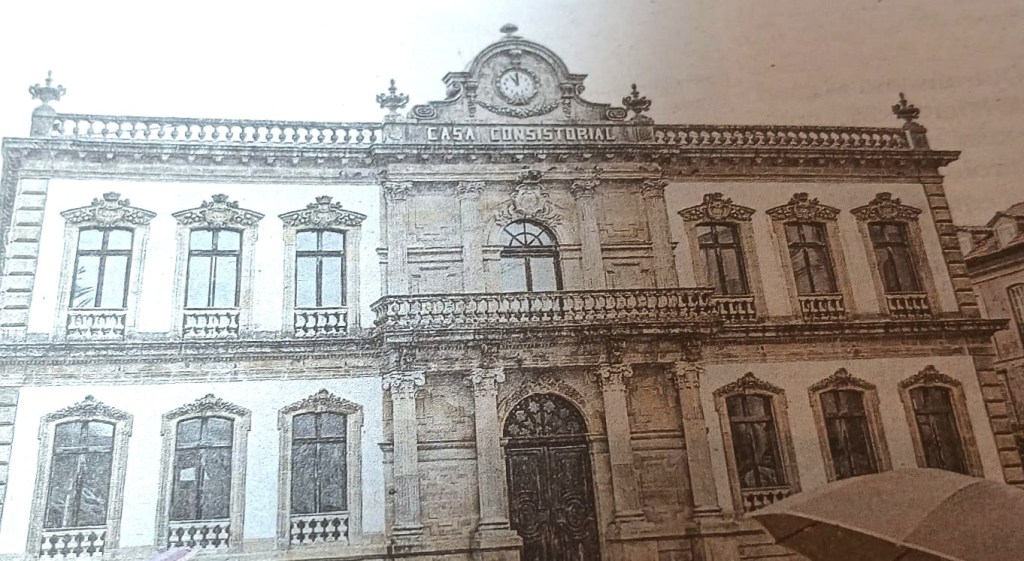
It’s lain empty for a while now. Well, except for the termites who’ve been found to have infested it. At least that should stop it becoming tourist flats. Or yet another albergue for ‘pilgrims’. It’s not really half white and half grey . . .
Another drugs bust, this time in nearby Sanxenxo – of a gang said to bring in 180 kilos of cocaine a year. If you want to see how they do it, watch Cocaine Coast on Netflix.
Confirmation comes from El Trafico that we have the 2nd most dangerous road in all of Spain – the A55, which runs from Vigo to Tui for 31km. The first is in Barcelona. Crazy Catalans, I guess.
We are about to have a Festival de Núbebes[sic] in Pv city. . . .
Portugal
Not before time, Lisbon is finally taking action against the building of the speedboats – narcolanchas – used by drug smugglers to bring heroin and cocaine from the ‘mother-ship’ into our bays and coves. Usually commissioned by Galician narcos I believe..
The UK
In his autobiography the former prime minister avoids introspection or penetrating insight, preferring instead to hide behind his cartoonish image. Boris, of course.
The EU
It’s not as if Brussels doesn’t take action against member states which disregard EU rules. For example, the Commission is now suing Spain, Cyprus, Poland and Portugal for failing to implement rules aimed at ensuring a global minimum level of taxation for multinational companies. And Spain has been sued and fined for several things in the last 2 decades. But France? It seems this ‘founder member’ can get away with almost anything. Two-tier justice? (a phrase very popular in the UK at the moment).
Quote of the Day
The perfect society is a block of flats filled with families from different cultures, all free to complain about the smell of each other’s cooking and curse each other’s music.
Spanish
Terciar/Tercio again: Cambiando de tercio . . . = Changing the subject . . . .
Did you know?
Under Roman law, subjects found guilty of patricide were subjected to poena cullei, the “penalty of the sack” — they were sewn into a leather sack with a snake, a cock, a monkey, and a dog and then thrown into water.
Finally . . .
It’s a long time since I’ve heard such awful tosh as this – a radio/podcast ad for a perfume, delivered withall the gravity appropriate to the announcement of the death of beloved monarch: Introducing Le Sel d’Issey by Issey Miyake. A tribute to today’s masculinity that gives men the desire to live intensely. A fragrance inspired by salt, an essential element of nature. An incisive freshness with a bold blend of woody and marine notes. Awaken your senses! Le Sel d’Issey, the new fragrance for men from Issey Miyake.
Finally, Finally . . .
Reader Noémi is on the final stage of a camino and might well have arrived in Santiago de Compostela today. If she makes the short train down to Pv city, I’ll happily show her our lovely Old Quarter. Or any other reader, of course.
Finally, Finally, Finally . . .
MY YEAR IN THE SEYCHELLES
- Episode 1: 12 September 2024: Why VSO?
- Episode 2: 13 September 2024: The Leaving of Liverpool
- Episode 3: 14 September 2024: An interlude: The Seychelles back then
- Episode 4: 14 September 2024: Departure, Nairobi and Arrival
- Episode 5: 15 September 2024: Arriving in MombasE
- Episode 6: 16 September 2024: The YCWA in Mombasa
- Episode 7: 17 September 2024: The flight to Mahé
- Episode 8: 18 September 2024: Our Arrival
- Episode 9: 19 September 2024: Early Days
- Episode 10: 20 September 2024: My Colleagues and Some Early Adventures
- Episode 11: 21 September 2024: Mr Warren and Me
- Episode 12: 22 September 2024: Chris Green
- Episode 13: 23 September 2024 The Hotel des Seychelles
- Episode 14: 24 September 2024: A Night to Remember
- Episode 15: 25 September 2024: Visitors
- Episode 16: 26 September 2024: Dr McGregor and Me
- Episode 17: 27 September 2024: Dr McGregor and Me 2
- Episode 18: 28 September 2024: Teaching Duties
- Episode 19: 29 September 2024: The Watch
- Episode 20: 30 September 2024: The Sea and Me
- Episode 21: 1 October 2024: Fishy Tales
- Episode 22: 2 October 2024: Photos
- Episode 23: 3 October 2024: Photos Follow-up
Episode 24: The Seychelles Islands
Conveniently for me, I wrote these notes a long time ago, conceivably back in 1969. Or even when I was still living there. A few laughs, but not many. I can’t vouch for their total accuracy and I accept they might come across as naïve at times.
History
The people of the islands are the product of years of inter-racial breeding. The books of statistics owe so much to the British navy that ships with a complement exceeding a few hundred are [were?] restricted as to the numbers they let loose on Victoria. The islands just couldn’t stand the consequences of an unchecked visit by an aircraft carrier, or more specifically its crew.
The islands were originally discovered and then lost for a couple of hundred years by the Portuguese. They were then re-discovered by the French who set up a ”Stone of Possession” on Mahé in 1756. It still stands today in the grounds of Government House.
Colonisation began some 14 years later in the face of rumours that Britain intended to extend her area of operations into the Indian Ocean. By 1807 there were on Mahé 71 white and 17 coloured heads of families and, between them, they cultivated 4,500 acres, ably assisted by 2,400 slaves. An eye-witness account written only a few years before that date relates that ‘The islands produce rice, maize, pineapples, bananas, sweet potatoes, maniocs, lemons, spices and very good cotton. Poultry and pigs are also raised in large quantities for re-victualling ships’.
In 1814, under the Treaty of Paris, the Seychelles became British. This fact, however, has been tacitly ignored by those descendants of the original French settlers who still live in the Seychelles. The Grands Blancs, as they are called by the natives, carry on as if Napoleon Bonaparte himself were due any day for his routine state visit. What really grates is the knowledge that the British forgot that the Seychelles were theirs until the French Governor died in 1827 and they were forced to find a replacement.
With the abolition of slavery in 1835, there came a labour problem. When the liberated slaves refused to continue working on a cash basis – preferring instead to survive on fish and theft – the colonists chose to abandon field crops in favour of coconut palms which needed relatively little labour once established. Vanilla, cinnamon and patchouli were added during periods of crisis in the copra trade but coconut palms remain by for the most predominant crop.
In 1835 there were 12 Africans for every European or mulatto of the population.
By 1911, after decades of rampant miscegenation, it had become impossible to classify the Seychellois by racial origins.
Geography
[Preface:] Rain and mist on landing. Remarkably clean looking after Africa. Very green; much higher mountains than I’d expected, rising to 3 thousand feet from the water’s edge almost; beautiful sea: very warm. Palm trees everywhere, said to be very dangerous in the evening when the nuts fall.
The Seychelles group consists of about 90 islands, of which the great majority are completely or almost completely uninhabited. The two largest islands are Mahé, which in 1965 had a population of 40,000, and Praslin, on which 5,000 souls eked out an existence.
The main group of islands is almost 1,000 miles east of Africa and 2,000 miles south west of India.
They are the sole stopping off place for the boats ploughing between Mombasa and Bombay. The Aldabra group, which unlike the main group are coral islands, are much nearer Africa and they represent the last refuge of the great tortoise and several species of sea birds.
The islands of the main group, including Mahé and Praslin, are granitic and are said to be the tips of the land mass, Gondwana Land, which joins Africa and India and which has only lain beneath the waves for a relatively short period in the history of the world. This would explain why the islands jut from the sea like cones standing on their bases with little or no coastal strips and scarcely a square mile of flat land. On one of the islands, 2 football pitches lie on the biggest stretch of level ground. And this only appeared as an after-effect of a devastating avalanche in the 1860s, which pushed Victoria several hundred yards into the sea.
The vegetation on the islands is almost exclusively comprised of palm trees, though sugar cane, cinnamon, patchouli and even tea grow nearer the mountain tops. It was apparently found more lucrative to cultivate coconut trees than the fruit trees which originally covered the islands.
Tropical plants and flowers are rare enough to be classed as non-existent and one can’t help feeling that the original settlers must have found them as appetising as the sea birds which have long ceased to fly around the main islands.
There are no wild animals, except the fruit bat, and the only things to fear are the scorpions – of which I never saw a single example – and the tropical centipede, of which I saw several and which can give, via its bite, up to 8 hours of excruciating pain. Or so Mr Warren informed his little Indian friend. I was never actually bitten.
The mere sight of one of these creatures, up to nine inches long and one inch wide, was sufficient to cause pandemonium in the hotel lounge or bars. At one time a particularly small specimen dropped from the thatched roof of the dining room onto the table at which 4 of us were eating but this was sufficient excuse for us to abandon the meal. It was probably turtle steak.
The Climate
The weather in the .Seychelles is reputed to be the world’s best and with some justification.
During the day, the temperature rarely rises above 85°F. and never drops below 75°. At night it drops to about 68° but it is on record that one unforgettable night it plummeted to 63° and one of my pupils was forced to wear 3 pullovers “because it was so cold”.
Despite the fact that the islands are only 4 degrees south of the equator, the heat, as opposed to the humidity, is rarely oppressive. This, of course, is largely due to the effect of the sea winds which perpetually fan the Seychelles.
Between October and February, the prevailing winds blow from the north west and from March to 3eptember they come from the south east.
These are laughingly called the ‘North West’ and South East monsoons, respectively. About the only discomfort they cause is the necessity for surfers to take their surfboards to the other side of the island, if they want to continue riding the waves.
There are no seasons in the Seychelles. My pupils found it extremely difficult to grasp the concepts of winter, spring, summer and autumn.
The rain refuses to confine itself to any particular month and can fall on any day or in any month. Or, perversely, it can refuse to descend for several weeks on end. In November 1965 – during the visit of Noel Coward – it rained for 3 weeks non-stop. But there could just as easily have been a drought.
There is just no way of computing good sunbathing weather! Rarely are the skies completely cloudless and never, if you choose to camp on top of Morne Seycellois, which, at 3,000 feet, is the group’s highest peak.
It has never snowed in the Seychelles.
Tomorrow: The Culture, another overview of a young man. . . .
*********
My thanks to those readers who take the trouble to Like my posts, either after reading on line or in my FB group Thoughts from Galicia.
The Usual Links . . .
- You can get my posts by email as soon as they’re published. With the added bonus that they’ll contain the typos I’ll discover later. I believe there’s a box for this at the bottom of each post. If you do this but don’t read the posts, I will delete your subscription. So perhaps don’t bother if you have other reasons for subscribing . . .
- For new readers: If you’ve landed here looking for info on Galicia or Pontevedra, try here. If you’re passing through Pontevedra on the Camino, you’ll find a guide to the city there.
- For those thinking of moving to Spain:– This is an extremely comprehensive and accurate guide to the challenge, written by a Brit who lives in both the North and the South and who’s very involved in helping Camino walkers. And this is something on the so-called Beckham Rule, which is beneficial – tax-wise – for folk who want to work here. Finally, some advice on getting a mortgage. And this article ‘debunks claims re wealth and residency taxes’. Probably only relevant if you’re a HNWI. In which case, you’ll surely know what that stands for.
 Thoughts from Pontevedra, Galicia, Spain
(Lenox) At the bullfight, the action is divided into three parts – los tercios: and thus, a change of subject.
LikeLike
Thanks, Lenox. Saw that in the RAE but didn’t make the connection . . .
LikeLike
Change of subject. The clothing and defensive equipment of the soldiers of the Hispanic Monarchy, the famous Tercios, underwent considerable evolution (change?) throughout the 17th century. https://en.wikipedia.org/wiki/Tercio
Militarily,
Perry
LikeLike
no blog today?
LikeLike
Patience! Busy day.
LikeLike