Awake, for morning in the bowl of night has flung the stone that puts
the stars to flight.
And, lo, has caught the sultan’s turret in a noose of light!

Spanish life is not always likeable but it is compellingly loveable – Christopher Howse: ‘A Pilgrim in Spain’
Cosas de España/Galicia
The discussions between the UK and Spain on Gib don’t seem to be going well. If I were the British PM, I’d consider doing a Franco and closing the border completely, locking out the 15,000 Spanish folk that go there to work on Gibraltar every day. Then I’d replace them by illegal immigrants into the UK. Two problems solved at once. Simples . . .
Given Hungary’s attitude towards EU rules, this strikes me as more than a bit cheeky . .
The Spanish government insists that its new ‘Big Brother’ law affecting tourists will come into force on December 2, despite the tourism in dustry being incapable of complying easily. Until now, the check-in form required around 14 items but the new law extends this to 40, including very personal details of the guest(s). As I’ve asked, if a tourist prepares a one page sheet containing all the required data, who’s going to check if it’s accurate or not? The postman never checks the false ID number I give him every time he delivers a package. And a friend tells me that Renfe never picks up on the wrong number she inputs on their web page, both for herself and her kids. No great surprise there.
Yesterday’s para on the Convent of San Francisco in Pontevedra was a tad confusing, as a key sentence had gone missing. This was to the effect that I’d heard that, when the medieval walls of Pontevedra were demolished, one of the gates – La Puerta de Santo Domingo or La Puerta de la Ciudad – was incorporated into its façade, at the main entrance. Here’s the foto again:-

So, as I’d thought, the gate wasn’t incorporated into the (much smaller) entrance to the adjacent church. Anyway, 2 other things about the convent:
- This comment in Spanish Wiki was news to me: When, in 1840, Pontevedra was besieged and invaded by troops from Vigo with the aim of stripping it of its status as provincial capital, the people of Pontevedra defended themselves from the convent of San Francisco.
- The very latest plans for the place are for conversion into a new home for the city archives, not into a 5-star hotel.
There are 2 or 3 different police forces operating in Pontevedra, all of which have cars which drive very slowly around the city’s streets, with 2 occupants. Indeed, at a walking pace. Which raises the question – Why don’t they just walk.? Especially in the narrow streets of the Old Quarter.
Which reminds me . . . Over the last few years there’s been a minor explosion in Pv city’s Old Quarter in laundrettes, food & drink vending machines, tourist flats, albergues and private dental surgeries. Given that the annual total of camino ‘pilgrims’ has risen in 15 years from 5,000 to 150,000, I imagine this factor might lie behind the first 4 of these but almost certainly not the last one. That might be down to the growing and ageing of the (ever richer) population.
France
Hard to believe this doesn’t run contrary to EU diktats; France is to pospone reaching the 3% deficit targets until 2029. Or the 12th of never, perhaps. Imagine if Greece did it. . .
Spanish
- Tajado para: “Its meaning varies depending on the context, and can refer to something physical, such as portions of food [sliced for cooking], or to a metaphorical preparation to face specific situations”. In the text I was reading, Tajado para el hotel was given by both Google and Deepl as ‘Off to the hotel’. But a Spanish friend said it meant ‘pissed’. Which fits with the preceding sentence about the number of pints of beer that had been downed.
- Desfallecido: weak.
- Tercer: Meaning no. 13 in the RAE: Dicho de una cosa o de la oportunidad de hacerla: Presentarse casualmente. e.g. Si te tercía, te hablaré de nuestro asunto.
Did you know?
The language of the (Celtic) Gauls – as it reached the British Isles – split into 2 sub-groups:-
- Goidelic: The (different) Gaelics of Ireland, Scotland, and the Isle of Man(Manx).
- Brittonic/Brythonic Celtic: The language of the original Brits and then, after the arrival of the Anglo Saxons, of only the Welsh and the Cornish. The latter took their language to both Brittany (Bretagne) in France and to the north of Galicia (Bretoña) in Spain.

Nothing remains by way of evidence of the Galician branch, other than a village still called Bretoña. Possibly two of them in our region. So, it’s rather ironic that the Galicians make so much of their Celtic-ness, so as to distinguish themselves from all other Spaniards.
Finally . . .
The robin has returned to my garden for winter. Time for me to play the recording of a British robin, to see how territorial it is.
Finally, Finally . .
MY YEAR IN THE SEYCHELLES
- Episode 1: 12 September 2024: Why VSO?
- Episode 2: 13 September 2024: The Leaving of Liverpool
- Episode 3: 14 September 2024: An interlude: The Seychelles back then
- Episode 4: 14 September 2024: Departure, Nairobi and Arrival
- Episode 5: 15 September 2024: Arriving in MombasE
- Episode 6: 16 September 2024: The YCWA in Mombasa
- Episode 7: 17 September 2024: The flight to Mahé
- Episode 8: 18 September 2024: Our Arrival
- Episode 9: 19 September 2024: Early Days
- Episode 10: 20 September 2024: My Colleagues and Some Early Adventures
- Episode 11: 21 September 2024: Mr Warren and Me
- Episode 12: 22 September 2024: Chris Green
- Episode 13: 23 September 2024 The Hotel des Seychelles
- Episode 14: 24 September 2024: A Night to Remember
- Episode 15: 25 September 2024: Visitors
- Episode 16: 26 September 2024: Dr McGregor and Me
- Episode 17: 27 September 2024: Dr McGregor and Me 2
- Episode 18: 28 September 2024: Teaching Duties
- Episode 19: 29 September 2024: The Watch
- Episode 20: 30 September 2024: The Sea and Me
- Episode 21: 1 October 2024: Fishy Tales
- Episode 22: 2 October 2024: Photos
Episode 23: Photos Follow up
First of all, here’s a map of the Seychelles group:-

And here’s a map of the main island, Mahé.
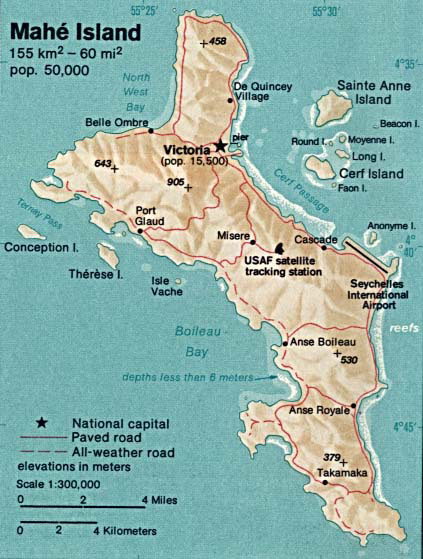
My nocturnal meeting with the 2 accursed and indecisive curs happened just above the letter T in the word Victoria. On the road to North West Bay, which encompassed Beau Vallon Bay,
Anse Royale, where the ex-lunatic asylum was, is bottom right.
And here’s Google’s road routes to Anse a la Mouche.

Phil Hunt and I, of course, ‘sailed’ round the north west point and past Therese island. And back that way too. Very painfully in my case.
Now on to some of yesterday’s photos . . .
Maryse, my girlfriend:
Maryse worked in the Tourist office, along with a female colleague. I met her there but have no idea why I went in. Her surname was Delpeche, the same as that of the Barclay Bank employee who used to go fishing with Paddy Taylor. Not surprisingly, as they were siblings. Descendants of one of the original planter families – ie colonists – from France. And, therefore important people in that still-feudal place.
When I wrote home to tell my family about her, my mother replied that her mother, my grandmother, had asked “Is she black?”. . . Which is surely why I sent that photo home and still have it.
Apart from beaches, there were few places to take a girlfriend on Mahé. Our big night out was on Friday evenings to a tiny thatch-roofed restaurant in Victoria, where – as I’ve said – I enjoyed egg and chips. I’m not sure that Maryse did but I am certain that the meal must have cost me a big chunk of the money left over from my compulsive saving for the Omega watch. Or maybe she paid . . .
Maryse visited me in hospital, of course, and I have a bizarre recollection of noticing, on one visit, what beautiful ankles she had. Something I don’t recall noticing of a woman ever again. Other things, yes. But never even just one ankle.
Another bizarre memory . . . Maryse introduced me to the custom of eating banana slices with a hot curry. But I’ve never again experienced the delight of first finding how a banana slice cools the mouth. I guess because it’s no longer a surprise. Oh, and grated coconut too.
Just before I left for home, Maryse gave me an EP disc of an Italian Belgian singer she was fond of, called Adamo. I still have it. Somewhere. No, I don’t. That went in the fire too. But I did later think about buying it, having found it on the internet. Sadly, none of the songs on it rings any bells for me now.
When Martin and I left, the boat sailed around the north of the island and went past Beau Vallon bay, en route westwards to Mombasa. Maryse had parked her car on the beach road and, as arranged, flashed the headlights several times in farewell. It was one of the sadder moments of my life. And I have to hold back the tears even now. It was, after all, the end of what would be the best year of my life.
We corresponded for a while and I drove myself into fits of painful nostalgia by playing a 1963 hit song called Hey Paula. By Paul and Paula. Given its lyrics, they probably shouldn’t have been singing it, as they were brother and sister. But they were apt for me.
But, as all log-distance romances do, this one faded and died. And the correspondence died along the way.
I have no idea what happened to Maryse and an AI search has produced nothing. Either about her or her brother, Percy. But I have learned that the Delpeche family came to the islands between 1770 and 1890. Along with slaves for their sugar cane plantation.
A final – just jogged – memory . . . chunks of sugar cane left in the fridge are truly delicious. No idea of the calorie content. Sadly, I’ve not enjoyed any since 1966. . .
The coco-de-mer
French for “coconut of the sea,” referring to how the nuts were originally found floating in the ocean before their source was known. Once thought to have grown on the sea floor. It’s a rare species of palm tree (Lodoicea maldivica) native to the Seychelles islands. It produces the largest seed in the plant kingdom, weighing 15-30kg. Its large, distinctive nut has a unique bilobed shape resembling buttocks or female genitalia, which has led to various legends and folklore. Some cultures thought the nuts had medicinal or aphrodisiac properties.
I brought home a beautiful example – large, black and glossy, with a tuft of fibrous material where you’d expect public hair to be. You’ll know by now what happened to it.
I’ve thought of buying a replacement but one could well cost even more than a replacement Omega ‘Constellation’ chronometer. The latter being less sexy.
Tenrecs
Little rodents that only live on the island of Praslin , in the Vallé de Mai. [After all these years, the name of the valley just came to me, unbidden as I was typing the first half of that sentence . . . ] The Vallée contains a pristine palm forest largely unchanged since prehistoric times – home to the world’s largest population of endemic coco de mer palms, which produce the largest seed in the plant kingdom. It supports many endemic fauna species, including the Seychelles black parrot and is recognized for its exceptional natural beauty and dappled sunlight through palm fronds. Often referred to as the “Garden of Eden” due to its pristine and mystical nature.
Well. That’s certainly how I remember it and will relate my visit to it in a future episode.
Meanwhile . . . The control of tenrecs is considered important for protecting the unique ecosystem of the Vallée de Mai. I recall them being striped, though not yellow. Perhaps this was the case only with the young. As with wild boars . . .
******
My thanks to those readers who take the trouble to Like my posts, either after reading on line or in my FB group Thoughts from Galicia.
The Usual Links . . .
- You can get my posts by email as soon as they’re published. With the added bonus that they’ll contain the typos I’ll discover later. I believe there’s a box for this at the bottom of each post. If you do this but don’t read the posts, I will delete your subscription. So perhaps don’t bother if you have other reasons for subscribing . . .
- For new readers: If you’ve landed here looking for info on Galicia or Pontevedra, try here. If you’re passing through Pontevedra on the Camino, you’ll find a guide to the city there.
- For those thinking of moving to Spain:– This is an extremely comprehensive and accurate guide to the challenge, written by a Brit who lives in both the North and the South and who’s very involved in helping Camino walkers. And this is something on the so-called Beckham Rule, which is beneficial – tax-wise – for folk who want to work here. Finally, some advice on getting a mortgage. And this article ‘debunks claims re wealth and residency taxes’. Probably only relevant if you’re a HNWI. In which case, you’ll surely know what that stands for.


Very movingly written, your memories of Maryse. Somehow we have probably all experienced a person like M. in our lives. You can’t turn back time. Who knows what awaits us in the here and now. Stay positive and keep working on yourself. Personally, I need to be braver. G
LikeLike
Braver???
LikeLike
Just for you
LikeLike
https://thoughtsfromgalicia.com/photos-of-me/
LikeLike
Tés unha foto con Stephanie que dá clases de inglés no Porriño
LikeLike
SI. Es una amiga desde hace muchos años.
LikeLike
Photos: A permanent twinkle in your eyes.
Before UK police had patrol cars, they had these, the Ariel Leader: https://www.jalopyjournal.com/forum/media/1958-ariel-police-patrol-cycle-with-tube-radio-and-bakelite-telephone-england-1958-1962-this-is-the-only-police-example-known-in-n-america.376519/
I hankered after the Ariel Arrow in those days. I settled for a Honda.
https://www.bikesrestored.com/9017/ariel-arrow-1962/arielarrow-1962-1/
One Somerset copper must have had fun: https://www.youtube.com/watch?v=1MfYsdHoRhw
T’was the Germani who drove the Keltoi from Galicia.
LikeLike
Two useful links: https://www.twz.com/ & https://kyivindependent.com/
LikeLike