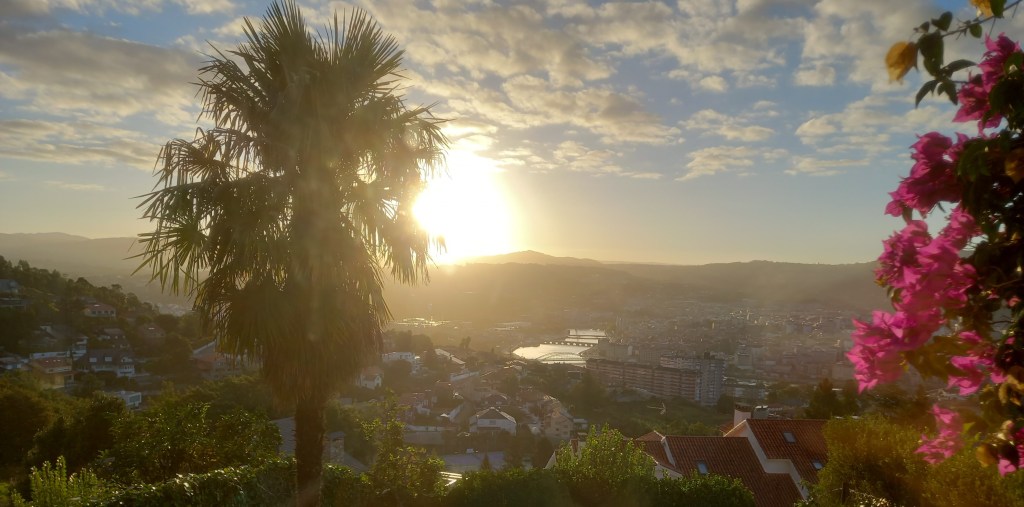
Awake, for morning in the bowl of night has flung the stone that puts
the stars to flight.
And, lo, has caught the sultan’s turret in a noose of light!
Spanish life is not always likeable but it is compellingly loveable – Christopher Howse: ‘A Pilgrim in Spain’
Cosas de España/Galicia
Lenox Napier doesn’t think much of the (Galician) leader of the PP party. It’s a distinct possibility that his opinion on this is shared by the leader of the PP in Madrid – his likely successor. If she has anything to do with it.
Can this be true? I read that recently the point was very recently reached where more than 50% of Spanish employees work for the state. This compares with, reportedly, only 18 to 20% in the UK. Chalk and cheese?? I can think of one factor . . . Public school teachers here are state employees, whereas they aren’t in the UK. Likewise many university employees, I guess. Then there’s the extra layer or two of administrations arising from Spain’s de facto federal system of government.
My friends and I were itemising last night the number of ways Spanish café/restaurant society has changed in recent years, very possibly influenced most by the loss of profits during Covid. Things that came up:-
- Few cafés allow you to use their internet now.
- Free newspapers aren’t as available as they were.
- Not all restaurants have returned to using menus, as opposed to QRs
- The custom of giving free chupitos(digestives) seems to have died out, unless you are a very regular customer.
- As has the habit of leaving a bottle of wine on the table and only charging you for what you’ve drunk.
- one or two up-market restaurants have a greeter at the door, to tell you whether you can come in or not. With prices way above anywhere else, presumably financing the greeter’s salary.
- Then there’s the ‘reserving’ of all the tables, allowing a decision on whether or not to let you sit at a table.
- Lastly, the introduction of the American custom of turns(turnos), under which you have only 90 minutes to eat before being pressured to leave.
All in all, the eating-out experience is not quite what is was not so long ago. Not in Pv city, at least.
Land ownership can be a very complicated matter in rural Galicia. Today’s VdG talks of the problems faced by the Xunta in trying to reduce the fire risk up in our hills . . .De tierra quemada a tierra aprovechada: “¿Quién es el dueño de esta finca que lleva tantos años creciendo? “ es una pregunta que con mucha frecuencia queda sin respuesta en Galicia. Y localizar a los propietarios de esas leiras[fincas], un paso necesario para que la Administración pueda tomar medidas preventivas de los incendios, resulta una tarea detectivesca. Ello explica que en los últimos tres años, la tierra abandonada y luego recuperada para usos agroforestales solo represente el 2 % de las 512.308 hectáreas de superficie agraria susceptibles en Galicia de ser aprovechadas. Los técnicos del Banco de Terras, convertidos en los Sherlock Holmes de las leiras, se han encontrado con zonas del interior de Ourense y Lugo donde el 70 % de las fincas estaban sin registrar.
Another problem in Galicia that’s proving hard to eliminate – wild boars ravaging the crops. It’s reported that the farmers are having to wait for Brussels to allow the measures they want to take. Which seems wrong to me. Why not just Madrid? Or Santiago de Compostela?
The first stage of a new by-pass around Pv city has opened, a mere 7 years later than predicted. I can see the 2nd state from my salón window – currently a long brown gash across the green hillside. I suspect it’ll be a while before I see any vehicles on it that don’t belong to the construction company.
Talking of cars . . . This amuses us from time to time in Pv city – a car being taken down some steps by its satnav/GPS, where it gets stuck . . .
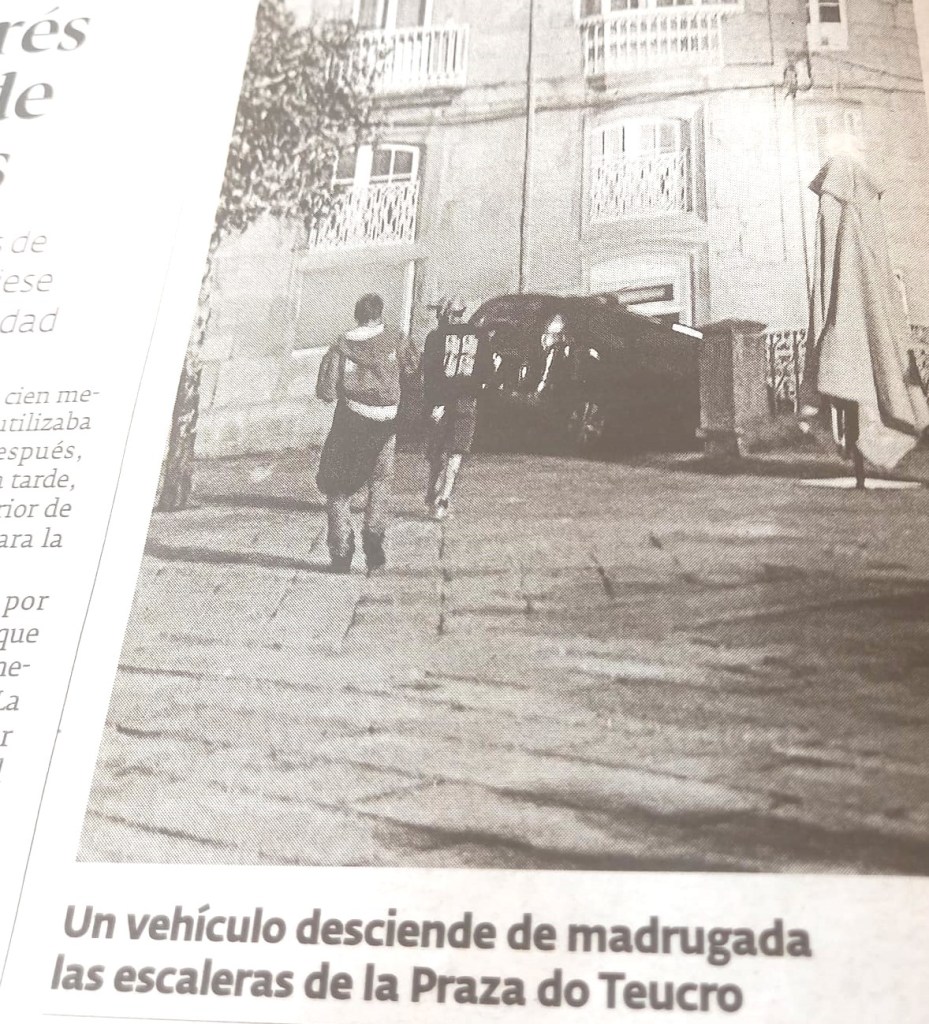
This usually happens in the main square, not here in Plaza de Teucro. Which is dedicated to the city’s (utterly mythical) Greek founder, the half-brother of Ajax. Who, of course, arrived here injured in a boat guided by angels, setting a precedent for St James. Though the latter was, of course, more than injured. Being dead and headless.
The USA
Is [North] America turning its back on the great legal weed experiment? Click here.
Social Media
This article might well prove useful to any reader locked out of FB.
Quote of the Day
Reputation is like a shadow. Sometimes it’s bigger than you, and sometimes it’s smaller
Spanish
Deleting old files this morning, I found this one of Spanish equivalents of ‘mate’. I can’t vouch for the fact they are still in use. Especially one of them:-
- Amigo
- Tio
- Tigre
- Chaval
- Marecón
- Cariño
- Hombre
Did you know?
Though it’s commonplace to think that the Arabs re-introduced the literature and sciences of the ancient world into Europe – specifically Spain – in fact, they’d first got these from India in the mid 7th century. Including ‘Arabic’ numbers and the useful concept of zero. It was at this point that Indian influence on the world reached its peak. Few folk know this, it’s said.
You Have to Laugh
The oldest joke in the world?
- Barber to Pharaoh: How would you like your hair cut?
- Pharaoh: In silence
Finally . . .
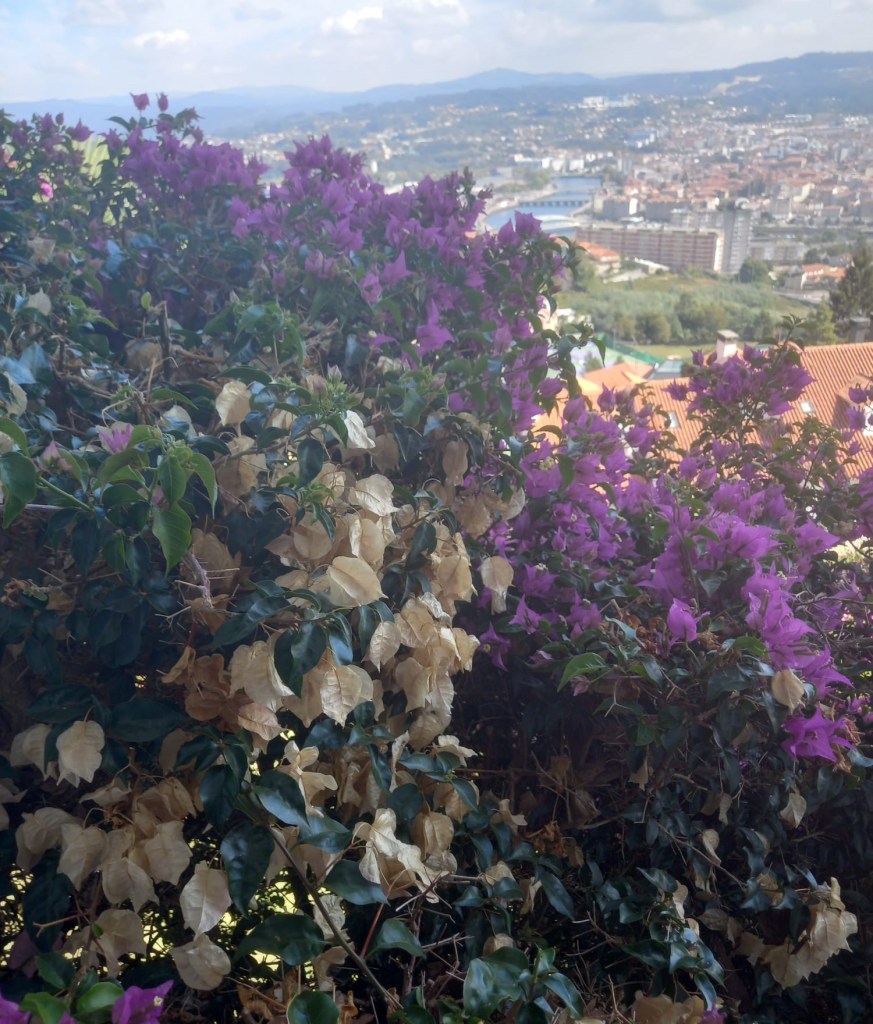
My bougainvillea is again astounding me this autumn/fall – growing pretty voraciously at the very top (outside my bedroom window) but slowly dying below this . . .
Finally, Finally . . .
Welcome to the chap who has this blog. There was someone else but, when I clicked on their blog, I was immediately subscribed to it. Which I didn’t want.
MY YEAR IN THE SEYCHELLES
- Episode 1: 12 September 2024: Why VSO?
- Episode 2: 13 September 2024: The Leaving of Liverpool
- Episode 3: 14 September 2024: An interlude: The Seychelles back then
- Episode 4: 14 September 2024: Departure, Nairobi and Arrival
- Episode 5: 15 September 2024: Arriving in Mombasa
- Episode 6: 16 September 2024: The YCWA in Mombasa
- Episode 7: 17 September 2024: The flight to Mahé
- Episode 8: 18 September 2024: Our Arrival
- Episode 9: 19 September 2024: Early Days
- Episode 10: 20 September 2024: My Colleagues and Some Early Adventures
- Episode 11: 21 September 2024: Mr Warren and Me
- Episode 12: 22 September 2024: Chris Green
Episode 13: The Hotel des Seychelles
As I’ve said, on the morning of my first day, Paddy drove over the centre of Mahé to North West Bay. Here, in Beau Vallon, was the Hotel Des Seychelles – “Seychelles Leading Hotel”. The VSO secretariat, in its wisdom, had decided to house its volunteers therein. This was to be my home for the next 12 months.
As far as Paddy was concerned, this was the best possible arrangement since, being only 18 and innocents abroad, we would have found it impossible to work and fend for ourselves in the Seychelles climate. We’d eat the wrong food, drink impure water, walk around with our shoes off, catch worms, go down with dysentery and generally fall down on the job. The Seychelles Government wouldn’t get its money’s worth. And after all, we were costing them a packet.
At that time this all seemed quite reasonable to me. I had to agree that the prospect of solid British food every day sounded better than curried fish and rice every 5 hours for 12 months. I did, though, have some misgivings at moving into a hotel. I was sure it wasn’t really within the spirit of voluntary service. But I resolved to give it a try and, in the meantime, ascertain whether I could find some way of living nearer the indigenous population.
The owner of the Hotel was Jerry Legrand, who had a very severe looking wife, Anne, who wasn’t really severe at all, and 2 very pretty daughters, Tony and Ginny. At this time there were no sanctions in operation against Rhodesia and the Hotel was nearly always full of tourists from there or South Africa. As the islands lacked an airport in in 1965, all of these had come by boat from Mombasa. Not on a DC-3. Or any other plane. They were good business, so Jerry didn’t wear the look of concern he was later to adopt when business gradually deteriorated after UDI in 1966. When the boats ceased to come.
Jane had arrived a week before Martin and I and was already a familiar figure on the incredibly beautiful beach not 5 yards from the hotel entrance. She introduced herself to Paddy before he could get a word in and I couldn’t help but be impressed with her spontaneity and warmth. Martin had arrived the night before and had already set up house in the chalet we were to share for the next 3 months. Jane had been given a chalet to herself, in the middle of the set of 3.
In the Seychelles Annual of 1962, admittedly a little out of date even when we were there, the Hotel des Seychelles was advertised as offering, amongst other things, “Charming lounges and residents’ bar in the Hotel; beachside cocktail bar; well-stocked private library; large selection of hi-fi music and a luxury fishing cruiser”. The kindest thing one can say is that this represented a specialised use of the words “charming”, “cocktail”, “well-stocked”, “large” and “luxury”.
But the hotel was not without some charm. This lay, however, not so much in the amenities it offered as in the people who lived and worked in it. The latter were all local Seychellois who could even smile away a monthly wage of 35 rupees. Or £2.60.
Though it might well then have been “The Seychelles leading hotel”, it was not really like any other hotel I knew. Its residents lived in individual chalets that were non-starters as far as the Michelin Guide was concerned. The furniture was adequate but rude. Our chalet, for instance, contained 2 beds, one wardrobe, one table and chair, one lavatory pan and one cold shower and sink. Nothing else; no carpets, no wallpaper, no armchairs (though there were a couple of deckchairs on the porch), no cupboards and no cooking facilities. The walls were brick, painted on the inside, and the roof was corrugated iron. Nice when it rained heavily.
All the chalets had names and ours was called “Pickwick”, though I could never figure out why. It was surrounded by palm trees which dropped coconuts on the iron roof with monotonous regularity. And the electricity cable descended from a pole which had a pernicious habit of crashing down onto the same roof whenever the wind blew more than 10 miles per hour, cutting off our electricity and terrifying us out of our wits in the process.
Eating was done at a central dining-room which was merely a floor space protected from the elements by a thatched roof which was always there and blinds which were dropped whenever the rain looked like forcing its way in.
Jerry valiantly strove to keep the menu British, so breakfast was inevitably bacon and eggs, with occasionally maybe an aubergine or frittered sheep’s brain thrown in for variety. He even provided a choice between cornflakes and porridge. The evening meal was nearly always beef, lamb or pork and roast potatoes, peas or green beans.
The only concessions to local eating habits were turtle steak every Friday evening and curried something or other at Saturday lunchtime. The high spot was Sunday midday when we feasted on chicken with ice cream to follow.
Listing it like this, everything sounds very grandiose and I was indeed very grateful for it, since every lunch time at the college where I taught I was offered a choice between curried fish and rice and nothing. But the food wasn’t as appetising as it sounds and it became as monotonous as the insistent fish and rice. The meat was not the best quality and the helpings of vegetables often meagre. Butter frequently ran out and fresh fruit and vegetables were in very short supply as none were grown in the islands and stocks were at the whim of suppliers in Africa. Back then, I couldn’t stand curry, so I starved when Saturday lunchtime came around.
The turtle steak, considered a delicacy by some, tasted abominable to us. For several weeks we fed our portions to Jerry’s large black Labrador, Satchmo, but this practice ceased after one embarrassing Friday evening when Satchmo took hold of the two pieces of steak, walked out of the dining room into the bar and deposited them at Jerry’s feet. From then on we used to go into Victoria every Friday and spend a quarter of our weekly wage of 20 rupees (thirty shillings, or £1.50) on a meal at one of the town’s cafes.
After we’d been there several months and had acquired the ability to dive and spear fish, we supplemented the menu occasionally with fresh cod and sometimes even crayfish. We even persuaded Jerry’s cook to prepare chips with the fish, until Jerry found out what was going on and barred us from the kitchen.
The evening meal was not served until 7.30 and. as school finished at 3.30, this meant a long wait for food. My salary didn’t allow me to go mad in the grocers and consequently, when 7.30 came round, I was usually weak with hunger.
I mentioned this hardship in a letter to my mother and asked whether she could send me some provisions on the next Seychelles-bound Brocklebanks boat leaving England. I had in mind a couple of tins of corn beef of something of that nature. I was, therefore, totally unprepared for the 75 tins of assorted soups, beans, rice and sago which arrived at the College, by special delivery, off the next boat. She’d even included a dozen bottles of tomato sauce with which to drown the curried fish about which I had so often complained.
I was very grateful – the laughing stock of the college and ultimately most of the island – but very grateful. Supplies lasted for several months and served as a good enough excuse to light a fire on the beach and have a beanfeast. Literally.
Food wasn’t our only problem, however. Being virtually on the equator, we were forced to change our clothes at least once a day. The basic rule was simple, either change your clothes or change your friends.
Jerry, understandably, ran a laundry service for his residents. The modus operandi of the washerwomen was not exactly modern but was, at least, effective. It was better than having one’s clothes beaten to death against a stone in the river, a method much favoured by the local women. Not unnaturally, though, Jerry exacted a toll for this service. We assumed that the Seychelles Government, who were paying for our board in every other respect, would pay our laundry bills as well. But it was not to be. And, since the bill amounted to 5 rupees a week and we were being paid only 20, there followed an acrimonious dispute with Jerry, with us refusing to pay and him refusing to do our laundry.
This stalemate dragged on for several weeks while we wrote letters home complaining about our dilemma and to VSO, demanding assistance. Meanwhile, rather than subject our scant wardrobe to the river test, we attempted to do our own washing. Since there was no hot water and no iron in our chalets, the results were little short of disastrous. For several weeks Martin and I turned into work crinkled and smelly, being unable to iron shirts and shorts and unable to get into the shower for fear of re-soaking all the articles of clothing draped therein.
Something must have been said in high places, however, since shortly after we began referring to Jerry as Isaac he informed us that he had only just heard how much, i.e. how little, we were being paid and that henceforth we could have all our washing and ironing done free. Thus did Martin and I return to respectability.
Of course once Jerry did learn of our relative poverty we ceased to exist as guests in any accepted sense of the word. Whilst he was grateful for the 450 rupees he was getting for each of us, this did represent a reduced, concessionary figure and we were taking up the space of 3 fully paid-up guests. (As it happens, after the introduction of UK sanctions against Rhodesia, the hotel was never again full but this appeared to be something of an irrelevancy to Jerry.)
The fact that none of us ran up hefty bar bills, unlike one or two of his regulars, was another reason for regarding us as pariahs. I think Jerry regarded my monthly bill of 7 shillings and sixpence(£0.38) as something of an insult, directed against him personally – especially since it was all incurred drinking lemonade. I guess he’d have been even unhappier if he’d known that his bar staff weren’t chalking up the majority of my drinks.
During the early months of our stay, visitors from Rhodesia and South Africa were quite frequent and we would amuse ourselves by giving them all nicknames. We never got to know any of them personally but one of our favourites was a very large Rhodesian gentleman who, bulging out of his trunks, used to waddle down to the beach for his afternoon swim still wearing his black trilby and carrying a rolled umbrella.
Others who stand out in the memory are a large Australian woman who delighted in telling risqué stories in stage whispers and the two young American boys who played darts by standing 7 yards from the board and hurling the darts, baseball-fashion, into – and through – the dartboard.
Sunday night was cinema night at the hotel. The dining room would be converted into a makeshift theatre and a screen set up. The blinds would be lowered to stop the locals getting a free viewing and, shortly before 7 o’clock, everyone who was anyone rolled up to pay their 4 rupees. The films were provided by ‘Kim Koon’s Travelling Cinema’ and were always unbelievably bad. All the same, I usually contrived to watch them, even if it was through the blinds with a large crowd of the natives. Well, I couldn’t really afford 4 rupees.
During the year, there were 1 or 2 special nights in the hotel, including one which included ’royalty’. As the inveterate snob he was, Jerry was delighted to have such high status guests in his hotel. At least for a while . . .
My thanks to those readers who take the trouble to Like my posts, either after reading on line or in my FB group Thoughts from Galicia. The two most recent are
The Usual Links . . .
- You can get my posts by email as soon as they’re published. With the added bonus that they’ll contain the typos I’ll discover later. I believe there’s a box for this at the bottom of each post. If you do this but don’t read the posts, I will delete your subscription. So perhaps don’t bother if you have other reasons for subscribing . . .
- For new readers: If you’ve landed here looking for info on Galicia or Pontevedra, try here. If you’re passing through Pontevedra on the Camino, you’ll find a guide to the city there.
- For those thinking of moving to Spain:– This is an extremely comprehensive and accurate guide to the challenge, written by a Brit who lives in both the North and the South and who’s very involved in helping Camino walkers. And this is something on the so-called Beckham Rule, which is beneficial – tax-wise – for folk who want to work here. Finally, some advice on getting a mortgage. And this article ‘debunks claims re wealth and residency taxes’. Probably only relevant if you’re a HNWI. In which case, you’ll surely know what that stands for.


A certain alcalde bordering Coruña blames the boars digging up his pristine coastal paths on the Xunta. All hogwash. He is the same one who built a statue of Che and has a shrine to Fidel in his back garden. In fact everything that is wrong or not happening with his council is blamed on every other surrounding council.
And yet the sheeple still vote him in.
Mate – Tiger? Never heard that one, although my late, very late Uncle Vic, before he was hit by a bus, called his drag queen mate Tiger. But that was in London.
LikeLike
There’s a moral in there somewhere. .
LikeLiked by 1 person
E ‘Pickwick’ non terá que ver coa obra de Charles Dickens?
LikeLike
Siii
LikeLike
very, very beautiful……breathtaking…….your bougainvillea, I would love to be able to look out of your bedroom at this splendour….we had a similar work of art near my convent school in Groningen/Netherlands
LikeLike
A convent girl, eh?
LikeLike