Awake, for morning in the bowl of night has flung the stone that puts
the stars to flight.
And, lo, has caught the sultan’s turret in a noose of light!

Spanish life is not always likeable but it is compellingly loveable – Christopher Howse: ‘A Pilgrim in Spain’
Cosas de Iberia
The big news, of course, is the hundreds of fires raging down in north and central Portugal. See this map:-

And see this leader in the VdG this morning: Portugal arde, Galicia se ahúma: Olor a humo y un extraño sol rojo sorprendieron ayer a los gallegos residentes en la provincia de Pontevedra y en el sur de la de A Coruña. Los incendios de Portugal, que han dejado siete víctimas mortales, se aliaron con los vientos del sur para dejar sobre Galicia una franja gris que se extendió hasta Santiago. Más al norte también se notó, pero en menor escala. Las previsiones meteorológicas apuntan a que la humareda seguirá llegando hasta el sábado, y llegará más lejos, aunque los chaparrones tormentosos podrían ayudar a que se depositen las partículas.
Southern Galicia was again en-smoked (ahumado) today, as well as yesterday. Here is María’s foto of the sea near her last night:-

And here is a (poor) foto of the ‘blood moon’ we had last night above Pv city:-
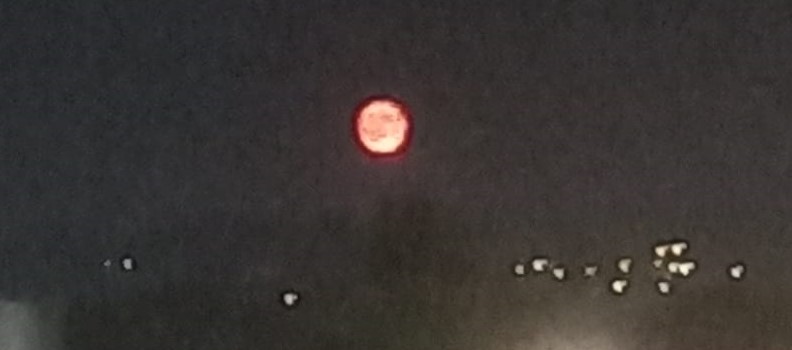
One aspect is even worse than I’d thought; it’s claimed that most of the fires – in which at least 7 people have died – were started deliberately.
Surprisingly, our dawn was rather as above. None of the spectacular skies we had back in 2006, when fires were burning all around Pv city and into the hills.
Thankfully, rain arrives tonight or tomorrow.
I’ve long suspected this . .‘Spain is one of the European countries that wastes the most water: national suppliers lose 30%’ through leakage and spills’ says 20minutos here. HT to Lenox Napier of Business Over Tapas for that
And for this . . . The [Socialist] Minister of Culture has annulled the National Bullfighting Award with the support of ‘over 90%’ of Spaniards.
And for this . . . Something on Spain’s white wines. In reality, a puff piece for just one of them, the Galician Albariño, Pazo de Barrantes.
Quote of the Day
A footnote is like running downstairs to answer the doorbell during the first night of marriage. — John Barrymore
BTW . . . This blog is short today as I’ve just wasted at least 45 minutes trying to book train tickets on Renfe’s site, on both my laptop and phone. When at last I thought I’d succeeded, I got Renfe’s equivalent of the whirling wheel of death – En estos momentos no podemos atenderle. Por favor vuelva a intentarlo pasado unos minutos. Disculpe las molestias.
Finally . .
I got 2 messages overnight, telling me I had a deadline to pay a traffic fine. They purported to be from the DGT but as the web page was myblueheaven, I decided they probably weren’t genuine. Even given my record.
Finally, Finally . .
MY YEAR IN THE SEYCHELLES
- Part 1: 12 August 2024: Why VSO?
- Part 2: 13 August 2024: The Leaving of Liverpool
- Part 3: 14 August 2024: An interlude: The Seychelles back then
- Part 4: 14 August: Departure, Nairobi and Arrival
- Part 5: 15 August: Arriving in Mombasa
- Part 6: 16 August: The YCWA in Mombasa
- Part 7: 17 August: The Flight to Mahé
- Part 8: 18 August: Our Reception
Part 9: Early days
My first breakfast in the Seychelles was fairly conventional – cornflakes, bacon and eggs, tea and vitamin powder. The Taylors insisted I heap the latter on my cereal to combat the enervating and pernicious effect of the climate.
After breakfast, we performed the morning ritual of listening to the BBC news. In effect, this was Paddy’s only real link with the outside world. He swore by the BBC. Or at least he did until Ian Smith made Rhodesia’s Unilateral Declaration of Independence (UDI). Like most of the expatriates I met in the islands, he passionately believed in ‘separate development’ and he was one of the few people who noticed a subtle change in the attitude of the BBC. From being a dispassionate and objective observer of world events, it had deteriorated into a government mouthpiece, disseminating lies and propaganda.
The starting point had been the declaration of UDI. Two days after this event, I was told, Paddy turned off the radio and forbade his wife ever to switch on the BBC again. This was particularly harsh for her as she had nothing to do all day but listen to the BBC’s overseas broadcasts. It was either that or interminable sitar music from India. Paddy, on the other hand, had only ever listened to the news before he departed for the office. Nevertheless, he was a man of principle.
After breakfast, I borrowed Paddy’s binoculars – they were stolen two weeks later – and trained them on the town of Victoria, down among the trees to the left of the Taylors’ house. The foliage hid most of the buildings from view and the only one I could really see was Government House. Seized by the beauty of it all, I ran for the 1938 Kodak box camera – borrowed from my aunt Jan – and took my first ever photo. It was meant to be a panoramic view of Victoria and its harbour. It turned out to be two telegraph wires, one telegraph pole and a mass of unidentifiable greenery.
The following day, Paddy took me on the 20 or 30 minute trip across the centre of Mahé, to a hotel located in the stunning Beau Vallon Bay. This – the Hotel des Seychelles – was to be my home for the next twelve months.
Now that the Seychelles are a major holiday resort, it has a number of four and five star hotels. But this wasn’t one of them. Although its setting was magnificent, the building themselves were rather basic, and a little run-down. The place survived on the visits of folk from Rhodesia (now Zimbabwe), which as this point was rapidly approaching the Unilateral Declaration of Independence (UDI) that was to make it an international pariah and to deprive the hotel’s owners – the Legrand family – of virtually all their business.
The hotel was spread over a large area of land, on the other side of the road which ran along Beau Vallon bay. It was screened from the sea by a line of tall takamaka trees. Opposite the entrance was a small bar and terrace on the beach itself. One of the few photos I have of my year in the islands shows me sitting in this with a couple who also taught at the boys’ grammar school and a chap called Phil Hunt. About whom, more later.
The rooms of the hotel were actually one-story huts spread throughout the extensive grounds, amidst tropical trees and bushes of every imaginable kind. I can’t recall whether there were any single-dwelling huts but I’m pretty sure there were some which we might describe as semi-detached. Or duplex, to US readers.
As for me, I had been put in the right hand room of a short terrace of three. Which I was to share with Martin. The middle room had been allocated to Jane Gunn alone and the room at the far left housed a chap called John Edgely, who’d also come to the islands to work as a volunteer but with a different organisation, the name of which escapes me. He, like his colleague Joanna Walley, was a few years older than Martin, Jane and me, who were all VSO ‘cadets’.
Our row of rooms was maybe 100 metres from the sea and the hut between us and it was at one time occupied by a Scandinavian couple who occasionally had the most spectacular nocturnal fights. More than once I found myself joined by the hotel owner, Jerry Legrand, as I stood listening, enraptured, to the proceedings.
Somewhere to the left of us, as we faced the sea, was a large wooden hut in which lived Peter Butcher, a fellow teacher at the grammar school. I don’t recall him ever using the hotel facilities so maybe this wasn’t part of the hotel. On one wall of his house, Peter had a two-line sign that tickled me so much it has stayed with me for a life-time. It ran:-
PLAN AHEA
D
As I say, the buildings were rather crude and certainly wouldn’t pass muster in today’s world of exotic tourism. Each of the rooms in our terrace of three was about six metres by three and had a small tiled sitting area in front and a basic bathroom at the back of it. Strangely, the walls of the latter didn’t reach to the ceiling, which didn’t do a lot for privacy.
Happily for me, there was a week or so between my arrival and the start of school. As we had no transport and were several miles away from anything or anyone else, there was little to do but laze around on the beach. This was, of course, a pleasant – if frustrating prospect – but I was very conscious of the risk of burning my fair skin. Before my departure from the UK, I’d been counselled to avoid the tropical sun at all costs and so I’d decided to expose myself very gradually. Or should I say very, very gradually. I literally sunbathed for 30 seconds the first day, 60 seconds the second day, 90 seconds the fourth day and so on. Once this was over, I covered up my skin to the max. Or sat in the shade of the takamaka trees. The only problem then was the ferocious sand flies which plagued the hotel beach. These were small enough to get through any protective netting and the reaction to their bites was far more virulent to those of mosquitoes.
During this week, the residents of the hotel included a certain Dr Palmer and his family. They were scheduled to live in Anse Royale, along the coast, where he would run a health centre and were only staying in the hotel a short while. Dr Palmer was an engaging anecdotalist and listening to his stories was a pleasant way of whiling away the idle hours. So much so that, once one of my brief bouts of sunbathing was over, I neglected to cover up my whiter-than-white legs. By five of the evening, I was sensing a certain tightness in my now richly red limbs and, by dinner time at seven, I could hardly walk. The next few days I spent in absolute agony, hauling myself from the bed to the bathroom to get the only relief obtainable by turning the cold shower onto my legs. The downside of this was that, for a while after this treatment, they were even more painful after this treatment than they had been before. Needless to say, whilst never returning to exactly the same approach, I’ve been cautious about the sun ever since.
Another group I recall meeting in these early days was of some American Peace Corp people who were in the islands on R&R (rest and recreation, I later learned) from their stint in Ethiopia. I’ve never forgotten them telling us that all food there was covered in a fierce red sauce. And that for the first six months it was difficult to eat anything. For the next six months it was possible to eat stuff but impossible to make out what it was. After a year, one could actually make out whether one was eating meat or vegetables and after two years it was impossible to eat anything without the sauce as it seem too bland.
But I have a far better reason for remembering them, totally nameless as they now are. I had never conquered a fear of water nor learned to swim. But their stories of the wonders below the surface of the sea finally persuaded me to don a pair of flippers, a mask and a snorkel tube and to venture out into a small but turbulent rocky bay. This was teeming with fish of every imaginable electric colour and the scene which met my eyes has never left me. It was all the stimulus I needed to teach myself to swim and to later enjoy hundreds of hours of diving on the coral reefs around the island. But more of that anon.
During this first week, I presented myself at a local tailors in order to have some shorts made. The tailor – an Indian, I recall – asked me if I wanted them like Mr Butcher had his. I hadn’t the faintest idea how this was – having not even met him at this stage, never mind examined his shorts. But I said that I did. I soon found out this mean long and baggy. Which meant that I spent the rest of the year with my voluminous shorts rolled up.
My thanks to those readers who take the trouble to Like my posts, either after reading on line or in my FB group Thoughts from Galicia.
The Usual Links . . .
- You can get my posts by email as soon as they’re published. With the added bonus that they’ll contain the typos I’ll discover later. I believe there’s a box for this at the bottom of each post. If you do this but don’t read the posts, I will delete your subscription. So perhaps don’t bother if you have other reasons for subscribing . . .
- For new readers: If you’ve landed here looking for info on Galicia or Pontevedra, try here. If you’re passing through Pontevedra on the Camino, you’ll find a guide to the city there.
- For those thinking of moving to Spain:– This is an extremely comprehensive and accurate guide to the challenge, written by a Brit who lives in both the North and the South and who’s very involved in helping Camino walkers. And this is something on the so-called Beckham Rule, which is beneficial – tax-wise – for folk who want to work here. Finally, some advice on getting a mortgage. And this article ‘debunks claims re wealth and residency taxes’. Probably only relevant if you’re a HNWI. In which case, you’ll surely know what that stands for.


Hi Colin, a similar photo of the haze and smoke blown up from Portugal was taken by the daughter of a friend this morning, just after sunrise here in Ferrol. It certainly travels a long way. Reminiscent of working in Singapore when the farmers in Indonesia would spend weeks burning the stubble of their crops and the smoke would envelop Singapore and parts of Malesia. As the smoke also covered parts of Indonesia, the government finally banned the practice.
LikeLike
Immensely enjoyable reading Colin. You need to publish the book.
LikeLike
Have converted from https://www.aspall.co.uk/blogs/cyder/premier-cru to Ayran. 50% yoghurt, 50% iced water shaken with a goodly pinch of sea salt. Being English, it has to be Maldon sea salt. https://www.gourmetfoodstore.com/maldon-maldon-sea-salt-13083
I rather suspect the influence of this video at 8.15. سرحال باشید
https://www.youtube.com/watch?v=Rhw53lLhqZw
LikeLike
The summer I was thirteen I came here on vacation with my parents from Boston. One afternoon, my cousin came by to take me to the beach with her. We joined a bevy of young people from the village on the sands, among them my future husband. As the day was hazy, and there didn’t seem to be any sun, I didn’t put on any sun cream. For the next week I could not bend my feet, my legs were swollen, and I could barely cover my shoulders with clothes, thanks to the blisters. I wound up with permanent freckles on my shoulders where I hadn’t had any before.
LikeLike