Awake, for morning in the bowl of night has flung the stone that puts
the stars to flight.
And, lo, has caught the sultan’s turret in a noose of light!
Spanish life is not always likeable but it is compellingly loveable – Christopher Howse: ‘A Pilgrim in Spain’
Cosas de España/Galicia
An insight into the mind of the man influencing the policies of the far-right Vox party.
Spain already has one of the lowest levels of permitted alcohol for drivers. And now the government is said to be planning to reduce it to close to the zero level of East European states. In a country of so much socialising, you might expect something of a backlash but I haven’t seen it so far. Time to invest in this?
A dedicated Camino site asks: What is a pilgrim? To which I answer: Increasingly a bloody nuisance.
Which reminds me . . . Last night I talked to the owner of best terrace restaurant in Pv city, prompted by the fact that almost all tables were displaying not the usual notice of a Reserva from a particular time but one which said Reserved. Please ask. Which a waiter had told me wasn’t really true. Turns out it’s a strategy to deal with ‘pilgrims’ who only want to drink. Or, if they do want to eat, consist of a large group of young people who refuse to leave the table after the 90 minutes allocated to them. In short, my friend will try to restrict the tables to small groups of (more respectful) older pilgrims. And who can blame him? As they say, more is not necessarily better.
The EU
A trend-setter? . . . Sweden – going through a “paradigm shift” – offers immigrants £26,000 to return home. The right-wing coalition government is dramatically increasing repatriation incentives in a reversal of previously welcoming policies. Next? A Rwanda scheme?
The USA
- The media stands accused of ‘sanewashing’ Trump. Listen here . . . Trump talks nonsense. Why do the US media make him sound more normal? Go to minute 10.30.
- Trump’s diary of a pretty bad week for him
- Just when you thought US politics couldn’t get any weirder/funnier, the nutty Marjory Taylor Greene attacks the even nuttier Laura Loomer, who’s a (close) adviser to Trump . . .
- What you need to know about Project 2025
Russia v. Ukraine v. NATO
Armageddon postponed?
The Way of the World
As someone said a few years ago . . . Art is whatever anyone who says they’re an artist is. A good example here.
Social Media/Quote of the Day
We wouldn’t sell a child alcohol or cigarettes, so why give them smartphones?
You Have to Laugh

Finally . .
For whatever reason, 4 of the 6 Gallegas in my Pilates class – the very talkative ones – didn’t return after the summer holiday. A shame. I hope it wasn’t something I said.
MY YEAR IN THE SEYCHELLES
Note:
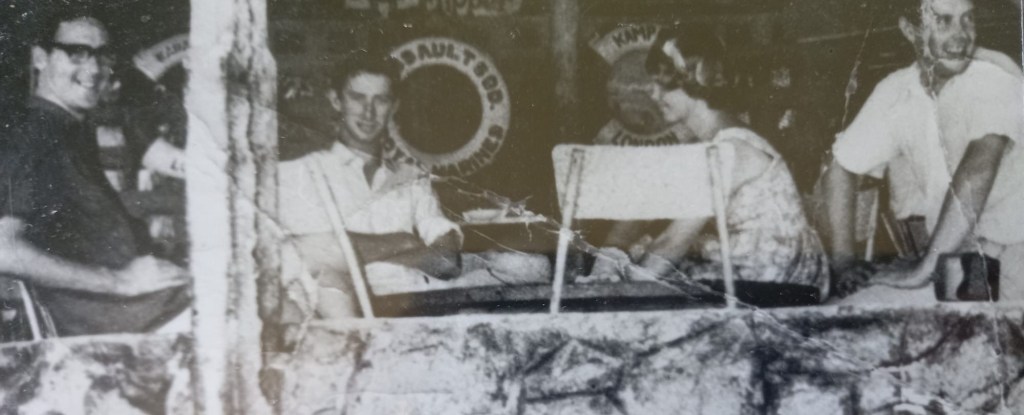
1. I’ve been asked for fotos of me back then. This is the only one I have, all the others having been destroyed in a warehouse fire when I was living in Iran a few years later. 2nd from left.
There are 2 new Parts to this today, in case you find the first rather boring. The narrative continues in Part 4.
- Part 1: 12 September 2024: Why VSO?
- Part 2: 13 September 2024: The Leaving of Liverpool.
- Part 3: 14 September: An interlude: The Seychelles back then
- Part 4: 14 September 2024: Departure, Nairobi and Arrival
The Seychelles is an archipelago of either 115 or 150 islands, lying either 936 or 994 miles (1500 or 1660 km) east of Mombasa in Kenya. Theres a belief that they form the only visible bits of a long-gone continent – now submerged – called Gondwanaland.
The islands were once a French colony, lost to Britain in 1812, and the local people speak a sort of pidgin French called Creole. There being no indigenous population on volcanic outcrop, the population is a melange of folk who’ve settled there over the centuries – African, Arabs, Indians and Chinese. Not to mention the European businessmen – especially French planters – and their colonial rulers.
The Seychelles have been independent since 1976 but when I went there they were a British Crown Colony and so were ruled by British bureaucrats.
Only one of the islands, Mahé, is heavily populated. Although the main island in the group, Mahé is rather small, measuring only 7 miles long and 3 miles at its widest point.
In 1965, there was no airport and the only way to get there was via boat. And there were not many of these. Apart from those arriving on small yachts, the only tourists were people from North Rhodesia arriving on one of the occasional boats which sailed from the African coast.
Apart from this, there were regular visits to the islands by a small plane which belonged to the American military – which had a satellite-tracking station on the islands – and which flew to back and forth from Mombasa once a week. Although this surely wasn’t its primary purpose, it performed the valuable function of delivering and picking up the islands’ mail.
Mahé had only one town of any size and this was the capital, Victoria. If it was famous for anything it was a clock in the middle of an intersection in the centre of town, where the traffic from the single quay turned either right or left. On one corner of this intersection was a branch of Barclays DSO, as this bank was called back then. At least in Britain’s (ex)colonial possessions. Diagonally opposite this bank was a jewellers shop, in the window of which I first saw the Omega watch that I saved most of my income to buy. But more of that later.
Victoria back then was a rather ramshackle town of single-storey wood buildings with, for the most part, corrugated metal roofs. The quay ran from the centre of town out into the sea for a good distance and at the end of it was a pen containing large turtles. Parallel to the quay, was the town’s football pitch and between the two was the post office where I used to go every week to check whether I’d received any letters from home.
The Seychelles lie virtually on the equator, so the sun rises and sets around 6 every morning and evening of the year. The climate is one of the most equable in the world, with the temperature being around 70F or 25C every day of the year. However, as you’d expect for islands in the middle of the Indian Ocean, there’s a fair amount of rainfall and its arrival is pretty unpredictable. Plus it can stretch over longish periods. While I was there, for example, the celebrated Noel Coward suffered a month of rain during a visit he was making to check out the Seychelles as an alternative to his Caribbean home. But more of that later too.
Technically, the Seychelles has a ‘north west monsoon’ for six months of the year and a ‘south east’ monsoon for the other six. But all this means is that the wind blows from one direction for half the year and from the opposite direction for the other half. Despite Mr Coward’s experience, it doesn’t mean there’s torrential rain every day.
The sea was certainly warm and, during one of the monsoon seasons, it was possible to ‘surf’ in the sizeable waves hitting the beach near which I lived. During the other monsoon season, it was like a placid lake.
Part 4: Departure, Nairobi and Arrival
In August, 1965, I flew out of Heathrow airport on a VC-10 plane, the first flight of my life. The passenger next to me turned out to be another VSO cadet, Martin Carlisle. Which was a surprise, as I’d been told he’d left two weeks earlier. Mind you, Martin was even more taken aback to meet me, as VSO had advised him he was the only male cadet going to the Seychelles. As I recall, Martin was to work with the Public Works Department, whereas I, of course, was slated to teach. But I wasn’t going to be the only VSO cadet doing this; Martin was able to tell me there’d be a third cadet, Jane Gunn, who’d be teaching in the girls’ grammar school, just down the road from the boys’ school I was to work in. She, I learned, was already in the islands, possibly having got there by boat from Mombasa.
Martin and I were scheduled to fly first to Nairobi, from where we’d have to take a later flight to Mombasa. And then a third flight to the islands. We’d both been told someone from VSO would meet us in Nairobi but nobody did. Finding we had several hours on our hands, we took a bus into the centre of the city. There were signs all along the road warning of wild animals but, despite intense efforts on our part, we failed to catch even a glimpse of any of them. Not even a bloody zebra.
Fortuitously, the bus dropped us outside a hotel whose name was on the lunch vouchers we’d found among our documents. The sun was brilliant, the glare from the buildings painful to the eyes and we entered the hotel and had a few beers plus, astonishingly, a dish of Irish stew. Sitting across the room from us was a rather handsome man with piercingly blue eyes. This, I later concluded, had been Peter O’Toole, taking a break from one of his films. Possibly “Lord Jim”. The only other memory that leaps out of my subconscious is that of lepers begging on the streets of Nairobi and along the sides of the roads.
Dutifully we posted off our “Arrived safely” postcards to our parents and then walked round Woolworths with our shoes on and the mosque with them off. We spent an hour traipsing the streets, avoiding the sun and the beggars, and another hour in the airlines office waiting for the bus back to the airport and listening to arguments between Africans. On the return trip, we saw twice as many wild animals as we’d seen on the way in.
My thanks to those readers who take the trouble to Like my posts, either after reading on line or in my FB group Thoughts from Galicia.
The Usual Links . . .
- You can get my posts by email as soon as they’re published. With the added bonus that they’ll contain the typos I’ll discover later. I believe there’s a box for this at the bottom of each post. If you do this but don’t read the posts, I will delete your subscription. So perhaps don’t bother if you have other reasons for subscribing . . .
- For new readers: If you’ve landed here looking for info on Galicia or Pontevedra, try here. If you’re passing through Pontevedra on the Camino, you’ll find a guide to the city there.
- For those thinking of moving to Spain:– This is an extremely comprehensive and accurate guide to the challenge, written by a Brit who lives in both the North and the South and who’s very involved in helping Camino walkers. And this is something on the so-called Beckham Rule, which is beneficial – tax-wise – for folk who want to work here. Finally, some advice on getting a mortgage. And this article ‘debunks claims re wealth and residency taxes’. Probably only relevant if you’re a HNWI. In which case, you’ll surely know what that stands for.
 Thoughts from Pontevedra, Galicia, Spain
2nd from left, beautiful, big ears… you will never, ever have a hearing problem.
LikeLike
I still have them, plus all my hair and teeth. No one has ever mentioned my ears . . .only my nose. . .
LikeLike
You look a bit like the young Prince of Wales. Who is the lady next to you?
LikeLike
the wife of the chap on the right
LikeLike
Before you travelled to the Seychelles, did you speak to MI6? Did they try to recruit you, or are you still not allowed to talk about it after all these years?
LikeLike
My lips are sealed…
SUffice to know my car has the matricula HMG .
LikeLiked by 1 person
Jeezus! Golly, I wish I was like you, fearless and humorous. Next time I want to be born a man. Did you have affairs there that you might not necessarily want to tell your grandchildren about?
LikeLike
What a question!
The details of my (not-affair) relationships over the decades are not for my kids and grandkids.
LikeLike
In my early days I was called a gigolette.Stille wateren hebben diepe gronden….
LikeLike
I guess that’s Dutch for Still waters run deep
LikeLike
A gigolette . . . I look forward to reading your autobiography . . . .
LikeLike
Read up on Namio Harukawa, then we can talk some more
LikeLike
I’m too afraid to . .
LikeLike
Ahem” ….the temperature being around 70F or 25C every day of the year.
Either 78F & 25C or 70F & 20C????
Temperaturentally,
Perry
LikeLike