Awake, for morning in the bowl of night has flung the stone that puts
the stars to flight.
And, lo, has caught the sultan’s turret in a noose of light!
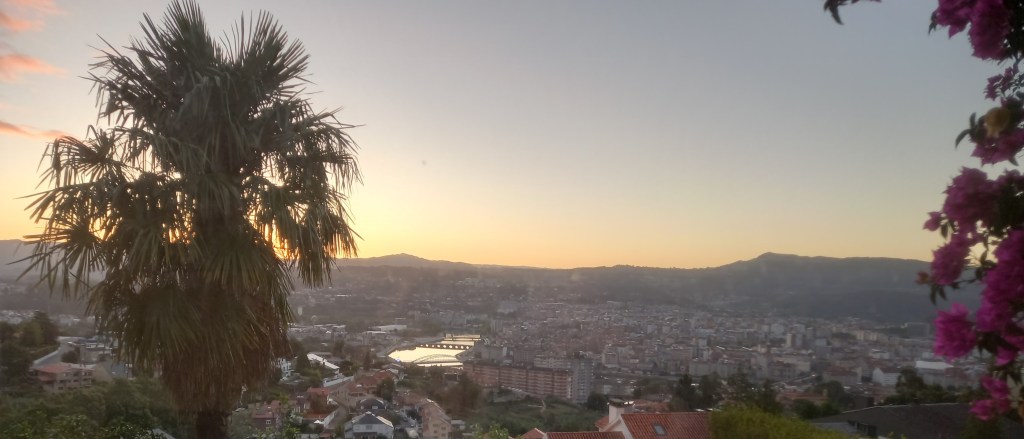
Spanish life is not always likeable but it is compellingly loveable – Christopher Howse: ‘A Pilgrim in Spain’
Cosas de España/Galicia
Fresh back from Beijing, where he sought more money for Spain, the PM has called on the EU to ‘reconsider’ tariffs on Chinese EVs.
Talgo is a Spanish company which makes trains. It’s recently been the subject of a takeover bid from a Hungarian company, blocked by Madrid. Here’s The Corner on the implications of this action taken on State strategic grounds.
Be prepared to be titillated . . .The disgraced ex-king – who has a lot to be disgraced about – is said to be writing his memoirs. This news has “lit up Spain’s literary world” but surely won’t go down well with his son, already troubled enough by reports of his wife’s infidelity. No wonder he’s gone grey.
Here’s Lenox Napier on a subject I mention from to time – the Spanish obsession with suspiciously over-accurate numbers.
My Ferrol friend, Richard, has reminded me of a more recent British attack on a Galician port, this time Ferrol in 1800. Also a failure. I had thought that the responsible British admiral had been court-marshalled and executed aboard his ship but this turns out to have been Admiral Byng, who was convicted of failing to do his best(‘utmost’) during a battle against the French off Minorca in 1757.
Gibraltar has asked Spain to give back something stolen from its waters by a senior Vox politico and his derring-do mates and placed at the entrance to the party’s HQ in Madrid. Urinating against the wind, I suspect.
News here of a possible threat to Spain’s tourist industry, or at least the low-cost element of it – a plane that puts sub-Saharan Africa, the Gulf and Central Asia within reach of Britain’s low-cost airlines. Personally, I’d not be attracted to the idea of having to fly for 6 to 8 hours back home after a holiday. But, then, I don’t like flying and have never done beaches.
The UK
In July Labour won a 174-seat majority with just 34% of the vote. To construct this extraordinarily thin but wide coalition, Labour zeroed in on voters who were more suburban, working class, socially conservative, patriotic and immigration-sceptic than its typical supporters. In targeting them, Labour embraced values far from its core identity because it recognised the truth that some votes simply matter more than others in a first past the post system. This is also true in the US.
The EU
A must-read for Europeans of all stamps . . . Europe’s tragedy is a big problem for the UK too. Economic stagnation will fuel the populist advance and weaken the continent’s ability to withstand Russia’s advances. . . . There is a highly dangerous mix of industrial decay, looming extremism and fragmentation. As I said recently, reading overviews like these does nothing for my confidence in the EU’s survival.
The USA

The post-debate probabilities . . . . He might still win . . . This election will be won and lost in moderate suburbia and specifically the state of Pennsylvania. With huge Democrat votes in its cities — Philadelphia and Pittsburgh — but big Republican support in its southern counties that border Maryland and 50/50 suburbs, it’s a composite of moderate, conservative America. . . . Some 60,000 voters will determine who becomes president. And whether it will be someone relatively normal or whatever noun or set of adjectives and nouns you prefer for Donald Trump. There’s quite a few to choose from, not many of which are positive.
Ukraine v Russia
Since Russia began its full-scale invasion of Ukraine in 2022, Vladimir Putin has depicted the war as a faraway conflict. But when Ukrainian drones hit a residential building outside the capital this week, that became much harder.
The Way of the World
A fascinating podcast. The making of an anxious generation – The impact of a combination of the internet, smartphones, social media and permissive parents.
Quote of the Day
Dans ce pays-ci, il est bon de tuer de temps en temps un amiral pour encourager les autres. (In this country, its good to kill an admiral from time to time to encourage the others.): Voltaire, in his novel Candide.
Did you know?
Every March since 2010, a white stork named Yaren has departed Africa, flown to the village of Eskikaraağaç in Turkey, and landed on the boat of fisherman Adem Yılmaz on the shore of Uluabat Lake. It spends 6 months in the village, fishing with Yılmaz every morning, then returns to Africa. A statue of the 2 now stands in the village’s central square.
Finally . . .
A new departure. One which won’t cost me any effort. For the past 25 years – off and on – I’ve been writing my autobiography, not for publication but for my grandchildren to read. More off than on, in all honesty. Here’s a bit about my year in the Seychelles as a VSO* ‘volunteer’.
*Voluntary Service Overseas, the British precursor to the American Peace Corps/
MY YEAR IN THE SEYCHELLES: [When they were an isolated archipelago and not yet a tourist destination, lacking an airport.]
Episode 1: So, why VSO?
My year in the Seychelles – autumn 1965 to autumn 1966 – was such a marvellous experience I can’t reflect on it now –’almost 60 years later – without suffering pangs of nostalgia. In truth, these are nothing like as painful as those that hit me during my first year back from the islands. But they’re bad enough.
It’s a tad ironic, then, that it was all an accident. Or at least it had nothing to do with any aspirations of mine. And it certainly didn’t stem from any altruism on my part.
In mid 1964 I’d sat my A levels, as one of the Alpha class of students who’d been ‘expressed’ to do these in only four years, compared with the norm of five. The theory ran that some of us would then be coached for Oxbridge entrance exams between September and November 1964 and then go up to our respective colleges in September ’65. Sadly, this didn’t quite work out in my case. My subject was History and I wanted to read law at Cambridge. But for three months, while my six or seven colleagues wanting to read English or one of the science subjects were given serious help, I played poker with my colleagues in the sixth form. And, if I did a stroke of work during this period, I don’t recall it.
The Cambridge entrance exam – over three or four days – would involve an English essay, a History paper and translations into and out of both French and Latin. Exams up to this point had never held any fear for me. Indeed, I recall the cleverest kid in our class – Martin Power – remarking to me in early ’64 that he envied my relaxed attitude to them. But, as November approached, I began to panic – very possibly conscious that I hadn’t done anything at all by way of preparation. And by the week of the exams I was in a pretty hopeless state. One which was to return for all future exams during my university years.
The first exam – on the Monday – was the English essay. From a short list, I chose the subject “Happy the country whose annals are blank”, finally rejecting the superficially-more-appealing statement of Francis Bacon – “Money is like muck, no good lest it be spread” and one or two others.
As I wrote the essay, I was conscious it was poor; and things were not helped when the headmaster of the school – brother O’Halloran – announced at the end of the allotted three hours he’d neglected to tell us we should only write on one side of the paper. But not to worry, he added, he’d got special permission from Cambridge to keep us locked in the room until we’d re-written our essays in accordance with the rules. Now, believe me, it actually takes longer to read and then re-write rubbish than it does to pen it in the first place. So I finally got to go home well after 9pm and, since this had deprived me of a night of revision for my History exam the next day, my feelings of panic soared. In fact, I recall turning up at the house of one my teachers in a parlous state, though I can’t remember what on earth I was aiming to achieve by doing so. Perhaps a stay of execution.
I don’t remember anything about the History paper but both the French and Latin translations were well beyond my capability. In fact, I don’t think I could make head nor tail of one of the Latin passages. Or possibly both.
Needless to say, I failed the exam. And my feelings of deep disappointment naturally grew when one or two colleagues who’d been lower than me in the class rankings made it to Oxford or Cambridge.
Anyway, my school decided to try to get me into Cambridge through what they called ‘the back door’. This involved identifying a college into which they had a good personal link and then persuading it to give me an interview. This link turned out to be the brother of one of the priests – Father McMahon – who used to administer to the religious needs of the school’s pupils. But, given my new tendency to freeze in the face of exams, the problem was how to get me into the college without having to re-take the entrance exam in 1966. The obvious solution was to have me out of the country on what would now be called a ‘gap year’. And this is where VSO (an organisation I’d never even heard of) came into the equation.
So, the school set up an interview with Queen’s College, Cambridge and I sent off an application to VSO. The latter was a success but the former another abject failure. The college rejected me and the end result was that, in autumn 1965, I went off on a now-pointless year with VSO without having secured, one way or another, a place at Cambridge.
However, my interview at Kings College in London had been more successful and I had chosen them over the other universities on my UCCA list who’d accepted me on the basis of my A levels. I’d originally been slated to start my degree there in September 1965 but they’d kindly agreed to postpone this to 1966 after I’d got the good news from VSO that they were sending me to the Seychelles.
Next episode: Being (sort of) trained and getting there.
My thanks to those readers who take the trouble to Like my posts, either after reading on line or in my FB group Thoughts from Galicia.
The Usual Links . . .
- You can get my posts by email as soon as they’re published. With the added bonus that they’ll contain the typos I’ll discover later. I believe there’s a box for this at the bottom of each post. If you do this but don’t read the posts, I will delete your subscription. So perhaps don’t bother if you have other reasons for subscribing . . .
- For new readers: If you’ve landed here looking for info on Galicia or Pontevedra, try here. If you’re passing through Pontevedra on the Camino, you’ll find a guide to the city there.
- For those thinking of moving to Spain:– This is an extremely comprehensive and accurate guide to the challenge, written by a Brit who lives in both the North and the South and who’s very involved in helping Camino walkers. And this is something on the so-called Beckham Rule, which is beneficial – tax-wise – for folk who want to work here. Finally, some advice on getting a mortgage. And this article ‘debunks claims re wealth and residency taxes’. Probably only relevant if you’re a HNWI. In which case, you’ll surely know what that stands for.


The VSO story was very entertaining. Hope we get to see more of that Don C
LikeLiked by 1 person
You will!
LikeLiked by 2 people
The Seychelles… I’ve never been there, but we’re finally learning more about Colin’s past. I can well imagine that your few female blog readers would also love to see photos of you from that time. If I ever get married again, the Seychelles would be my first choice for a honeymoon. But it takes two to tango. G
LikeLike
All except one of my fotos were destroyed in a fire whem i was in Iran a few years later.
LikeLike
i will post it tomorrow
LikeLike
The Seychelles, how exciting. Did you build schools and hospitals there? Taught pupils? I’m really curious to know how you fared there in the 60s. Were you the only white person there? So far away from your mum, from your family. Apparently there was no airstrip or anything like that. Did you go there by boat?
LikeLike
All will be revealed!
LikeLike