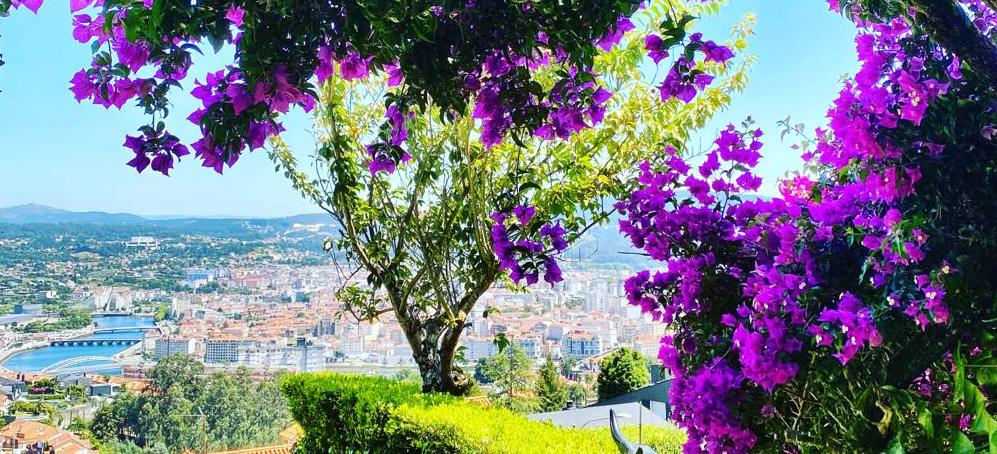
Awake, for morning in the bowl of night has flung the stone that puts the stars to flight.
And, lo, has caught the sultan’s turret in a noose of light!
Spanish life is not always likeable but it is compellingly loveable: Christopher Howse: ‘A Pilgrim in Spain’
Cosas de España
A must-see for my next trip to Madrid: Spain makes a show of its dark past. Madrid’s Prado museum has curated works that put a spotlight on more than a century of Jewish persecution.
The article refers to the Cantigas de Maria. Per Wiki, these are 420 poems with musical notation, written in the medieval Galician-Portuguese language during the reign of Alfonso X of Castilla, known as ‘The Wise’ (El Sabio) (1221–1284). Traditionally, they are all attributed to Alfonso, though scholars have established that the musicians and poets of his court were responsible for most of them, with Alfonso being credited with a few as well.
I asked Bing which of these referred to Jews and got this impressively comprehensive reply: There are several cantigas de maria that refer to Jews, either as protagonists, antagonists, or background characters. Some of the most notable ones are:–
- 4: The Murdered Jewish Boy. This tells the story of a Jewish boy who was killed by his father for singing in a Christian church. The Virgin Mary resurrected him and he converted to Christianity.
- 12: The Image of Christ Reviled by the Jews of Toledo. This narrates how the Jews of Toledo insulted and abused an image of Christ that was displayed in their synagogue. the image miraculously spoke and denounced them, and many Jews were converted by the miracle.
- 108: Merlin and the Jewish Sage. This describes a theological debate between Merlin and a Jewish sage, who denied the Incarnation. Merlin prayed to the Virgin Mary to make the sage’s son be born with his head on backwards, as a sign of his error. The child was born deformed, and Merlin used him to convince the Jews to accept Christianity.
- 286: The Jewess who was Healed by the Virgin’s Milk. This relates how a devout Christian woman gave some of her breast milk to a sick Jewish woman, who was suffering from a fever and a sore throat. The milk cured her illness, and she realized that it was the Virgin Mary’s milk.She converted to Christianity and became a nun.
You can find more information about these cantigas in the Oxford Cantigas de Santa Maria database which provides texts, translations, commentaries, and musical transcriptions of the poems.
Some years ago, I identified at least 12 daily newspapers published in Galicia – a region of 2.8m souls. I now see that, since January 2020 there’s been another one – Nós Diario, a 5-days-a-week paper entirely in Gallego. Wiki says, though, that it also contains articles in the related language of Portuguese. Surprisingly, it’s not one of the newspapers which gets subventions from the Galician Xunta. Must have upset someone. [P. S. There’s another foot race around Pv city’s old quarter on Sunday. As is now the norm, the fliers advising of road closures is only in Gallego.]
Which reminds me . . . Yesterday I was stopped in downtown Poio by a TV crew and asked if I’d answer a question. I told them – in Castellano – that I was a guiri and that I didn’t speak Spanish. Adding to their confusion, I then said, in Gallego, that I could respond in that language. They were impressed by this lie but I said I had to move on and instructed the cameraman, with a smile, not to put me on the TV. They assured me they wouldn’t without my permission. However, I departed without 100% confidence in this.
Another quote from Cees Noteboom’s Roads to Santiago: [Writing about the huge incense burner – el botafumeiro (the ‘smoke-thrower’) in SdC’s cathedral, originally used to mask the stench of sweaty pilgrims but now a (potentially dangerous) tourist attraction] Throughout the spectacle the Archbishop of Santiago, with staff and mitre and wearing the crimson of the martyrs, stands amongst the other mitred men. He looks quite grand, a clothed idol, next to the king’s envoy, the Marquis of Mondéjar, old, white-haired, a black tail-coat in a dusky hedge of officers’ uniforms. Reformation, capitalism, Enlightenment, industrial revolution, Marxism, fascism – it must be a pretty tough substance to have survived all that. I do not doubt that more sagacious comments may be made here, but pure amazement is excusable.
I’m reminded of a Jehovah’s Witness friend whom I took to see the spectacle a few years ago, expecting him to hate it. His surprising verdict: ‘Well, we might worship God in very different ways but what magnificent drama!’
The EU
Surely a contentious view – see the Comments – on the project’s (absence of a) future. The essence of it: Tiered membership will replicate the logic of the Holy Roman Empire in its long, slow diffusion of power and authority to emergent nation-states across 1648 to 1806
The USA
So, who’s really responsible for the rise of white Christian nationalism?
Russia v Ukraine
An interesting essay . . . The revival of the Danube axis spells trouble for Ukraine. An unjust peace with Putin is becoming increasingly attractive to central European leaders who are allowing economic anxiety and latent Russophilia to drive a wedge between them and the Zelensky government.
English
What the Italians are doing to it . . .
Spanish
That article on Italian English contains the example schedulare. I guess this would be (e)shedular in Spanish but there’s no evidence this exists.
Finally . . .
Thanks to that article on the Russia-Ukraine war, I now know that the Danube is the second-largest river in Europe, after the Volga in Russia. It flows through much of Central and South Eastern Europe from the Black Forest south into the Black Sea. A large and historically important river, it was once a frontier of the Roman Empire. In the 21st century, it connects 10 European countries. Originating in Germany, it flows southeast for 2,850 km (1,770 mi), passing through or bordering Austria, Slovakia, Hungary, Croatia, Serbia, Romania, Bulgaria, Moldova, and Ukraine. More on Wiki here.
For new readers:– If you’ve landed here looking for info on Galicia or Pontevedra, try here. If you’re passing through Pontevedra on the Camino, you’ll find a guide to the city there – updated a bit in early July 2023.
For those thinking of moving to Spain:- This is an extremely comprehensive and accurate guide to the challenge, written by a Brit who lives in both the North and the South and who’s very involved in helping Camino walkers.
Finally, finally . . .
Some readers, I hope, will know that the verse I cite at the top of my posts is the opening quatrain of Fitzgerald’s wonderful – but very ‘free’ – translation of The Rubaiyat of Omar Khayyam, which you can read about here. Some verses are well known, of course, eg:-
The moving finger writes; and, having writ,
moves on: nor all thy piety nor wit
shall lure it back to cancel half a line,
Nor all thy tears wash out a word of it.
My favourite:
Myself when young did eagerly frequent
doctor and saint, and heard great argument
about it and about: but evermore
came out by the same door as in I went.
 Thoughts from Pontevedra, Galicia, Spain
I had a book when I was a child, with the Nihil Obstat and Imprimatur, called Lives of the Saints. There were a few child martyrs in it who suffered at the hands of the “wicked” Jews. I think the book was from the 1950’s, so not that long ago the Church’s official view of the Jews saw them as perfidious murderers of Christ. I think a few in the hierarchy still do, at least behind closed doors.
LikeLike
Yes, I think this view was still current in my Catholic secondary school.
Odd, isn’t it – As God always intended to have his son die to expiate man’s sins, why blame the Jews? Surely God’s fault. I guess all 3 of him bought into the plan . . .
LikeLike
Nós Diarionon recibe subvencións porque vai contra o PP. A xustificación da Xunta é que é unha publicación que non é diaria.
As entrevistas na rúa son unha trampa. Eles publican o que queren.
LikeLike
Grazas.
LikeLike